
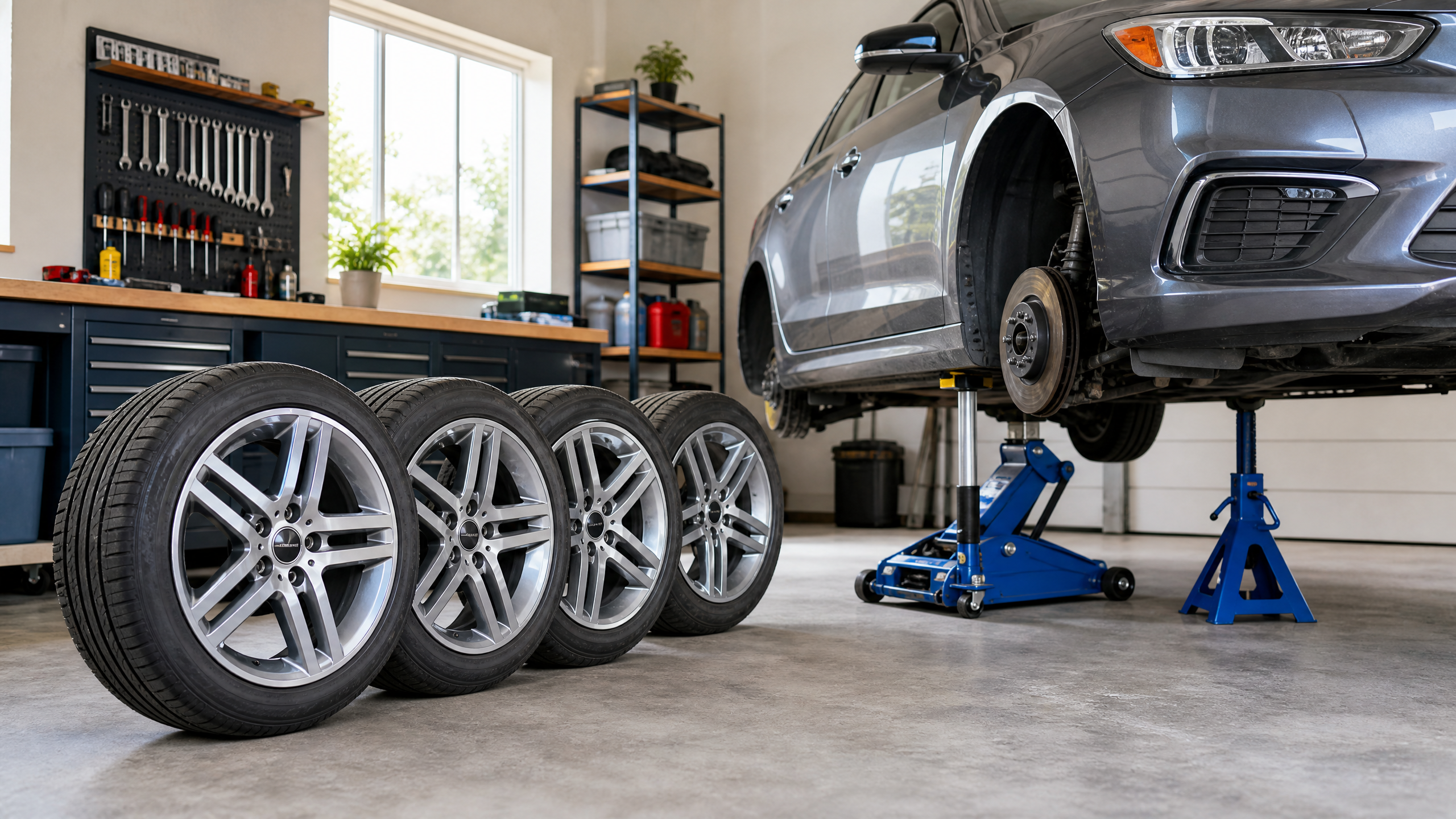
A customer rolled her Civic onto my flat pad last spring, convinced the tire company sold her a bad set. The fronts were corded at 19,000 miles, shoulders sawed down to the belts. Then I pulled the rears: an honest 7/32 of tread, barely broken in.
Nothing was defective. The tires just never swapped corners. She paid for two new fronts and a four-wheel alignment, when the whole bill would have been a free half-hour in the driveway if someone had rotated them at 10k.
I’ve been turning wrenches and handling tires long enough to have strong opinions here. This is the same talk I give friends at a cookout, minus the hot dog.
What Rotation Actually Means
Rotation doesn’t mean spinning anything. It means swapping each tire to a new corner on a set pattern, so every tire spends time at every job.
Steering, braking, driving, and cornering all chew rubber differently. Rotation spreads that chewing out evenly.
Why Your Tires Wear Unevenly
The fronts on most cars carry the engine’s weight and do 70 to 80 percent of the braking. That alone scrubs the shoulders.
Add steering scrub every time you turn into a parking space, and front tires live a harder life.
On a front-wheel drive car, the fronts also pull the car down the road. Drive torque plus weight plus steering is why I see FWD fronts dead at half the life of the rears.
Rear-wheel drive flips part of that story. The rears take the drive scrub, especially if the right foot is heavy.
Alignment settings matter too. Manufacturers dial in a touch of toe and camber for straight-line stability, and that kiss wears the edges slowly enough that you miss it.
EVs are their own animal. Battery weight plus instant torque chews rubber fast. I’ve pulled fronts off EVs at 15,000 miles that looked like they’d seen a gravel rally.
What Rotation Buys You
Even wear means you replace four tires at once, at full tread, instead of buying two early apologies.
It keeps the mileage warranty alive. Most tire makers demand proof of rotation every 5,000 to 8,000 miles before they honor a wear claim. No receipts, no warranty.
It’s also a built-in inspection. Wheels off means you see nails, bulges, weeping valve stems, and brake trouble while they’re still cheap.
And it keeps the ride quiet. Tires that wear in one spot too long develop a pattern noise that hums like a bad wheel bearing.
How Often Should You Rotate?
My default is every 5,000 to 7,500 miles, or whatever the tire’s paperwork says, whichever comes first.
If your oil change interval matches, pair them and only remember one thing. I write the next due mileage on a sticker in the door jamb, right next to the oil sticker.
Drive an EV, tow, or mash the throttle a lot? Tighten that to every 5,000.
Directional or staggered setups still need rotation, just on a different pattern. More on that in a minute.
Read the Sidewall Before You Lift Anything
Two sidewall facts decide your pattern, so check them now.
Directional tires have a molded arrow and the word “Rotation” on the sidewall. They must keep rolling the same direction forever, which limits you to front-to-back swaps on the same side.
Staggered fitments run different sizes front and rear, like a 245/40R18 up front and a 275/35R18 out back. The sizes are molded right on the sidewall. Those can never swap front-to-back.
If you’re staggered and directional, your only legal move is no move. Some shops remount and flip them on the rim, but for a home job, leave them be.
Got a full-size matching spare? Lucky you. Include it in the pattern so all five age together.
The Patterns That Work
| Setup | Pattern name | In plain words |
|---|---|---|
| FWD | Forward cross | Fronts go straight back; rears cross to the opposite fronts |
| RWD / AWD / 4WD | Rearward cross | Rears go straight forward; fronts cross to the opposite rears |
| Directional | Front-to-back | Same side only, both directions |
| Staggered, non-directional | Side-to-side | Lefts swap with rights on the same axle |
| Staggered + directional | None | Leave them, or let a shop remount and flip |
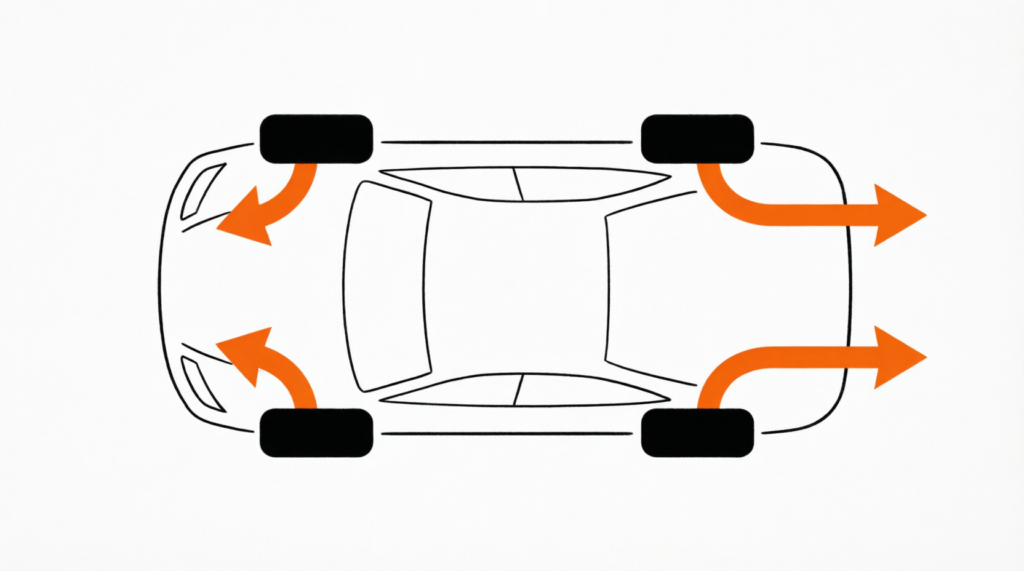
Rotation is just choreography: each tire moves to a new corner on a set pattern. The exact moves depend on your drivetrain and tire type, so match your setup in the chart above and the picker tool below.
Tools: The Short List
- Hydraulic floor jack, rated for your vehicle’s weight.
- Jack stands — two minimum, four better. Buy rated stands, not the cheapest no-name pair on the shelf.
- Wheel chocks. A cut 2×4 works in a pinch.
- Breaker bar or 4-way lug wrench for breaking nuts loose.
- The right socket, usually 19mm or 21mm (some cars use 17mm, 3/4-inch, or 13/16-inch).
- A 1/2-inch drive click-type torque wrench. This is the tool that keeps wheels attached.
- Wire brush for the hub face.
- Paint pen or tire crayon for marking positions.
- Tread depth gauge, or a quarter and a penny.
- If you insist on an impact gun, a torque stick — a 100 ft-lb stick is the common one.
Step by Step: A Full Rotation in the Driveway
1. Park smart. Level concrete or asphalt, transmission in Park (or in gear), parking brake set, chocks against the tires that stay on the ground.
2. Break the lugs loose on the ground. Half a turn, no more. The tire can’t spin while it’s planted, so you get full leverage. Keep the breaker bar low and push with your legs, not your back.
3. Lift at the factory points. Look for the notches or arrows on the pinch weld, or check the manual. Cars with plastic pinch welds — many BMWs, Mazdas, and Teslas — want a rubber jack pad adapter so you don’t crunch the rocker panel. I crunched one rocker on a loaner Mazda years ago and still remember the sound.
4. Set the stands, then test. Jack up, place the stands under the rated points, and slowly lower the car onto them. Give the body a firm shake. If anything shifts or creaks, stop and redo it.
5. Pull the wheels and mark them. Paint pen on the inner barrel: FL, FR, RL, RR. Now you can’t lose the pattern halfway through.
6. Clean the hubs. A minute with the wire brush on the hub face and center bore keeps the wheel seated flat. A dirty hub is a classic cause of a steering-wheel shake at highway speed after a rotation.
7. Move tires per your pattern. Double-check against the chart. Directional arrows must still point forward when the wheel lands.
8. Snug in a star. Start every nut by hand so threads can’t cross, then snug in a criss-cross star pattern with the breaker bar or a light impact setting.
9. Lower and torque. On the ground, torque in a star to spec — usually 80 to 100 ft-lbs, and your manual’s number wins. Go around twice. The first pass seats, the second pass measures.
10. Repeat the other end, then re-torque. After 50 to 100 miles, click through every nut again. Studs settle and aluminum wheels seat. This is the step everyone skips and the step that matters most.
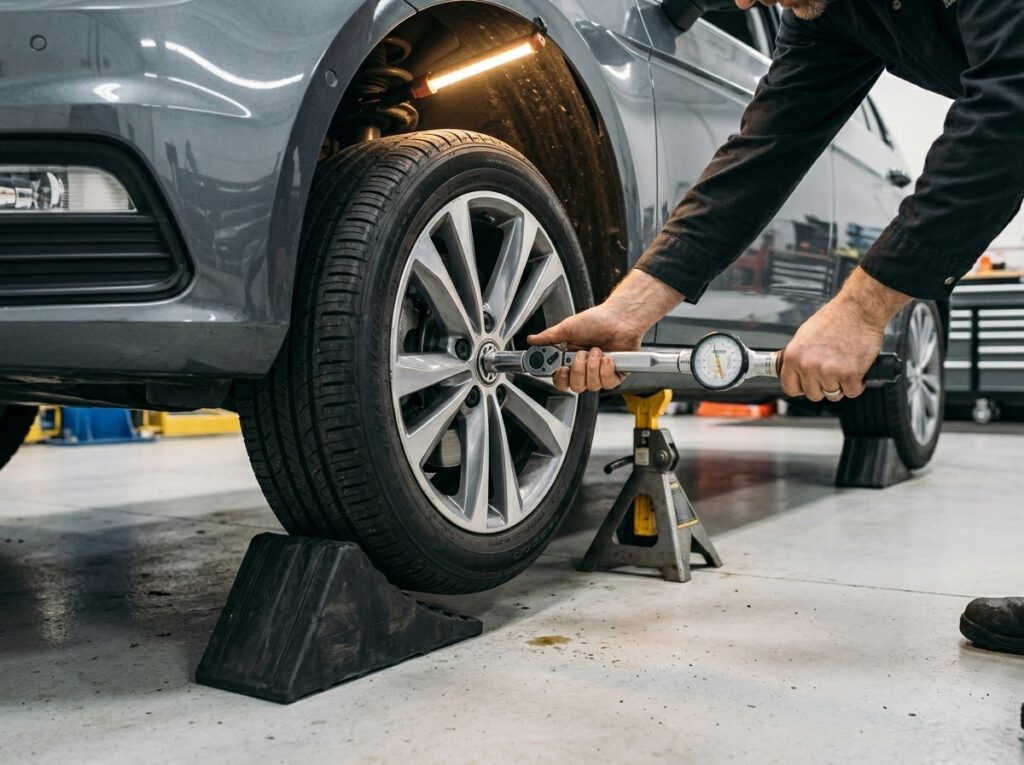
Stands under the rated points, chocks behind the grounded tires, and a torque wrench doing the final click. This is the whole safety program in one photo.
The Safety Lines I Don’t Cross
- Never put any part of you under a car held by a jack alone. Jacks fail. Rated stands, seated properly, don’t.
- No cinder blocks, no stacks of wood, no “it’s just for a minute.”
- Level ground only. A slight slope turns a 4,000-pound car into a rolling problem.
- One tool, one job. The torque wrench never doubles as a breaker bar.
A buddy of mine skipped his re-torque exactly once. Somewhere on the interstate a nut backed off, the wheel went clunk-clunk-wobble, and he spent the night on a shoulder waiting for a tow. He re-torques now. Religion.
While the Wheels Are Off: The 2-Minute Inspection
Grab the tread gauge and read each tire in three grooves. Write down the lowest number. New tires start around 10/32 to 12/32 of an inch. The molded wear bars show at 2/32, which is the legal floor and past time to shop.
No gauge? Penny test: Lincoln’s head, upside down in the groove. If you can see all of Abe’s head, the tire is done.
Now read the wear like a mechanic:
| Wear pattern | Usual suspect |
|---|---|
| One shoulder bald | Alignment / camber out of spec |
| Both edges worn | Underinflation |
| Center rib worn | Overinflation |
| Feathered edge, smooth one way, sharp the other | Toe out of spec |
| Cupping or scalloped dips | Worn shocks or struts |
Check the sidewalls for bulges, cracks, and cuts. A bulge is a broken belt knocking from the inside. That tire is a countdown, not a repair.
See a nail? Don’t pull it. Mark it, and let a shop plug it from the inside. An outside string is a get-home fix, not a fix.
Glance at the
A Word on TPMS
Rotating wheels doesn’t hurt the sensors. But a few cars track which sensor lives at which corner and want a relearn after a swap — older Fords are the famous ones, needing a tool or a brake-pedal procedure.
If your pressure light starts pointing at the wrong corner after a rotation, that’s why. The manual spells out the relearn. Five minutes, done.
Mistakes I Keep Seeing
Full-send impact gun. Stretched studs, warped rotors, and a brake pedal that pulses three months later. Snug with the gun, finish with the torque wrench, or use a torque stick.
Anti-seize on lug studs. It lowers friction, so your torque wrench lies to you and the wheel can over-torque or back off. Clean, dry threads are the spec on modern cars.
Skipping the re-torque. Covered above, with my buddy’s tow bill as evidence.
Rotating a damaged tire “to even it out.” A separated belt or a sidewall injury stays where it is, or gets replaced. Rotation is maintenance, not medicine.
Ignoring the wear story. If one tire is badly off from its neighbors, fix the alignment or suspension first. Rotating bad wear just spreads it around.
Quick Reference Chart
| Question | Answer |
|---|---|
| How often | Every 5,000–7,500 miles (5,000 for EVs, towing, hard driving) |
| Torque | Usually 80–100 ft-lbs, star pattern, two passes |
| Re-torque | 50–100 miles later |
| Directional tires | Front-to-back, same side only |
| Staggered | Side-to-side only, and only if non-directional |
| Tread floor | 2/32 at the wear bars; start shopping at 4/32 for snow |
Try It: Pick Your Setup, See Your Pattern
Tap your setup and the grid shows exactly where each tire lands.
Rotation pattern picker
Wrap-Up
Rotation is the cheapest insurance in car care: half an hour, four stands, and a torque wrench, and your tires die old instead of dying young.
Do it on a Saturday morning, re-torque after a week of driving, and write the next due mileage somewhere you’ll actually see it.
If your wear pattern told you a story this rotation didn’t fix, drop it in the comments with the car and the mileage. I read every one, usually from under a fender.




Leave a Reply