
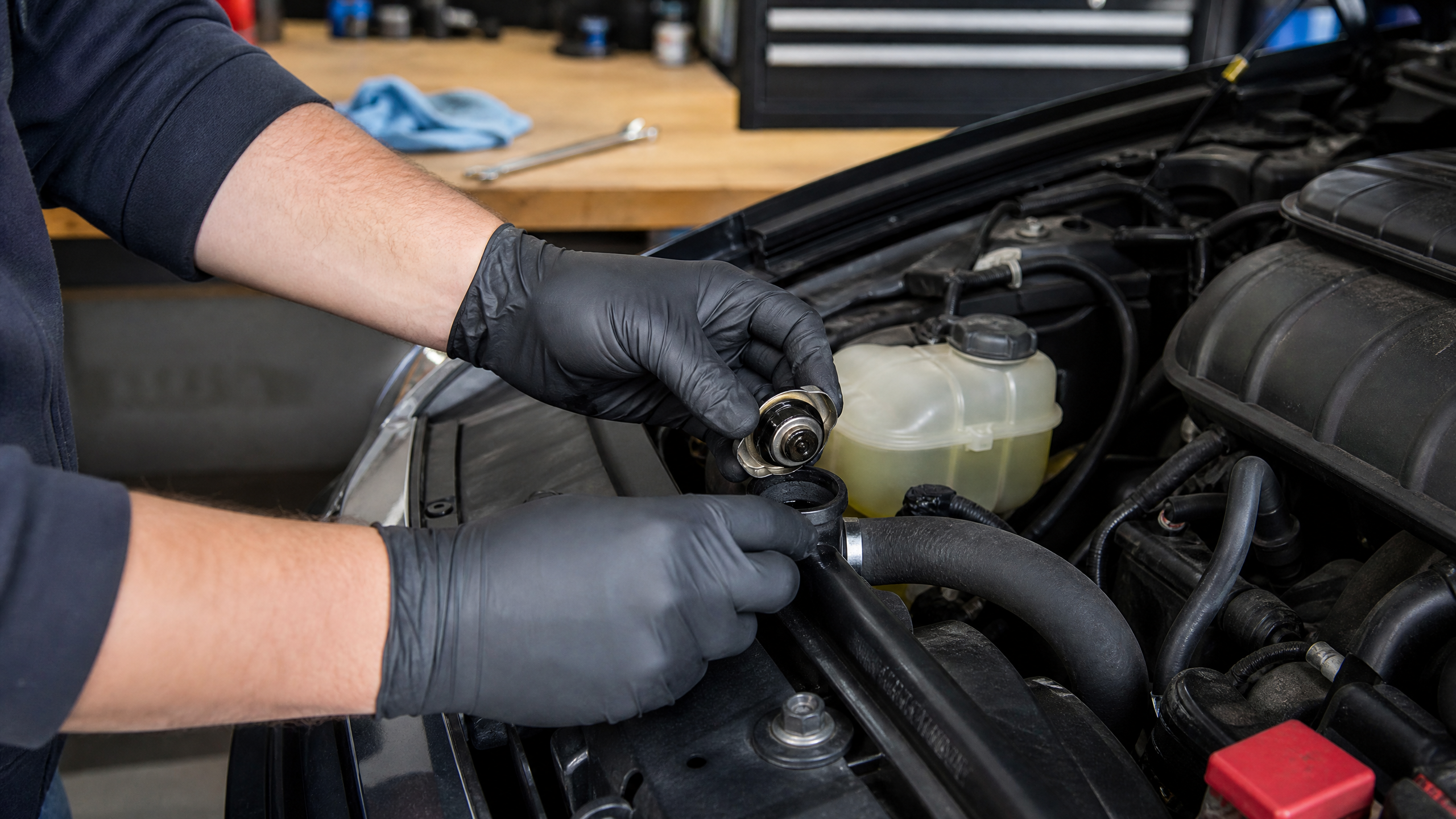
Cooling System Maintenance: Prevent Your Engine from Overheating
The most expensive $20 part I ever saw killed a $3,000 engine. A customer ignored a low coolant light for a month, topped it off with tap water twice, and drove until the gauge pinned. Head gasket, warped head, tow bill — the whole funeral.
The cooling system is the most neglected system on a modern car, right up until it ruins the engine. Here’s how to keep yours from ever making that headline.
How the System Works
The water pump circulates a 50/50 mix of coolant and water through the engine, where it steals heat, then through the radiator, where air strips the heat away.
The thermostat blocks flow while the engine is cold so it warms up fast, then opens to hold temperature. The fan covers you at idle and low speed when ram air isn’t enough.
The pressure cap is the quiet hero. Pressure raises the boiling point about 3°F per psi, so a 15-psi system boils near 265°F instead of 225°F. A tired cap loses pressure, and losing pressure is how coolant boils over on a hot climb. I replace caps at every major coolant service. They’re cheap insurance.
Why Coolant Dies
Coolant is water plus antifreeze plus a chemistry package that fights rust and lubricates the water pump seal.
Those additives wear out. Old coolant turns acidic and eats aluminum and solder joints from the inside. It also picks up stray voltage — electrolysis — that plates holes in radiators. I’ve pressure-tested radiators that dissolved from the inside while the outside looked brand new.
Test strips at any parts store check freeze point and acidity in ten seconds. If the strip says the additives are gone, flush, don’t top off.
Don’t Mix Colors
Coolant chemistry comes in families: old green IAT, orange/red OAT, and hybrid HOAT. The color tells you the family, usually.
Mix the wrong families and the chemistries can drop out of solution into a gel or sludge. I’ve pulled water pumps packed with green-orange slime that looked like a science fair accident.
Use what the manual specifies. “Universal” coolant is an acceptable pinch fix, but if you mix it in, plan a proper flush at the next service.
The Safety Rules I Never Break
- Never open a hot cooling system. A pressurized cap at temperature is a grenade of scalding coolant. Wait at least 30 minutes after shutdown, or check the upper hose — if you can’t squeeze it comfortably, it’s still pressurized.
- Work on the reservoir, not the radiator, for routine top-offs. The see-through tank has MIN and MAX marks and no pressure when cold.
- Coolant is sweet and toxic. A spilled puddle kills pets and kids find the taste appealing. Clean spills and store jugs sealed.
The Monthly Once-Over
Cold engine, level ground. Check the reservoir level against the marks. Top off with the correct pre-mixed coolant if it’s low.
Squeeze the hoses. They should feel firm but yielding. Rock-hard hoses are aged; mushy or bulging hoses are on borrowed time. Swollen ends and crusty white deposits at fittings mean weeping.
Look at the belt that drives the pump: glazing, cracks, or frayed edges mean replace.
Sniff around the cap and the reservoir. A sweet, syrupy smell is coolant escaping somewhere, even if you never see a puddle.
Water Pump and Thermostat: The Two Wear Items
The water pump has a weep hole under the housing. When the internal seal tires, coolant seeps from that hole and leaves a crusty trail on the pump body. A little dry crust is a warning. Wet shine or a bearing that wiggles when you grab the pulley means replace soon.
Pumps usually die between 60,000 and 100,000 miles. If yours is original past 100k and you’re already paying for a timing belt or coolant service, swapping the pump at the same time is cheap labor overlap.
Thermostats fail two ways. Stuck closed means overheat, fast — tow truck territory. Stuck open is sneaker: the engine takes forever to warm up, the heater is lukewarm, and fuel economy drops because the computer never leaves cold-running mode. If your temp gauge reads low on the highway and climbs in traffic, suspect the thermostat before the gauge.
Flushing: When and How
Old green IAT coolant wants a flush about every 2 years or 30,000 miles. Modern OAT and HOAT coolants run 5 years or 100,000 miles in most manuals. Yours wins.
A proper flush goes like this:
1. Cold engine. Drain the radiator petcock or crack the lower hose at the radiator end. Catch everything in a clean pan.
2. Fill with water, run to temperature with the heater on high, drain again. Repeat until it runs clear. A flush tee or a garden-hose adapter kit speeds this up.
3. Refill with the right concentrate-and-distilled mix, pouring slow so air can escape.
4. Burp the system. Air is the enemy. A trapped air pocket blocks flow exactly like a closed thermostat, and it loves heater cores. That’s why a car that overheats while the heater blows cold usually has low coolant or an air pocket, not a bad thermostat.
Many cars have a bleeder screw on the thermostat housing or a bleed port on the heater core line. Open it during fill until coolant streams without bubbles, then close it. A spill-proof funnel kit that threads onto the reservoir makes burping a one-person job.
My View on Stop-Leak Products
I’ll say it plainly: I don’t use stop-leak in customer cars. The good ones slow a tiny seep for a while; the bad ones gel in narrow passages and plug heater cores and radiator tubes.
If a leak strands you far from help, stop-leak is a legitimate get-home move. Then flush the system and fix the leak properly. It’s a bandage, not a repair, and bandages come off.
Warning Signs to Act On
- Gauge creeping in traffic but fine at speed: fan or fan clutch problem.
- Heat waves or sweet smell after shutdown: weeping somewhere.
- White steam under the hood: pull over, engine off, now. Idling a hot engine with no coolant turns aluminum into scrap.
- Milky film under the oil cap or white exhaust smoke: coolant meeting oil or combustion. That’s gasket territory — stop driving.
A Simple Top-Off and Check Routine
1. Cold engine only. Wipe the reservoir cap area clean before opening so grit stays out.
2. Fill to MAX with the correct coolant, pre-mixed or mixed with distilled water only. Tap water drops minerals into the system that seed corrosion and scale.
3. Run the engine to full temperature with the heater on high. Watch the reservoir level drop as the system burps itself, and top off again once cold.
4. Note the date and mix on a sticker under the hood. Coolant without a date is a guess.
Try It: Coolant Mix Calculator
Enter your system’s capacity and your target mix, and it does the math so you never guess with a jug.
Mix it right
Wrap-Up
Overheating is almost never sudden. It’s a slow story of low levels, tired coolant, and ignored warnings that ends with a tow truck.
Check the reservoir monthly, squeeze the hoses, use the right coolant and distilled water, and replace the cap at every flush. Cheap habits, expensive engine saved.
Tell me your car and what the coolant looks like today in the comments, and I’ll tell you whether it’s time to flush.
Related posts:
 Brake Fluid Breakdown: Understanding DOT Ratings and When to Bleed Your Braking System
  Why Is Your Car Leaking Clear Fluid? (How to Identify 5 Common Leaks)
  Rainy Season Car Care: Essential Tips for Safe Wet-Weather Driving
  The Science of Suspension: Choosing the Right Car Parts for Enhanced Performance and Comfort
Leave a Reply