
The Cost of Ignoring the Small Issues
Here’s something most drivers don’t know: 90% of tow truck calls are caused by minor, ignored maintenance habits. A belt that squeaks for months before it snaps. A slow coolant leak that goes unchecked until the engine overheats on the highway. By the time the tow truck shows up, a $20 fix has turned into a $2,000 repair bill — sometimes worse.
I’ve seen it happen more times than I can count.
In my 15 years wrenching on cars, I’ve realized that the drivers who spend the least money at repair shops aren’t lucky — they just have a system. You don’t need to be a certified master tech to keep a car running past 200,000 miles. You just need a simple, proactive schedule and about 10 minutes a month to stick to it.
That’s exactly what this guide is. Just the checks that matter, when they matter, and how to actually do them.
Maintenance Savings Calculator
Make use of the car maintenance savings calculator I have created below to estimate how much you can save by keeping your car in top shape.
💰 Maintenance Savings Calculator
See how much you can save by choosing routine maintenance over emergency repairs.
Note: Estimates are based on average industry data. Regular maintenance typically preserves 10-20% more resale value and prevents major component failures costing $3,000+.
🛢️ Monthly Checks: The 10-Minute Walkaround
These are the checks I do every single month without fail. They take less time than a coffee run and catch the problems that cause roadside emergencies.
Engine Oil: Pull the Dipstick, Don’t Just Glance at It
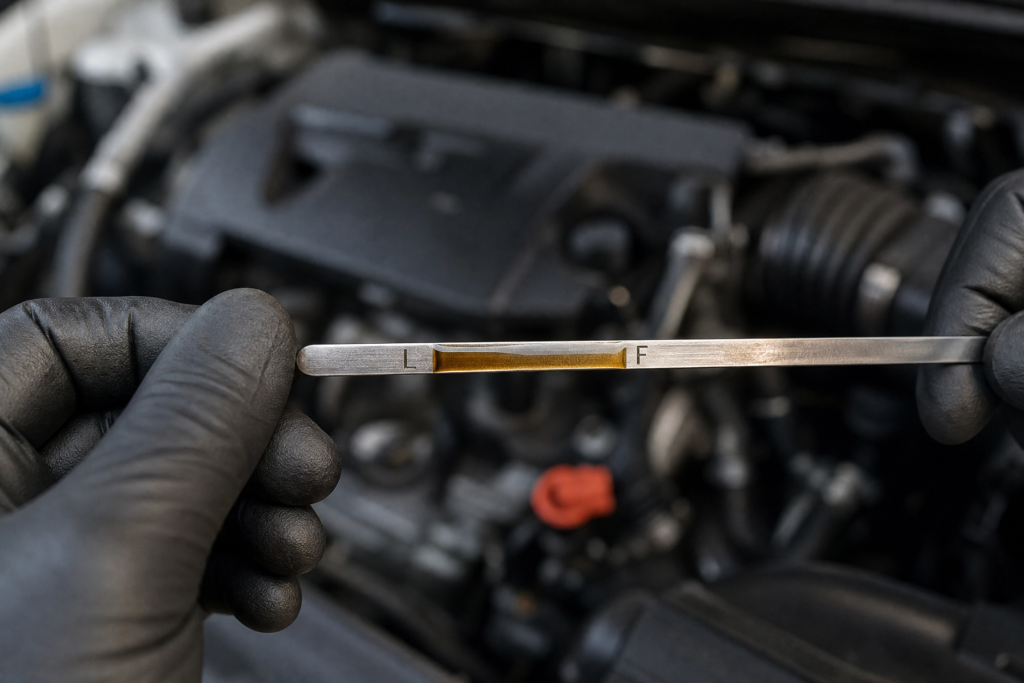
Most drivers pop the hood, see oil on the dipstick, and call it done. That’s not enough.
Here’s the right way to do it:
- Park on level ground and let the engine sit for a few minutes after shutting off.
- Pull the dipstick out, wipe it completely clean on a white shop rag.
- Reinsert it fully, pull it out again, and hold it up to the light.
Now look at the color, not just the level:
- Clear amber/honey color — You’re good. Oil is fresh and doing its job.
- Dark brown — Normal wear. Getting close to change time.
- Pitch black sludge — Change it immediately. This oil isn’t lubricating anything properly anymore.
The shop rag matters. On a dirty rag, you can’t read the color accurately. Keep a stack of clean white rags in your garage for exactly this purpose.
Windshield Washer Fluid: Don’t Let It Run Dry
This one sounds trivial until a muddy semi-truck sprays your windshield at 65 mph and you hit the stalk — nothing comes out.
Top off the reservoir when it hits the halfway mark. Use a proper washer fluid, not plain water, especially in cold climates where water freezes in the lines overnight.
Lights: The Lone-Driver Garage Trick
Most people skip brake light checks because they don’t have someone to stand behind the car. Here’s the fix:
At night, back up close to a closed garage door or a brick wall. Step on the brake pedal and look in your rearview mirror. You’ll see both brake lights reflected clearly on the surface behind you.
This trick takes 30 seconds and has saved me from traffic tickets more than once. Do it monthly. Burn-outs happen without warning.
🕒 Every 3 Months or 3,000 Miles: The Vital Fluids
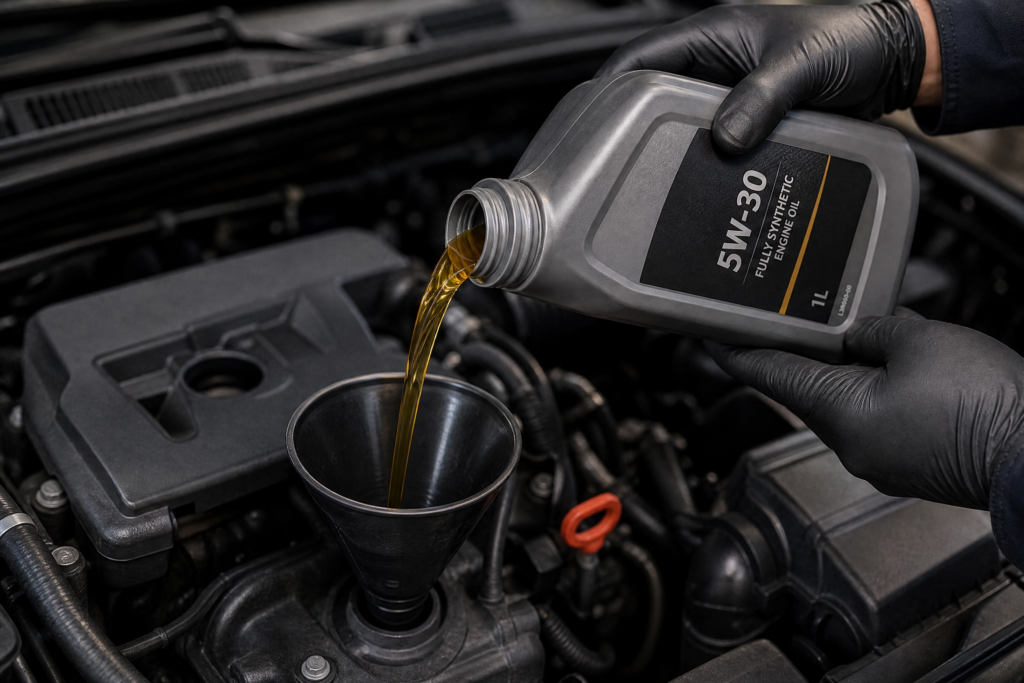
Engine Oil and Filter Change
The old “every 3,000 miles no matter what” rule comes from conventional oil. Here’s the updated breakdown:
- Conventional oil: Change every 3,000 miles
- Full synthetic oil: Can push to 5,000–7,500 miles depending on the manufacturer
Check your owner’s manual first. But if you’ve been pushing past those intervals because the car “feels fine,” stop. Oil doesn’t announce when it’s failing.
Transmission Fluid Visual Check
Automatic transmission fluid is easy to read if you know what you’re looking for.
Pull the transmission dipstick (usually red-handled, toward the rear of the engine bay on rear-wheel-drive cars). Wipe it on a clean white rag:
- Bright pink or red, slightly translucent — Healthy. Leave it alone.
- Dark brown or murky — Getting burnt. Plan a fluid change soon.
- Smells burnt — Don’t wait. A transmission flush now costs ~$150. A gearbox rebuild costs $3,500+.
Power Steering Fluid
Pull the cap on the power steering reservoir (check your owner’s manual for location — it varies). The fluid should be clear to light pink. If it’s dark or foamy, flush it.
Letting power steering fluid go low puts unnecessary pressure on the pump and rack. Those aren’t cheap to replace.
Interactive Tool: The DIY Fluid Color Diagnostic
After years of staring at dipsticks, I’ve learned that color tells you everything. Below is the same cheat sheet I keep pinned above my workbench—match your fluid’s hue to the chart. Clear amber? Keep driving. Burnt brown or milky? Time to grab a drain pan. I’ve seen too many guys ignore that dark fluid and pay for it later—don’t be that guy.
🧪 Interactive Fluid Color Guide
Check the color of your car’s fluids to assess their health. Select a fluid type below.
Fluid Health Status
Click on a color swatch above to see what it means for your vehicle.
Tire Pressure Check
Tire pressure changes roughly 1 PSI for every 10°F shift in temperature. That means a tire sitting at 32 PSI in summer could be at 26 PSI by January — and you’ll never feel it until the handling goes loose.
Use a quality digital gauge (not the ones at the gas station). Check when tires are cold, before you’ve driven more than a mile. Your door jamb sticker has the correct PSI — ignore the number molded into the tire sidewall; that’s the maximum, not the target.
🍁 Every 6 Months or 6,000 Miles: Under the Car & Chassis
Tire Rotation
Your front tires do the heavy lifting — steering, most of the braking, and on front-wheel-drive cars, acceleration too. They wear out at roughly twice the rate of the rear tires.
Rotating in an X-pattern every 6 months moves the harder-worn fronts to the rear and vice versa. This balances the wear across all four tires and adds thousands of miles to your tire lifespan. On a set of $800 tires, that’s real money.
Most shops charge $20–$30 for a rotation. Some tire places do it free if you bought tires there.
Wiper Blade Replacement
Rubber wiper blades break down from UV exposure in summer and ice scraping in winter. Most last 6–12 months before they start streaking or chattering across the glass.
Test them the next time it rains. If you’re getting smeared streaks or a squeaky dragging sound, don’t wait — visibility in heavy rain with worn wipers is genuinely dangerous.
Replacement blades run $10–$25 each and click on in about 60 seconds.
🗓️ Once a Year or 12,000 Miles: Deep Filters & Stopping Power
Cabin Air Filter
The cabin air filter sits behind your glove box and catches dust, pollen, and road debris before it gets blown into your face. A clogged one kills A/C airflow and circulates garbage into the cabin.
Pull it out and hold it up to a bright shop light. If you can’t see light through the pleats because they’re packed with dirt and dead bugs, it’s trash. Most cabin filters take 5 minutes to replace and cost $15–$25. No tools required.
Engine Air Filter
The engine air filter feeds clean air into the combustion process. A choked filter starves the engine of oxygen, drops fuel economy, and over time causes carbon buildup.
Same test — hold it up to bright light. If the pleats are grey and sealed with grime and no light passes through, replace it. These usually run $15–$40 depending on the vehicle.
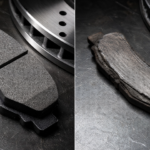
Brake Pads: Stop Guessing and Use Your Ears
Brake pads don’t fail silently. They’re engineered to tell you exactly how much life they have left — if you know what to listen for.
High-pitched squeal when braking: This is the wear indicator — a small metal tab built into the pad — dragging against the rotor. Your pads are at about 10–15% of their life. You have some time, but book a brake inspection this week, not next month.
Harsh metal-on-metal grinding sound: The pad material is completely gone. You are now scraping bare metal caliper bracket against your brake rotor. Every mile you drive is gouging an expensive rotor deeper. Stop driving and get this fixed immediately. What would have been a $150 pad replacement can turn into a $400–$600 rotor and pad job.
Brake pedal feels soft or goes closer to the floor: That’s a hydraulic issue — likely low or contaminated brake fluid. Check the reservoir under the hood. Important: brake fluid is highly corrosive to car paint. If you spill any, wipe it up instantly and rinse with water. Even a small drip can eat through clearcoat down to bare metal.
Car Noise Symptom Checker Tool
Make use of the tool below to help you pinpoint where that weird noise might be coming from and what it means:
🔊 “What’s That Noise?” Checker
Identify strange car sounds before they turn into expensive repairs.
Potential Diagnosis
*This is a preliminary guide. Always consult a certified mechanic for a professional diagnosis.
📈 Why Preventive Maintenance Beats Reactive Repair Every Time
I’ll make this simple with real numbers:
| Maintenance Item | Preventive Cost | Reactive Repair Cost |
|---|---|---|
| Oil change | ~$50 | Engine replacement: $4,000–$8,000 |
| Transmission fluid flush | ~$150 | Gearbox rebuild: $3,500+ |
| Brake pad replacement | ~$150 | Rotors + calipers + pads: $600–$1,200 |
| Coolant flush | ~$100 | Head gasket repair: $1,500–$3,000 |
| Tire rotation | ~$25 | Full tire set replacement: $600–$1,200 |
The pattern is obvious. The repair cost is almost always 10 to 40 times more than the maintenance that would have prevented it.
Cars don’t break down randomly. They break down because something small was ignored long enough to become something catastrophic.
Interactive Tool: Build Your Personalized Maintenance Schedule
I can’t tell you how many times someone asks me, ‘When should I change my oil?’ and my first question is always—’Do you sit in stop-and-go traffic every day or cruise highway miles? Do you live in the desert or the snow belt?’ That changes everything. So I put together a little builder below. Tell it your ride, your daily grind, and your climate, and it’ll build a month-by-month plan that makes sense for your garage.
Personalized Car Maintenance Schedule Generator
Answer a few questions about your vehicle and driving habits to get a customized maintenance checklist based on our expert recommendations.
________________________________________
🏁 Final Word from Alex Mercer
Your car is almost certainly your second-largest financial investment, right behind your home. It’s also what gets your family where they need to go every single day.
Taking 10 minutes a month to look under the hood isn’t about being a gearhead. It’s about protecting that investment and making sure you’re not the person standing on the shoulder of the highway watching traffic go by while you wait for a tow.
Print this checklist. Stick it in your glove box. Set a phone reminder for your 3-month fluid checks. The habit takes about 30 days to stick — after that, it’s second nature.
If you found this guide useful, our Maintenance Savings Calculator above shows you exactly how much money a consistent maintenance schedule can save you over the life of your vehicle.


Leave a Reply