
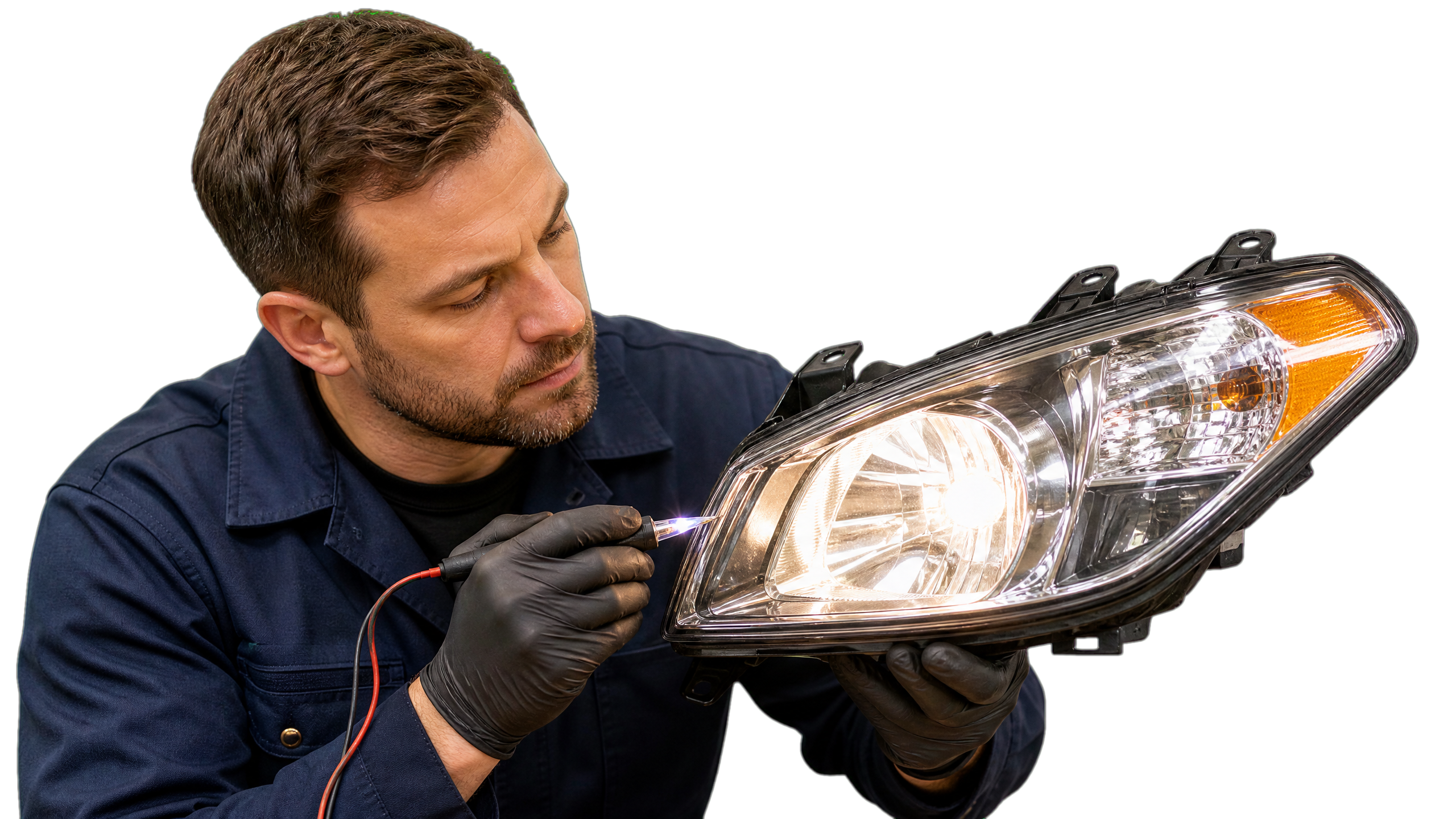
A kid got pulled over last month for “one headlight,” and when he rolled into my yard the next day, I found the truth: his low beam was fine. The high-beam filament on that side and both brake light bulbs were dead, and he’d been driving that way for a year because nobody ever told him.
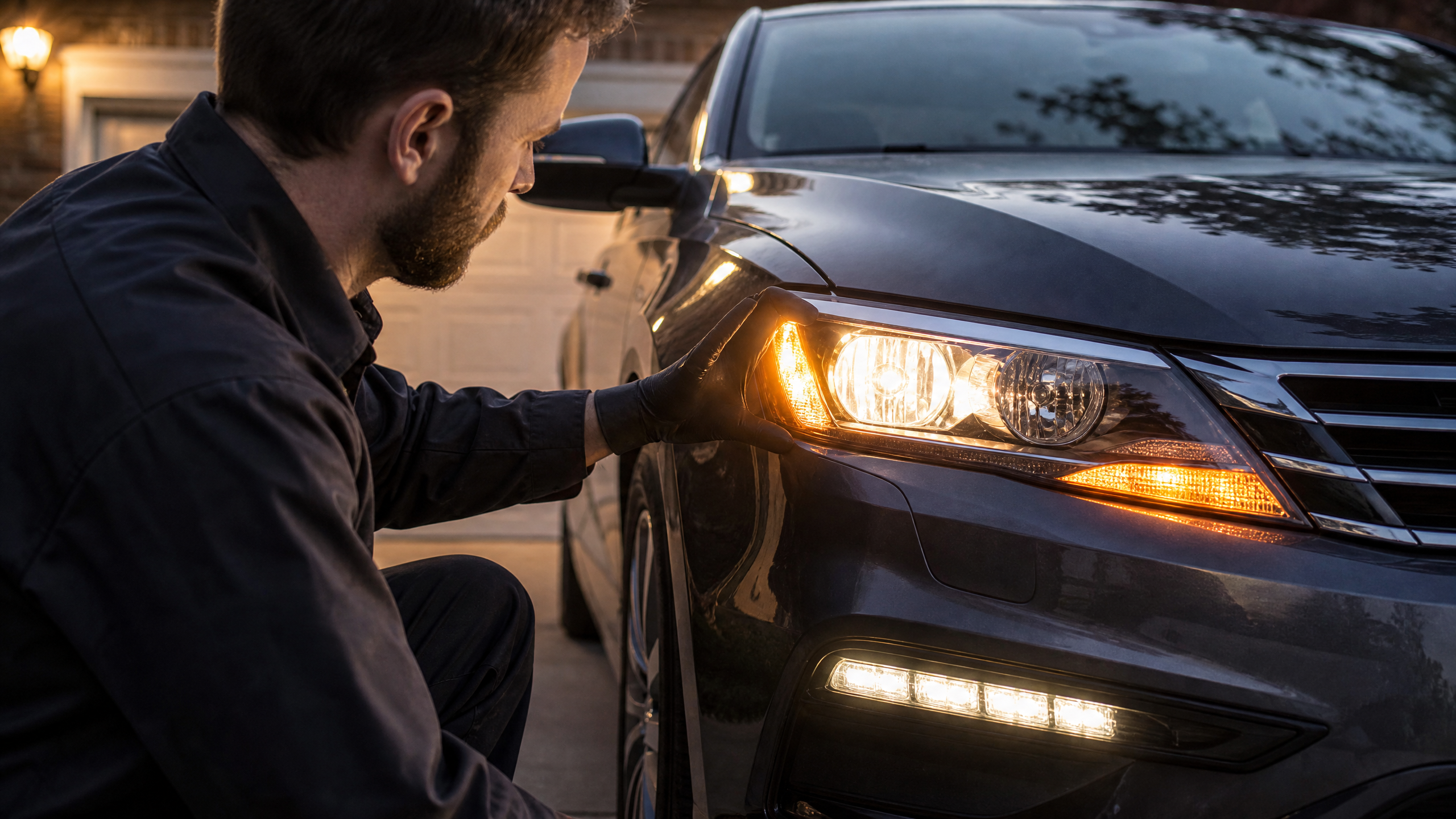
Lights fail quietly. You can’t see your own brake lights, and half your lighting points at the road behind your back. Here’s the full walkaround I do on every car that enters my yard, and how to swap bulbs without killing them on day one.
Two Jobs: See and Be Seen
Your lights do two separate jobs. Headlights and fogs let you see. Everything else — brake, tail, turn, marker, plate — lets the world see you.
The second job gets skipped more, and it causes the crashes. A car with one brake light is a guessing game for the driver behind you. A dead turn signal turns your lane change into a negotiation.
The Full Light Inventory
Walk the car and check every one of these:
- Low beams and high beams, both sides.
- Daytime running lights, if equipped.
- Front turn signals and side markers.
- Rear turn signals, tail lights, and brake lights.
- Third brake light up top — the one everyone forgets.
- Reverse lights and license plate lights.
- Fog lights, front and rear if equipped.
That’s roughly a dozen checkpoints. A bulb pack for the common ones costs less than a pizza.
Testing Solo: The Reflection Trick
Brake and tail lights are hard to check alone, unless you use the world as a mirror.
Back the car up to a garage door or a wall at night. Hold the brake pedal down with your foot (key on, engine off is fine) and watch the door in your mirrors. You’ll see both brake lights and the third brake light glowing in the reflection.
Same trick for reverse: key on, shifter in reverse, watch the wall light up white.
For a rolling check, a phone camera propped in the back seat facing the rear window will record your brake lights while you tap the pedal in the driveway. Low tech, works every time.
Better yet, grab a spouse, a kid, or a neighbor for sixty seconds. Two people turns the whole inventory into a five-minute job with zero tricks.
A Monthly Routine That Sticks
Once a month, at your regular fuel stop or oil-check Saturday, do one lap:
1. Key on, engine off. Walk the front: lows on both sides, markers, plate. 2. Flip high beams, walk the front again. 3. Hazard flashers on. Walk the whole car and watch every amber and red flasher blink. A flasher blinking fast on one side means that side’s bulb is out — the relay tells on it. 4. Brake pedal: reflection trick or helper. 5. Reverse: reflection trick.
Write down what’s dead and buy bulbs in one trip. Done in five minutes.
Know Your Bulb Numbers
Bulbs carry their size right on the base or the box: H11, 9005, 9006, H7 for headlights; 7443, 3157, 1157 for brake and turn; tiny 194/168 wedges for markers and plates.
Pull the dead bulb and read it, or look it up by vehicle. Buying by number beats buying by guess, and the parts store chart is free.
Halogen bulbs are the yellowish glass ones — cheap and hot. LED replacements run cool and bright. HID/Xenon are the blue-white factory units with a ballast behind them. Know which your car uses before shopping; an HID headlight that dies is usually the bulb or the ballast, and the diagnosis is different.
The One Rule With Halogen: Don’t Touch the Glass
Skin oil on halogen glass creates a hot spot when the bulb runs at temperature. That hot spot etches the glass and the bulb dies early, sometimes in days.
Handle a new halogen bulb by the plastic base only, or wear a glove, or hold it in the plastic sleeve it ships in. If you do fingerprint the glass, wipe it with isopropyl alcohol before it ever lights.
This single habit is the difference between a bulb that lasts five years and one that pops by spring.
Replacing a Headlight Bulb
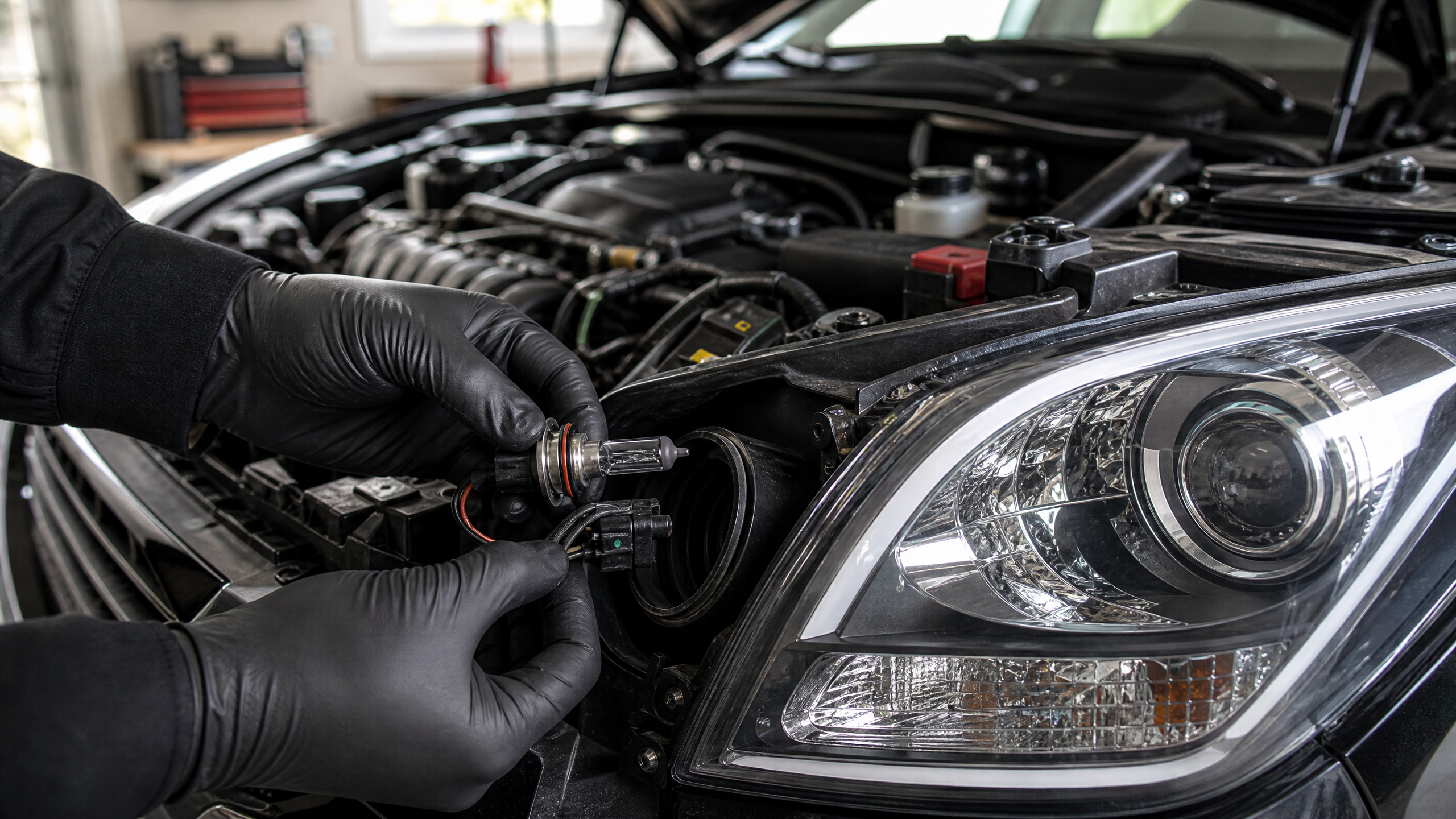
1. Hood up, find the back of the headlight. You’ll see a round or square cover, or the bulb base with a wiring plug. 2. Unplug the connector. It pulls straight off; wiggle, don’t yank wires. 3. Release the retainer. Some are a wire spring clip you squeeze and swing aside. Some are a plastic ring you twist counter-clockwise. Some are two screws. 4. Pull the old bulb out. 5. Seat the new bulb. It only goes in one way; align the tabs on the base with the notches in the housing. 6. Re-lock the retainer and plug the connector back in. 7. Test before you close the hood.
Brake, Turn, and Plate Bulbs
These usually live behind a plastic cover in the trunk or hatch, or you have to remove two screws to pull the whole tail light housing away from the car. Once you see the back of the socket, twist it counter-clockwise to unlock it. The bulb then either pulls straight out (wedge style) or you push and twist (bayonet style).
If the socket is green or white with crusty stuff, that’s corrosion. Clean the contacts with a small wire brush or a flathead screwdriver and apply a dab of dielectric grease to keep moisture out. This saves you from the “new bulb that still doesn’t work” headache.
Fogginess and Dim Lights
A lens with drops inside after rain has a failed seal or a cracked housing. A little fog dries out; standing water kills the socket. Vent the housing, seal the crack with clear silicone on the outside seam, or replace the housing if it’s pooled.
Dim or yellowing headlight lenses are oxidized plastic, not weak bulbs. A polish kit restores most of them; badly hazy lenses want wet sanding and a UV sealant, or replacement.
Aim Check at the Wall
Park 25 feet from a wall on level ground. Low beams should hit slightly below and right of straight ahead on the left lens, and the cutoff should be crisp. If one beam paints the roofline or the ditch, the aim screws on the housing need a turn. Ten minutes with a tape measure and a screwdriver keeps you from blinding the oncoming lane.
Try It: Light Fault Finder
Tick what’s misbehaving and get the likely culprit for each.
What’s acting up?
Wrap-Up
Lights are the only safety system you can fully test with a walkaround and a wall. Five minutes a month, bulbs by number, gloves on halogens, grease on crusty sockets.
Do the lap this weekend with a helper or a garage door, and drive like the people behind you can finally read your mind.
Got a housing that fogs or a bulb that pops every few months? Comment with the car and which light, and I’ll help you hunt the real cause.



Leave a Reply