

Engine oil is the hardest-working fluid in your car. It never gets the spotlight, but it decides how long your engine lives, how quiet it runs, and how much fuel you burn. Let’s break down what actually matters when you stand in front of that wall of bottles at the auto parts store.
Why Oil Matters More Than You Think
Inside your engine, metal parts move fast. Pistons slam up and down thousands of times per minute. The camshaft spins. Bearings carry huge loads. Without oil, those surfaces would weld together in seconds.
A good oil does five jobs at once. It forms a film that keeps metal apart. It pulls heat out of places coolant can’t reach, like the underside of pistons. It carries soot and carbon to the filter. It neutralizes acids that form from combustion. And it helps piston rings seal so you keep compression.
- Friction control: Less drag means less wear and better mileage
- Heat transfer: Oil can carry 40% of engine heat in some engines
- Deposit control: Keeps ring lands and turbo bearings clean
- Corrosion defense: Protects when car sits for weeks
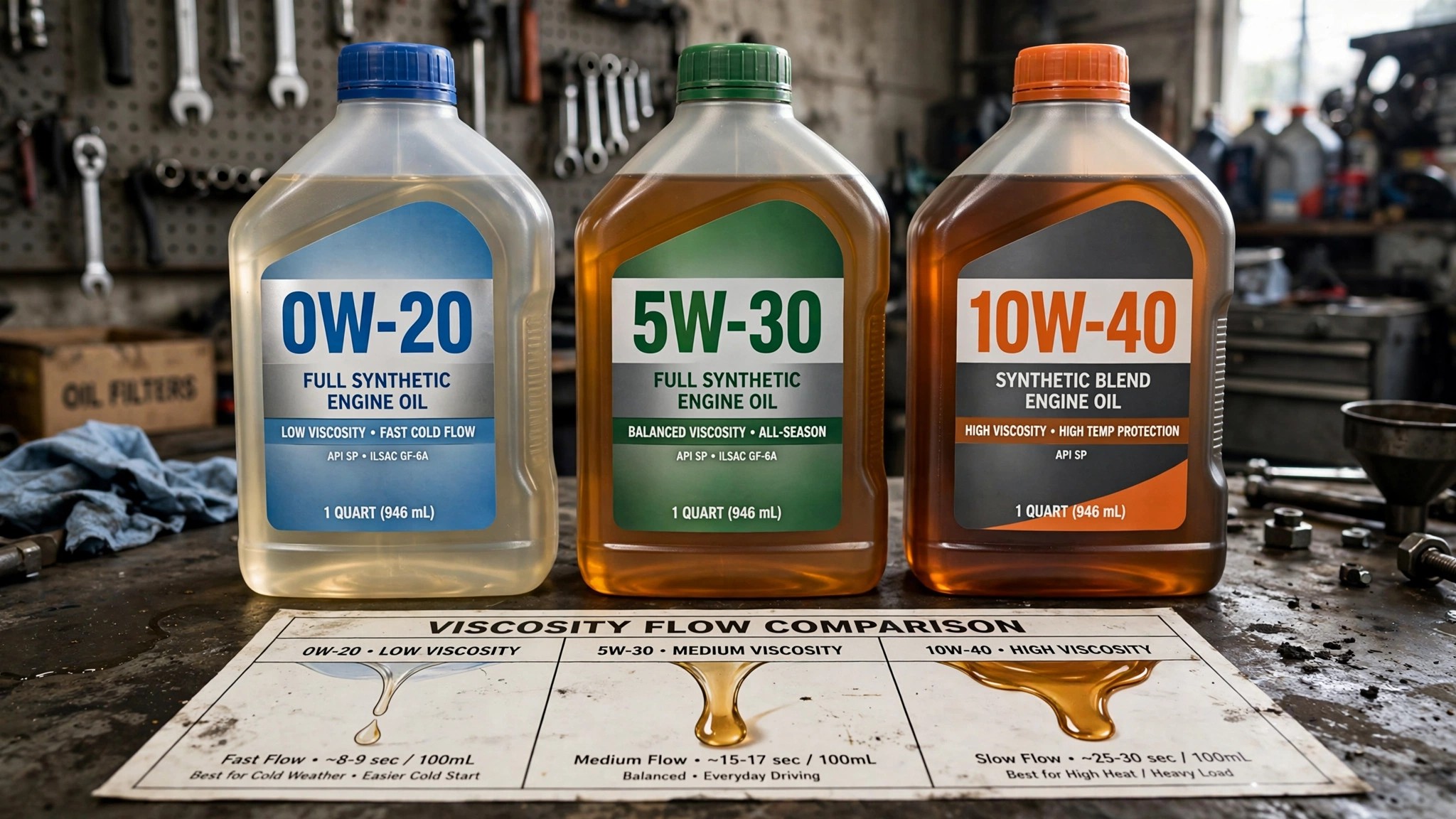
The Real Difference Between Oil Types
Conventional Oil
Refined from crude and mixed with basic additives. It was standard for decades. Today it fits older engines with loose clearances and low stress. Price is low, but it breaks down faster under heat. If you drive a 90s Corolla that sees gentle use, conventional 5W-30 changed at 4,000 miles still works. For anything turbocharged or direct-injected, skip it.
Synthetic Blend
About 30% synthetic mixed with conventional. You get better cold flow and a bit more resistance to oxidation. Many quick-lube shops use this as their default. It’s a solid middle ground if you want better protection without paying for full synthetic, especially for mixed city/highway driving.
Full Synthetic
This is built, not just refined. Molecules are uniform in size, so it flows faster when cold and stays stable when hot. Most 0W-20 and 0W-30 oils are full synthetic by definition. It resists sludge, handles turbo heat, and lets you safely run 7,500 to 10,000 miles in many cars. The price per quart is higher, but cost per mile is often lower because you change less often.
High-Mileage Formula
Once you pass 75,000 miles, seals get hard and you may start burning a little oil. High-mileage oils add seal conditioners that make old gaskets swell slightly and extra anti-wear chemistry like zinc and phosphorus. If you see a few drops on the garage floor or you add a quart between changes, switch to high-mileage in the same viscosity your manual calls for.
Reading the Label: Viscosity Made Simple
5W-30 looks like code, but it’s simple. The number before W means winter. Lower number means thinner when cold, so it pumps faster at startup. That’s when 75% of engine wear happens. 0W gets to the top of the engine faster than 10W.
The number after W is thickness when hot at 100°C. 20 is thin, great for economy. 40 is thicker, holds a stronger film under heavy load. Don’t guess thicker is better. Modern engines have tight bearing clearances. If you pour 20W-50 into an engine built for 0W-20, you’ll starve the cam on cold starts and trigger variable valve timing codes.
| Grade | Where It Shines | Common Fit |
|---|---|---|
| 0W-16 / 0W-20 | Max economy, instant cold flow | New Toyota, Honda, Mazda Skyactiv |
| 5W-20 | Balance for many US cars | Ford, Chrysler, Honda |
| 5W-30 | Most versatile worldwide | Most SUVs, trucks, older cars |
| 5W-40 / 0W-40 | Turbo and European | VW, BMW, Mercedes, Audi |
| 10W-40 | Heat and high mileage | Bikes, older performance cars |
Specs Beat Brands Every Time
Flip the bottle and read the back. You want approvals, not marketing. Look for API SP, ILSAC GF-6A or GF-6B, and your maker spec like GM dexos1 Gen3, Ford WSS-M2C962-A1, BMW Longlife-01, VW 504 00 / 507 00, or MB 229.71.
API SP is the latest for gasoline, with protection against low-speed pre-ignition that can crack pistons in small turbo engines. ILSAC GF-6 adds fuel economy and timing chain wear tests. European ACEA specs demand higher high-temp stability.
If your manual says VW 508 00 0W-20, use only oil that lists VW 508 00 on the label. A generic 0W-20 that doesn’t carry that approval can cause warranty trouble and wear in that specific engine.
When to Change: Mileage Is Only Half the Story
Your driving pattern matters more than the number on the windshield sticker. Short trips under 10 minutes, where oil never fully warms, create moisture and fuel dilution. Stop-and-go traffic cooks oil. Dusty roads load it with particles. Towing raises oil temps above 120°C.
- Conventional: 3,000-5,000 miles / 6 months
- Blend: 5,000-7,500 miles
- Full synthetic: 7,500-10,000 miles, some Euro long-life up to 12,000 with proper spec
- Severe service: Cut those by 30% if you do mostly city, short trips, or towing
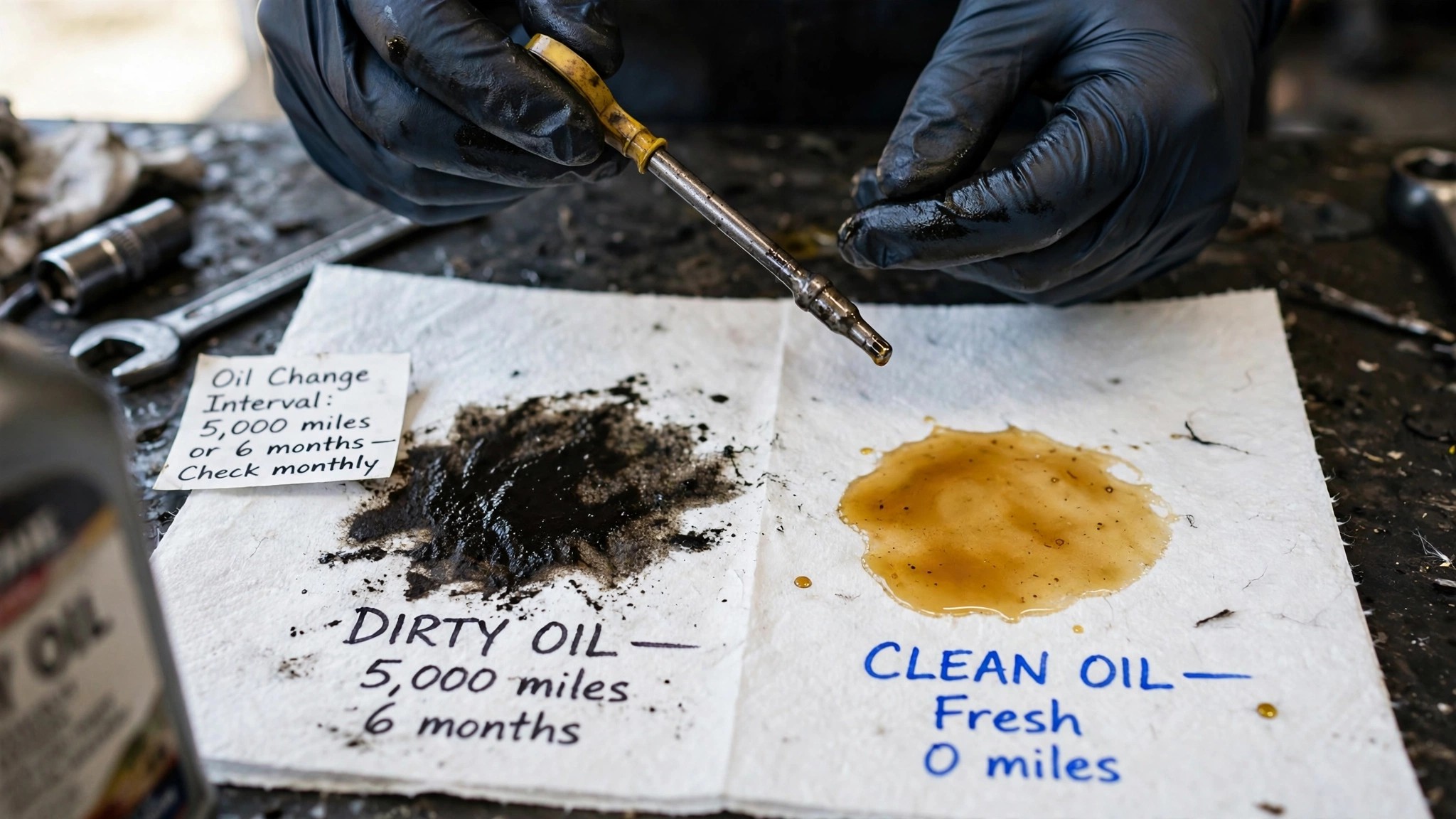
Check your oil monthly. Park level, wait five minutes after shutdown, pull dipstick, wipe, reinsert, pull again. Level should be between holes. Color should be brown-amber, not coal black. Rub it between fingers. If you feel grit, change it. Smell it. Strong gasoline smell means fuel dilution — common in direct injection — and you should shorten your interval.
How to Do a Paper Towel Test at Home
Put one drop of warm oil from the dipstick on a white paper towel and wait an hour. Good oil spreads evenly with a light amber center. Bad oil leaves a dark black center with a sharp outer ring and grit you can see. It’s a quick way to spot soot overload.
Mistakes That Cost Real Money
- Overfilling by a quart. Crankshaft whips oil into foam, oil pressure drops, and you get lifter tick
- Using car oil in a motorcycle with wet clutch. You need JASO MA2, not API SP car oil
- Adding thick oil to stop a leak. It masks the symptom but starves tight passages
- Skipping filter. A new filter holds 15-20% of system capacity and does the cleaning
- Resetting oil life monitor without changing oil. You lose your service record
Your Next Steps
Open your hood today. Find the oil cap — it often says the viscosity. Check your manual for spec. Buy one extra quart of the correct oil and keep it in the trunk with a funnel. Check level at each fuel fill for one month. You’ll learn how much your engine uses and catch a leak early.
Oil is cheap insurance. A jug costs $30. A short block costs $5,000. Keep it clean, keep it full, and use the exact approval your engine was designed around. Your cold starts will be quieter, your fuel economy steadier, and your engine will stay out of the shop.
Oil Filters, Oil Life Monitors, and Storage Tips
Your filter does half the cleaning. A cheap filter with weak bypass valve can starve your engine on cold starts. Use a filter that meets OEM flow and pressure specs. If you drive short trips, change filter every time, not every other time. For spin-on filters, pre-fill it with fresh oil before installing to reduce dry start time. For cartridge filters, replace O-rings and torque cap to spec.
Oil life monitors are smarter than simple mileage counters. Most track cold starts, engine revolutions, temperature profiles, and idle time. GM’s system counts revolutions and penalizes short trips. Honda’s Maintenance Minder watches operating conditions. Trust it, but don’t stretch beyond one year even if it says 40%. Oil oxidizes just sitting.
Storing oil? Unopened, it lasts 4-5 years in cool dry place. Opened jug picks up moisture. If you opened a jug six months ago, use it for top-up only, not full change. Always shake gently before pouring if it’s been sitting, because additives can settle.
Synthetic Myths Busted
Myth: synthetic causes leaks. Fact: it cleans sludge that was blocking a leak that already existed. If seals are healthy, synthetic doesn’t create leaks. Myth: you can’t switch back to conventional after synthetic. Fact: you can switch anytime, as long as spec matches. Myth: racing oil is better for street. Fact: racing oil often has less detergent and is meant to be changed after each race.
Climate and Driving Style Adjustments
Living in hot climates? 5W-30 or 5W-40 gives you a bit more hot film strength than 0W-20. In cold winter regions, 0W-20 or 0W-30 pays back on first crank. If you tow, climb long grades, or sit in heavy traffic for hours, consider shortening interval by 1,500 miles even with full synthetic. Turbo engines run oil 30-50°C hotter than non-turbo, so they need full synthetic with turbo-approved spec like GM dexos1 Gen3 or API SP.
Quick Checklist Before You Buy
- Check oil cap for viscosity
- Check manual for spec: API SP, ILSAC GF-6, ACEA, plus maker approval
- Match mileage: over 75k? Consider high-mileage same viscosity
- Check filter part number and have new crush washer for drain plug
- Have torque wrench: drain plug usually 25-30 Nm, filter cap per manual
How Oil Choice Affects Fuel Economy
Lower viscosity reduces pumping losses. Switching from 10W-40 to 0W-20 can improve fuel economy 2-3% in city driving. That’s small per tank, but adds up over year. Don’t go thinner than manual allows just for economy, because wear goes up if film is too thin for your engine’s clearances. Stick to approved range.
What About Oil Additives From Parts Stores?
Most quality oils already have balanced additive package. Pouring in extra zinc or moly can upset balance and cause deposit issues. The only additive that makes sense is fuel system cleaner for injectors, not oil thickeners. If engine is sludged, do two short-interval changes with good synthetic instead of flushing with harsh chemicals that can block oil pickup.
🔧 Oil Viscosity & Change Calculator
Pick your car details and get a recommendation + next change date.
One last habit that pays: keep a simple log. Date, mileage, brand and spec, filter part number. Snap a photo of the odometer and receipt. If you ever sell the car, that log adds value. If you need warranty help, it proves you cared.
FAQ: Engine Oil Questions Drivers Ask
Can I mix brands? Yes if same viscosity and spec. Brand is less important than approval. Mixing two API SP 5W-30 oils is fine in emergency top-up.
Is thicker oil better for old engines? Not always. If engine was built for 5W-20, going to 20W-50 will cause oil starvation at startup and trigger VVT codes. If you burn oil, try high-mileage version of same grade first.
How long can I go without checking? No more than a month or 1,000 miles. Some engines use a quart every 1,500 miles and that’s considered normal by maker. You won’t know unless you check.
What about diesel oil in gasoline car? Don’t. Diesel oils have higher ash and can damage gasoline catalytic converters.





Leave a Reply