
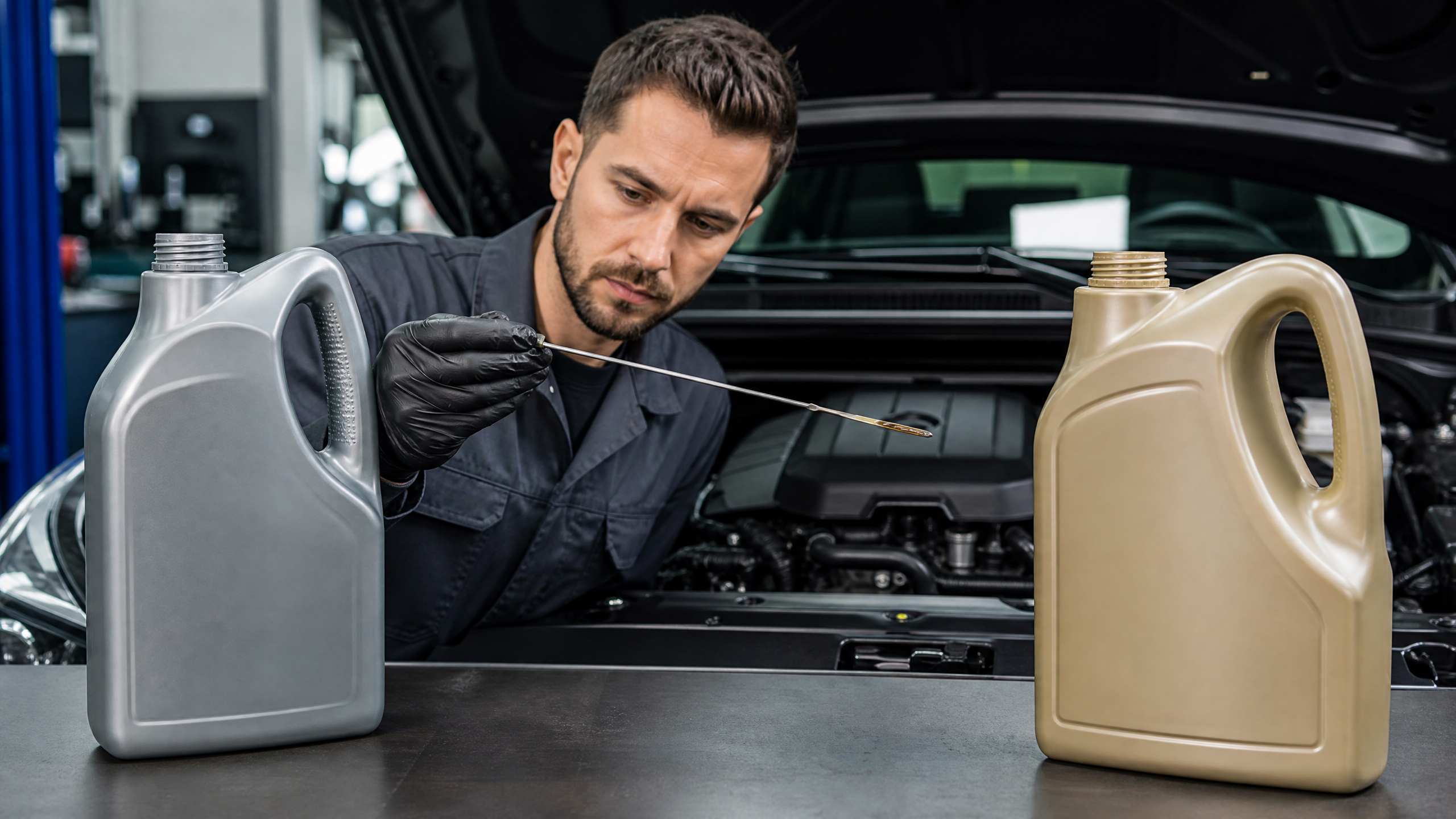
I stood in the oil aisle last spring helping a friend, and he just stared at the wall of bottles like it was a wine list. Conventional, blend, full synthetic, high-mileage, “extended performance” — four price points, twenty brands.
He asked the question I get every week: “Is the expensive stuff actually better, or is it marketing?”
Sometimes yes, sometimes no. Here’s the honest split, from someone who cuts open the results.
What Oil Actually Does
Oil isn’t just slippery stuff. It does four jobs at once.
It lubricates metal sliding on metal. It cools parts that water can’t reach. It cleans by holding soot and metal bits in suspension until the filter catches them. And it seals the tiny gap between piston rings and cylinder walls.
Any oil you buy is a base stock plus a chemistry package. The base stock is where conventional and synthetic part ways.
Conventional: The Old Workhorse
Conventional oil is refined crude, purified but still a natural product. Its molecules come in mixed sizes and shapes, including waxes and impurities that synthetic leaves out.
That mixed crowd is why conventional thickens hard on cold mornings and breaks down faster under heat. It’s also why it’s cheap.
For a simple, naturally-aspirated engine that gets oil changes on time, conventional still does the job fine. My old farm pickup runs it and has 212,000 honest miles.
Synthetic: The Lab-Tailored One
Synthetic base stocks are built molecule by molecule to be uniform. No waxes, few impurities, and sizes chosen on purpose.
Uniform molecules slide past each other easier, so synthetic flows at cold start — the moment most engine wear happens. It also resists heat breakdown longer, holds its viscosity across a wider temperature range, and cleans better.
That’s why every turbocharged, supercharged, or tight-tolerance modern engine left the factory on synthetic.
The Scorecard
| Conventional | Full synthetic | |
|---|---|---|
| Price per quart | $4–$7 | $7–$12 |
| Cold-start flow | Fair | Excellent |
| Heat resistance | Good | Excellent |
| Change interval | 3,000–5,000 mi | 7,500–10,000 mi |
| Best for | Simple engines, short budget, on-time changes | Turbos, towing, extremes, long intervals |
| Weak spot | Thick when cold, sludge if neglected | Costs more up front |
Synthetic blend sits in the middle: part synthetic base stock, part conventional. It’s a good budget upgrade for older engines that see some hard use, and it’s what many fleets run. Think of it as splitting the difference, not as getting half of each benefit.
Reading the Bottle: 5W-30, Explained
The numbers are viscosity, or thickness. The W number is cold (winter) thickness — lower flows easier at startup. The second number is thickness at operating heat.
A 0W-20 pours like water on a freezing morning and still protects at temperature. A 10W-40 is an old-school thicker grade for older engines and hot climates.
Your manual picks the grade. Synthetic or not, the grade never changes — a 5W-30 synthetic and a 5W-30 conventional flow in the same weight class, just with different manners.
The Alphabet Soup on the Back Label
Flip the bottle over and look for the API service symbol — a donut that says something like API SP for gas engines. That’s the current performance standard. ILSAC GF-6 means it also passes fuel-economy and timing-chain wear tests.
Some cars demand a manufacturer approval instead: dexos for GM, VW 502/504, BMW LL-01, and so on. If your manual names an approval, the bottle must show it. The right approval in conventional beats the wrong approval in synthetic.
High-Mileage Oil: Worth It?
High-mileage formulas, conventional or synthetic, add seal conditioners that swell aging gaskets slightly, plus extra detergents for older sludge.
Past about 75,000 miles, I switch engines to high-mileage synthetic. It won’t fix a leak, but it often slows the seep and keeps old seals supple. On a tight, dry old engine it’s harmless.
Zinc and Old Flat-Tappet Engines
Classic cars with flat-tappet camshafts need higher zinc (ZDDP) than modern oils carry, because modern oils dropped zinc to protect catalytic converters. Running modern passenger-car oil in an old flat-tappet V8 can wipe the cam.
If you wrench on classics, buy oil labeled for that use or add the zinc supplement the cam maker specifies. Modern roller-cam engines don’t need it. Don’t swap the other way either — high-zinc racing oil in a modern cat-equipped car cooks the converters.
Can You Switch Back and Forth?
Yes. The old campfire rule that “once you go synthetic you can’t go back” is false. Oil is oil; the grades mix fine.
One honest warning: synthetic cleans. If an old engine’s leaks were being plugged by sludge, a switch to synthetic can wash that plug away and reveal the leak that was always there. The oil didn’t cause the leak. It just stopped hiding it.
And no, you don’t need a special flush before switching. Drain it warm, change the filter, fill with the new oil. Done.
My Honest Recommendations
- Newer car, turbo, or start-stop tech: full synthetic, no debate. It’s what the engine was designed around.
- Towing or hauling: full synthetic with the manual’s grade. Heat is the enemy and synthetic eats heat.
- Cold winters: full synthetic for the cold-start flow. That first ten seconds after startup is where wear lives.
- Older simple engine, changes on time, tight budget: conventional is acceptable. Just keep the interval short.
- Older engine past 75k with a damp driveway spot: high-mileage synthetic.
- Long road-trip car on a monitor: full synthetic and let the monitor stretch the interval safely.
- Classic with a flat-tappet cam: high-zinc oil made for it, changed on a short schedule.
Try It: Pick My Oil
Answer three questions and get the bottle I’d hand you across the counter.
Hand me the right bottle
Engine
Climate
Use
Wrap-Up
Synthetic isn’t a scam and conventional isn’t garbage. They’re tools for different jobs and budgets.
Match the oil to the engine, the weather, and the work — then change it on time. On-time conventional beats neglected synthetic every single day of the week.
Still staring at that wall of bottles? Comment with your car and miles and I’ll point you to a shelf.
Related posts:
 The Science of Car Audio Tuning: Why Your Speakers Sound Off (And How to Fix It)
  Why Is Your Car Overheating? How to Safely Check 4 Common Culprits
  Why Your Car Cranks But Won’t Start (How to Safely Check Fuel and Spark at Home)
  Understanding Your Brakes: A Comprehensive Guide into Car Brake Replacement and Maintenance for Safety
Leave a Reply