
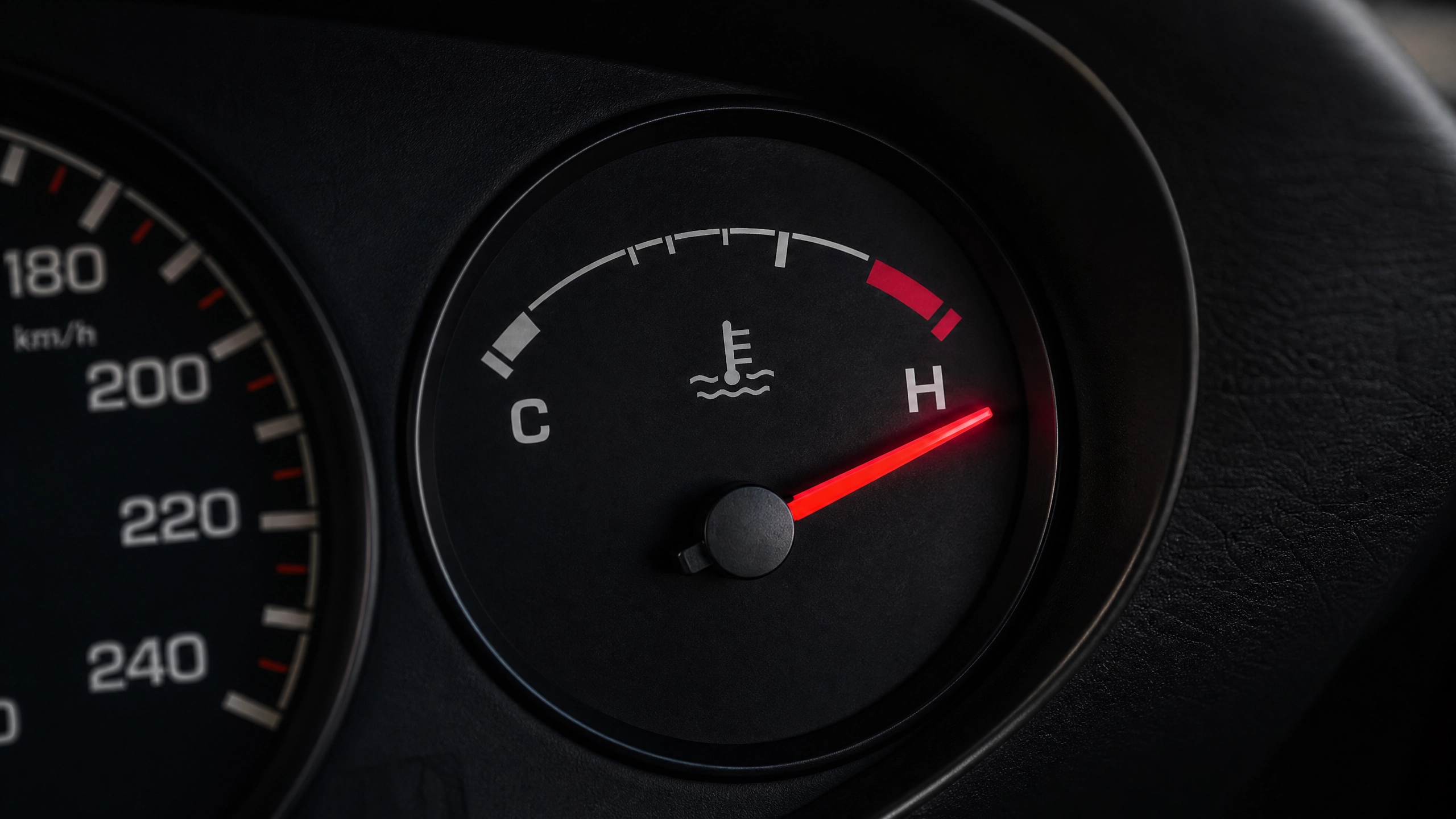
The Needle of Doom
You’re cruising down the highway, radio on, not a worry in the world. Then you glance down and the temp needle isn’t just high. It’s buried in the red.
Or maybe it’s worse. White steam starts curling out from under the hood seams like your car just gave up and started smoking a cigarette.
I’ve had that exact moment happen to me on a stretch of I-70 with a 2008 Civic that I swore was running fine that morning. Your engine generates an insane amount of heat just from burning fuel, and the only thing standing between “normal Tuesday commute” and “warped cylinder head” is your cooling system doing its job. Ignore a red needle for even five minutes and you can crack a head gasket. That’s not a $40 fix. That’s a $2,000-plus repair bill, easy, and sometimes the whole engine is toast.
So let’s talk about why it happens, and how to check it yourself without getting hurt.
The Warning I Give Every Customer Before Anything Else
Never, ever open a hot radiator cap.
I mean it. I’ve seen a guy in my old shop ignore this and end up with second-degree burns across his forearm.
Here’s the physics in plain English: your cooling system runs under pressure, and that pressure raises the boiling point of the coolant inside. The moment you crack that cap, pressure drops instantly. The coolant flashes to steam in a fraction of a second. What comes out isn’t a gentle puff. It’s a geyser of boiling liquid and scalding vapor shooting straight up at your face and hands.
Wait until the engine has been off for at least one to two hours. Touch the radiator cap with the back of your hand first. If there’s any warmth at all, walk away and grab a coffee. Come back later.
The 4 Most Common Overheating Culprits
1. Low Coolant or a Hidden Leak
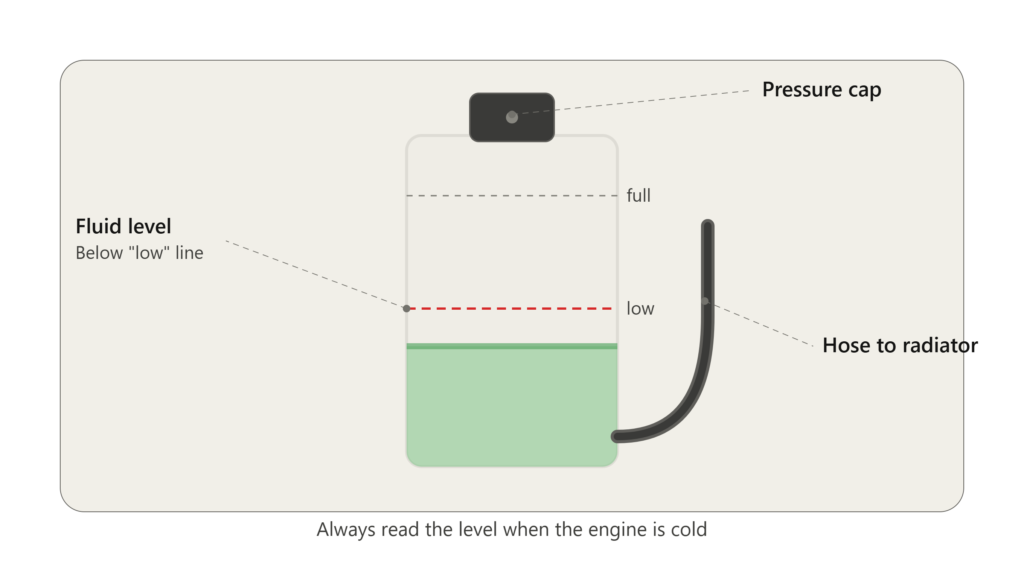
This is the most common one I run into, hands down.
Once the engine is stone cold, look at the translucent plastic overflow tank near the radiator. There are usually “Low” and “Full” lines molded right into the plastic. If the level sits below “Low,” something’s wrong.
Coolant doesn’t evaporate in a sealed system. If it’s low, it’s leaking somewhere, period. Here’s how I track it down:
- Use your nose first. Antifreeze has a sweet, almost syrupy smell when it hits a hot exhaust manifold. If you catch that smell after a drive, pop the hood.
- Check the ground. Look for a green, pink, or orange puddle under the front of the car after it’s been parked overnight.
- Inspect the hoses. Crusty white or chalky residue near a hose clamp usually means coolant has been seeping out slowly for weeks.
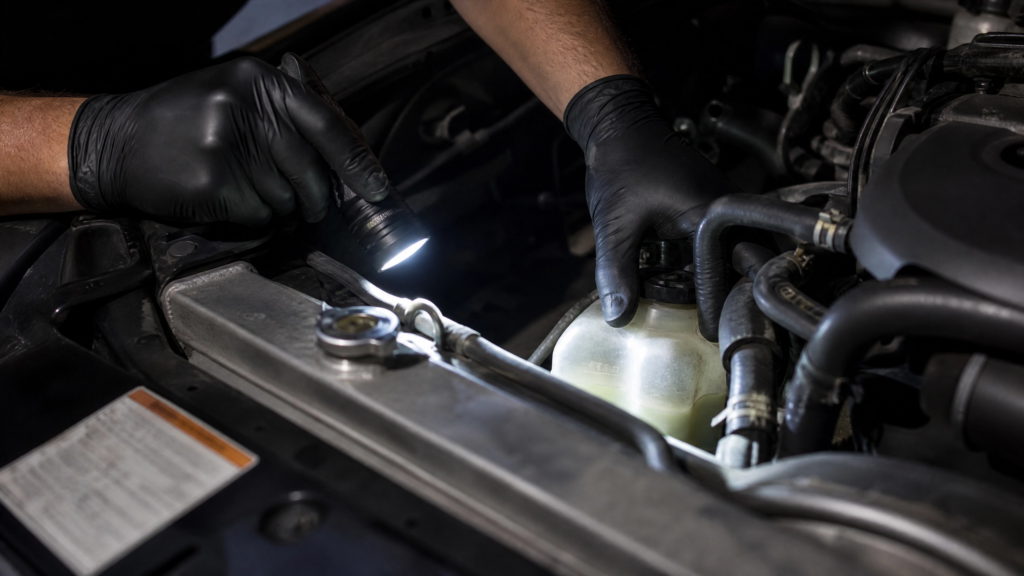
Always check reservoir levels cold. A “low” reading on a hot engine can be misleading.
2. A Stuck-Closed Thermostat
The thermostat is a tiny spring-loaded valve, maybe the size of a hockey puck, and it costs about $15 at the parts store. Its whole job is to stay shut until the engine warms up, then open and let coolant flow to the radiator.
How to check it: Start the car cold and let it idle. Place your hand carefully on the upper radiator hose (the one going into the top of the radiator). For the first 8-10 minutes it should be cool. Then it should get noticeably hot as the thermostat opens.
If your temp gauge is climbing toward the red zone but that upper hose stays stone cold the whole time, the valve is jammed shut. All that heat is trapped in the engine block with nowhere to go.
My old trick: pull the thermostat and drop it in a pot of boiling water on the stove with a kitchen thermometer. Watch the valve. If it doesn’t pop open by around 195°F, it’s garbage. Twenty minutes of testing saves you from reinstalling a bad part.
3. A Failing Cooling Fan
This one fools a lot of people because the car seems fine on the highway.
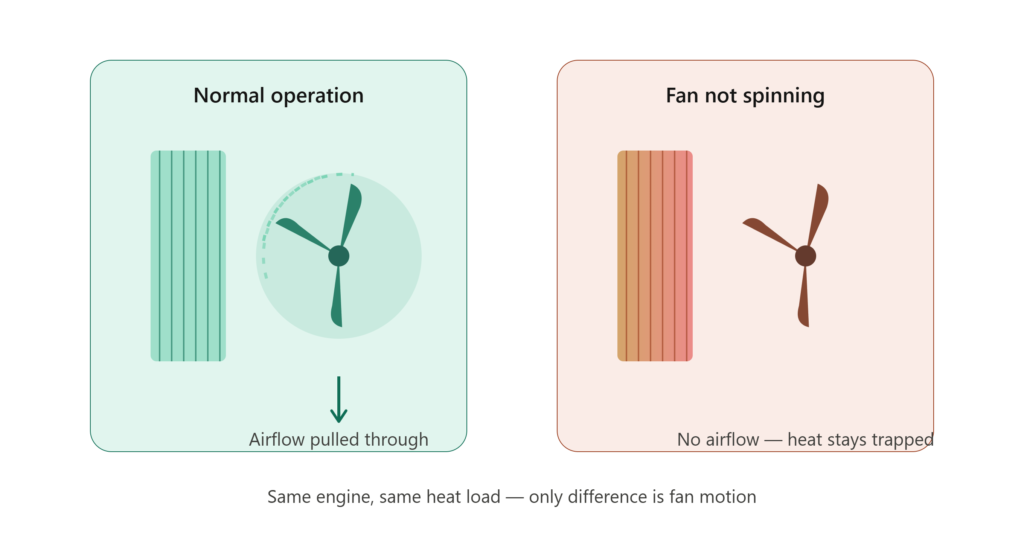
How to check it: With the engine running, crank the A/C to max and pop the hood. Look down behind the radiator. You should see the plastic electric fan blades spinning fast.
Alex’s Shop Note: If your car only overheats sitting in traffic or idling at a drive-thru, but cools right back down once you’re moving again, the fan motor is dead. At highway speed, wind pushes through the grille and does the fan’s job for it. Sitting still, there’s no airflow unless that electric fan is spinning. No fan, no airflow, no cooling.
4. A Dead or Slipping Water Pump
The water pump is the heart of the whole system. An impeller wheel inside spins constantly, shoving coolant through the engine block and out to the radiator.
How to check it: Look directly underneath the front pulleys on the side of the engine for a steady green or orange drip. Listen for a high-pitched whine or grinding sound from the belt area, especially right after starting the car cold.
Here’s a detail most people don’t know: water pumps have a tiny “weep hole” drilled into the housing right behind the pulley. It’s designed on purpose. When the internal seal starts to fail, coolant drips out of that weep hole as an early warning before the pump fully dies. If you see a small wet trail right there, order the part now. If the internal bearing seizes completely, it can shred your serpentine belt and strand you on the spot, since that same belt often runs your alternator and power steering too.
Troubleshooting Quick-Reference Table
Cooling System Troubleshooting Guide
Identify symptoms, diagnose issues, and take the right action to prevent engine damage
| Symptom | Likely Culprit | Danger Level | Next Action |
|---|---|---|---|
| Reservoir below “Low” line, sweet smell | Low coolant / leak | Moderate | Top off, find leak source, pressure test system |
| Upper radiator hose stays cold while gauge climbs | Stuck thermostat | High | Replace thermostat (don’t just remove it) |
| Overheats in traffic, fine on highway | Failing cooling fan | Moderate | Test fan relay and fuse, then fan motor |
| Wet drip near pulley, whining noise | Water pump failure | High | Replace pump and belt together |
| Steam from hood, needle pinned in red | Multiple/severe | Critical | Pull over now, shut off engine, call a tow |
Try It Yourself: Quick Overheating Diagnostic Tool
I put together a simple interactive checklist below. Answer a few questions about what you’re seeing and hearing, and it’ll point you toward the most likely culprit before you even pop the hood.
Quick Overheating Diagnostic
Answer 3 questions to narrow down the likely cause
Likely Culprit
Emergency Roadside Protocol: If It Happens Right Now
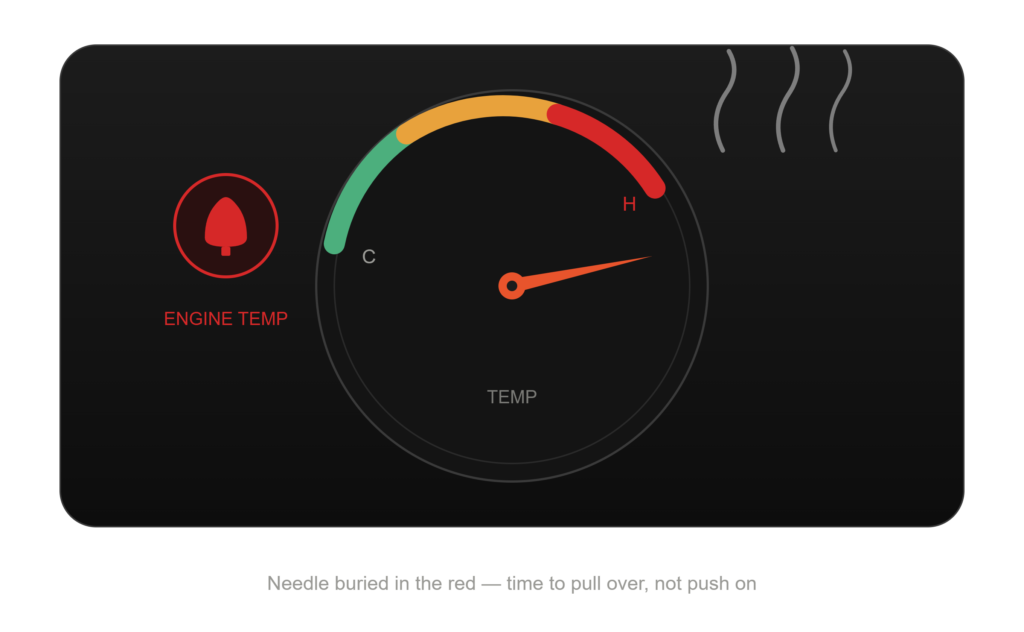
If that needle hits red while you’re actually driving, do these three things in order. Two of them feel completely backwards, but they work.
- Turn off the A/C immediately. The compressor puts a serious extra load on an engine that’s already struggling. Killing it frees up a little headroom.
- Crank the heater to max heat and max fan speed. I know, it sounds miserable in July. But the heater core under your dash works like a tiny second radiator. Blasting it pulls heat out of the engine and dumps it into the cabin, which can buy you another mile or two before things get worse.
- Pull over, shut the engine off, and call a tow truck. Do not try to limp it home. I’ve seen more blown engines from “I was only five minutes away” than almost any other cause.
A radiator cap, a $15 thermostat, or a cheap fan relay are all things you can diagnose in your driveway in under twenty minutes. A cracked head from driving on a red needle is not. Catch it early, and your wallet will thank you.



Leave a Reply