
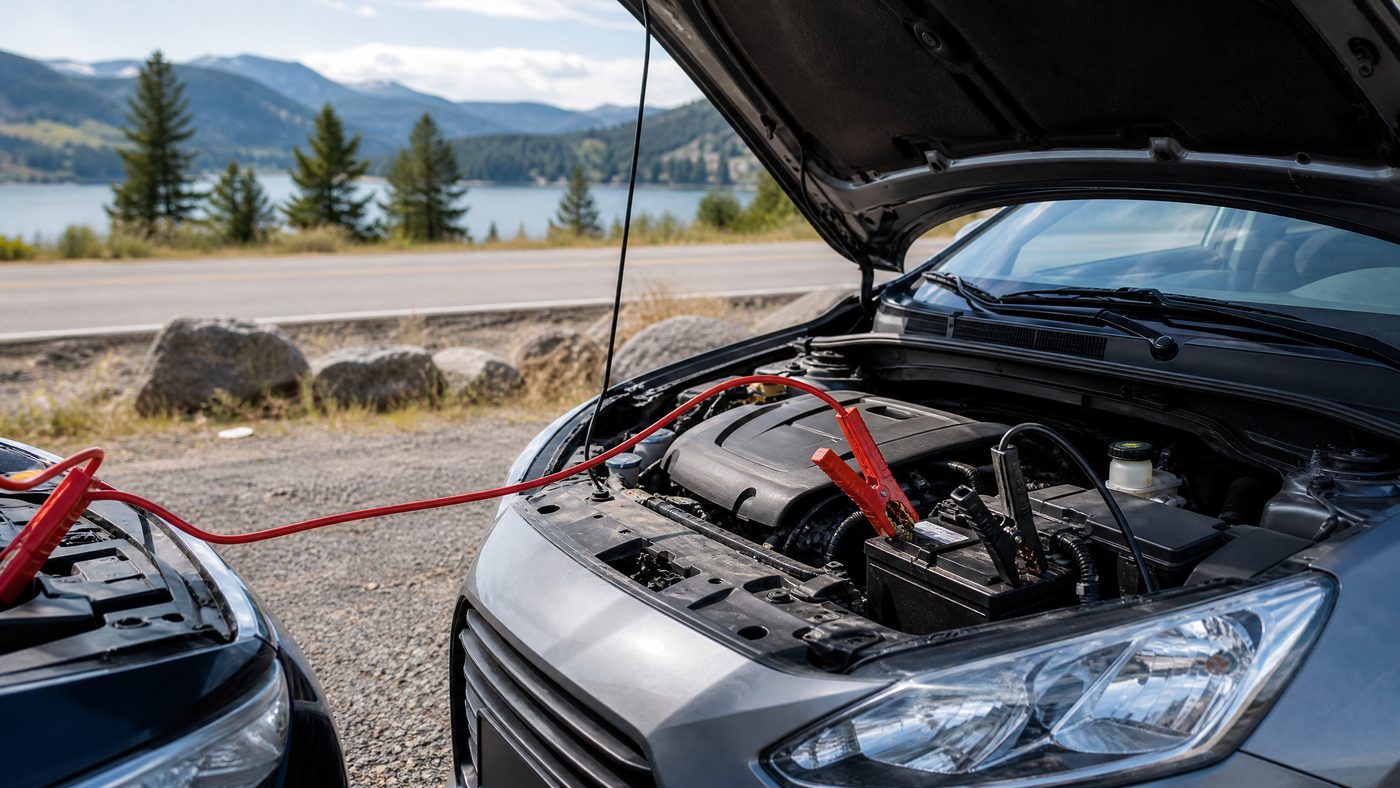
We have all been there. You turn the key, and instead of the engine roaring to life, you just hear a rapid click-click-click. The dash lights flicker like a dying flashlight. Your battery is dead.
I remember the first time it happened to me. I was parked outside a grocery store in the freezing rain. I had to beg a stranger to help me jump my old Honda Civic. Since then, I have jumped hundreds of cars in my own garage and on the side of the road.
Jumping a car is easy. But doing it wrong can fry your car’s computer or blow up the battery. Let me walk you through how to do it safely.
Safety First in the Garage
Before we grab the cables, we need to talk safety. Car batteries contain sulfuric acid. They also vent hydrogen gas. Hydrogen is highly flammable. A single spark near the battery can cause an explosion.
Always wear safety glasses. I keep a pair of cheap plastic safety glasses in my toolbox. Battery acid in your eye is no joke. It will blind you faster than you can blink.
Wear old gloves, too. Battery grime is nasty. I also keep a stack of clean shop rags handy. You will need them to wipe down the terminals.
Keep a bottle of water nearby. If you get battery acid on your skin, flush it with water immediately. I also keep a small box of baking soda in my kit. Baking soda neutralizes acid spills instantly.
Gathering Your Tools
Here is what you need to get the job done right.
- Jumper cables: Get thick ones. Thin cables melt and fail. Look for 4-gauge or 2-gauge pure copper wires. Avoid copper-clad aluminum. They are cheaper but carry less current.
- A donor car: This needs a healthy battery and a working alternator.
- Safety glasses and gloves.
- A wire brush: A cheap battery terminal brush works best.
- A 10mm wrench or socket: Sometimes the terminal clamps are tight and need adjusting.
- Shop rags.
Step 1: Park the cars close together
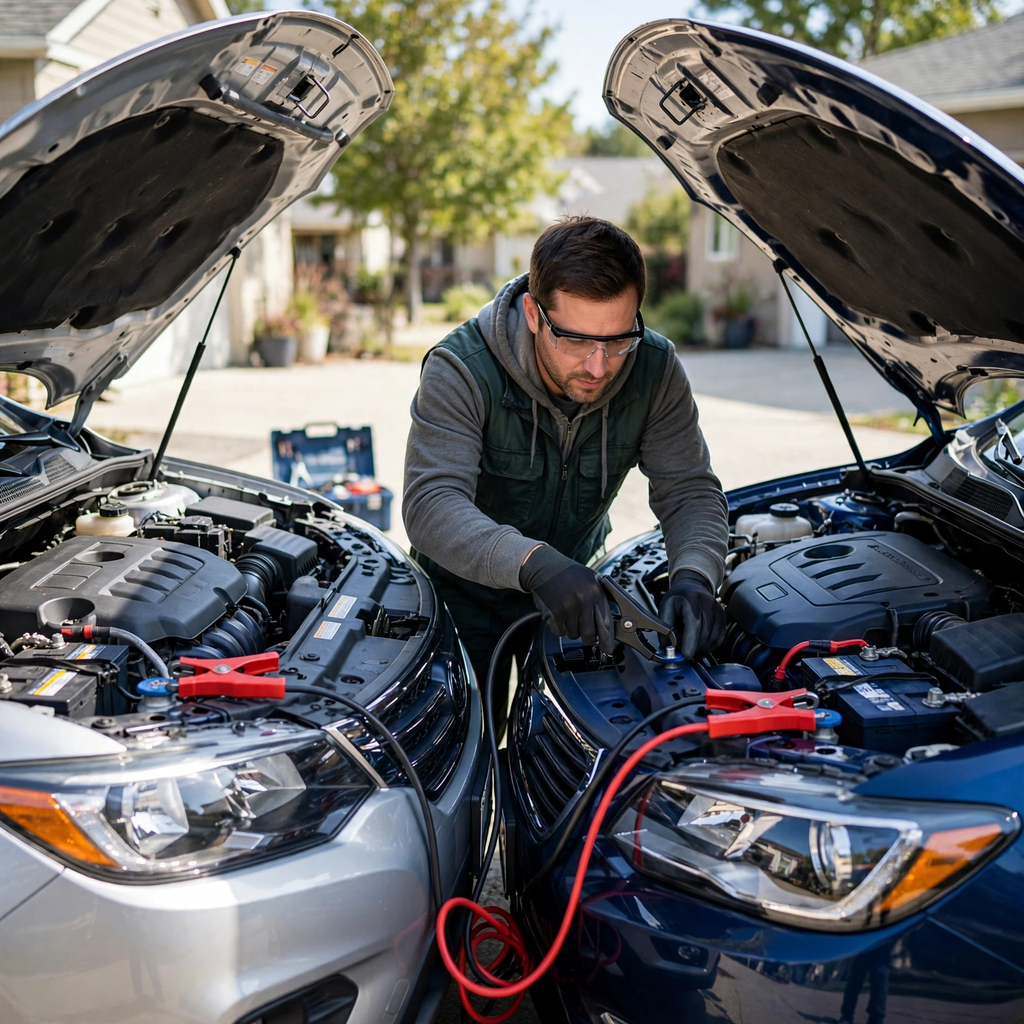
Pull the donor car close to the dead car. Make sure the cars do not touch. If they touch, you create a ground path that can bypass your cables and weld the frames together.
Turn off both engines and set the parking brakes. Put both cars in park, or first gear for manuals.
Step 2: Pop the hoods and find the batteries
Open both hoods. Prop them up securely so they do not fall on your head. Locate the batteries.
Most are obvious, but some are hidden under plastic covers. If you see a red plastic cap on the positive terminal, pop it off. Some modern cars have the positive terminal far away from the battery. Follow the red cable to find the remote jump post.
Step 3: Inspect the dead battery
Look closely at the dead battery. Is the plastic case cracked? Is it bulging?
If there is acid leaking out, stop right there. Do not jump a damaged battery. It can explode. Call a tow truck instead.
Step 4: Clean the terminals
Look at the metal posts on the battery. Are they covered in white or blue crust? That is corrosion. It blocks the electrical flow.
Take your wire brush and scrub the posts. I use a dedicated battery terminal brush. It has a small wire wheel for the post and a flat brush for the clamp.
Scrub until you see shiny metal. Wipe away the dirt with a shop rag. Keep the dirt away from the battery cap so it does not fall inside. Dirty caps can ruin ABS valves or clog delicate sensors if it gets into the fluid reservoirs nearby.
If the clamps are loose, use a 10mm wrench to tighten them later. A loose clamp will arc and melt.
Step 5: The Cable Hookup
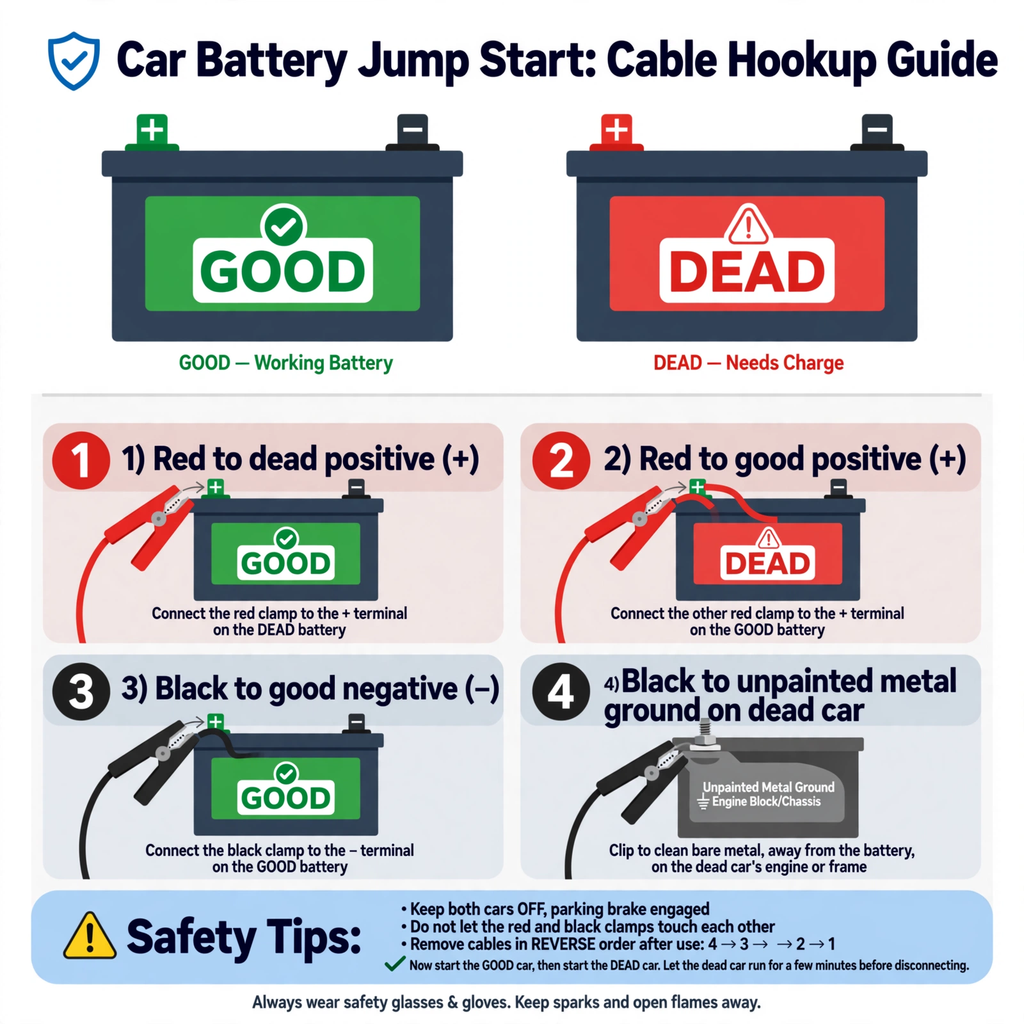
This is where people mess up. Follow this exact order. Memorize it. Red goes to dead, red goes to good, black goes to good, black goes to metal.
- Red clamp to the DEAD battery positive (+). The positive post is usually larger and has a red cover or a plus sign. Push the clamp down hard. Wiggle it a bit to bite into the bare metal.
- Red clamp to the GOOD battery positive (+). Do the same thing on the donor car. Make sure it is tight.
- Black clamp to the GOOD battery negative (-). The negative post has a minus sign and is usually black. Clamp it on tight.
- Black clamp to UNPAINTED METAL on the DEAD car. This is the secret step. Do not connect the last black clamp to the dead battery’s negative post. Find a bare, unpainted metal bolt or bracket on the engine block. A good spot is often the alternator bracket or a sturdy engine mounting bolt.
Why do we do this? The battery vents hydrogen gas. Connecting the final clamp to the battery creates a spark. By connecting it to the engine block, the spark happens away from the battery. It keeps you safe.
I once saw a guy fry the Powertrain Control Module (PCM) on a late-model Ford because he connected the negative cable to the negative post. The voltage spike went straight into the computer. Always use the engine block ground.
Step 6: Start the donor car
Get in the donor car and start the engine. Let it run for about three to five minutes. This sends some charge to the dead battery.
You can press the gas pedal slightly to hold the RPMs around 1500. This makes the alternator work harder. Have a friend watch the cables. If they start smoking, disconnect them immediately.
Step 7: Start the dead car
Get in the dead car. Turn the key. If it just clicks, wait another two minutes. Try again.
When it catches, let it run. Do not rev it high right away. Just let it idle. Listen to the engine. Make sure it sounds smooth.
If it does not start after three tries, stop. You might have a bigger issue. The starter could be dead, or the engine could be seized.
Step 8: Remove the cables
Take the cables off in the exact reverse order. This prevents sparks near the batteries.
- Remove the black clamp from the engine block of the dead car.
- Remove the black clamp from the negative post of the good car.
- Remove the red clamp from the positive post of the good car.
- Remove the red clamp from the positive post of the dead car.
Coil the cables up neatly. Do not just throw them in the trunk. They will tangle and the clamps will scratch your paint next time.
What to do next
Keep the revived car running. Drive it for at least twenty minutes. The alternator needs time to recharge the battery.
If you turn it off in your driveway, it might not start again. The alternator charges the battery, but it takes time. Idling in the driveway does not push enough power. You need to drive it on the highway.
If the car dies again the next day, your battery is toast. Or your alternator is bad. You will need to test them with a multimeter.
Set your multimeter to DC volts. With the engine off, the battery should read about 12.6 volts. Start the engine. The voltage should jump up to 13.5 to 14.5 volts. If it stays at 12 volts, your alternator is not charging.
Look at the sticker on the top of the battery. You will see a date code. It usually looks like a letter and a number, like 8A. That means January 2018. If your battery is over four years old, it is living on borrowed time.
If your battery keeps dying every morning, you might have a parasitic draw. This is when something in the car stays on when it should be off. A trunk light stuck on, or a bad aftermarket radio. You can test this with a multimeter set to amps, but that is a topic for another day.
What if you do not have a donor car?
Sometimes you are stuck in a dark parking garage at midnight. You do not have a friend with a car. This is when a portable lithium jump starter saves the day.
I keep a small lithium jump pack in my glovebox. They are about the size of a paperback book. The hookup is the same. Red to positive, black to engine ground.
Just make sure the jump pack has a charge. Check the battery indicator on the pack before you buy it. Keep it plugged in with a USB cable every few months.
Maintaining your battery
Once you get the car running, take five minutes to clean the battery. Mix a tablespoon of baking soda with a cup of water.
Use an old toothbrush to scrub the terminals. The baking soda will fizz. That means it is neutralizing the acid. Rinse it with a little bit of clean water. Wipe it dry with a shop rag.
Apply a thin layer of dielectric grease or petroleum jelly to the terminals. This keeps moisture out and stops corrosion from coming back. Tighten the clamps with your 10mm wrench. They should not twist by hand.
Interactive Quiz: Test Your Jump Start Knowledge
1. Where should the final black cable clamp be connected on the dead car?
2. What size wrench is commonly used to tighten battery terminal clamps?
3. What should the alternator voltage read with the engine running?
Final thoughts before you turn the key
Jumping a car is a basic skill every driver should know. It takes five minutes and saves you a massive tow bill. Just remember the sequence. Red to dead, red to good, black to good, black to metal.
Keep your cables clean and your safety glasses handy. Treat the battery with respect. It holds enough power to start a massive engine, and it can bite back if you are careless.
Now get out there and get that engine running.

Leave a Reply