
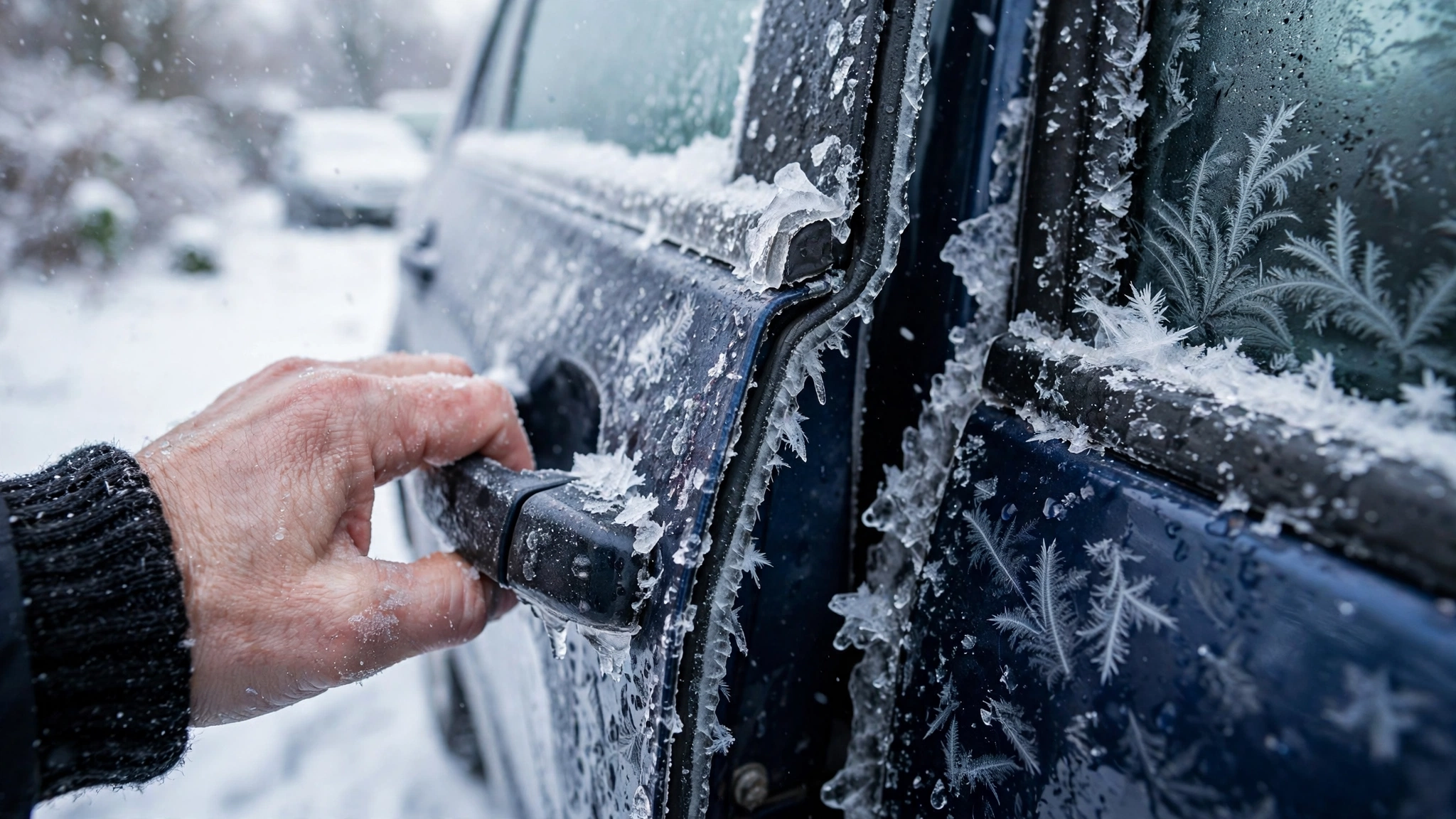
It was minus 12°F in Boulder, my Mazda 3 was covered in that crunchy half-inch glaze after an overnight ice storm, and I had a 7:15 a.m. client call. I yanked the driver’s handle and… nothing. Not locked. Frozen. The whole rubber seal had turned into a solid ice weld. I learned the hard way that day that yanking harder only rips the weatherstrip, and replacing a door seal on my Mazda cost me $87 and a Saturday I didn’t have.
After ten winters writing for carsrevamp.com/ and dealing with my own cars in Colorado, I’ve tried literally every internet “hack” — cooking spray, WD-40, Vaseline, even rubbing the seals with a dryer sheet. Most of them either make a mess, attract dust, or destroy your rubber in a season. Only three things have consistently worked for me and the readers who email me in January panicking.
They are: pure silicone spray for the seals, 303 Aerospace Protectant for long-term conditioning, and a proper lock / latch de-icer strategy so you don’t snap your key or burn out your door actuator. You don’t need all three every time, but if you do them in October, you’ll never be that person doing the frozen door shuffle in the parking lot again.

Why Your Car Door Actually Freezes Shut (It’s Not Just Cold)
It’s not the metal. It’s the moisture trapped in your EPDM rubber door seals. Those soft, hollow D-shaped and P-shaped weatherstrips are designed to compress and keep water out, but they also have tiny micro-pores. When you drive in rain, wash your car, or get that lovely freeze-thaw snowmelt, water sits in the channel between the seal and the painted door frame.
When temps drop below 32°F (0°C), that water expands about 9% as ice. It literally glues the seal to the paint. The colder it gets, the stronger the bond. My worst freeze was at -18°F after a car wash — I couldn’t even open the trunk.
Three other culprits make it worse:
- Worn seals with micro-cracks. Old rubber holds more water. If your car is 5+ years old, run your finger along the seal. If it feels tacky or you see small splits, it will freeze first.
- Missing paint protection. Bare or thin clear coat in the door jamb gives ice more tooth to grip.
- The latch and lock cylinder. The door might be free but the latch mechanism inside is iced. You pull, it feels stuck, and you blame the seal.
Trick #1: Pure Silicone Spray – The 15-Minute Barrier That Actually Works
This is the one I tell every neighbor about. It’s cheap, it’s fast, and if you use the RIGHT silicone, it doesn’t damage rubber like WD-40 or petroleum products do.
What You Need
- 100% silicone spray, water-based or dry formula (I use 3M Silicone Lube or Nextzett Gummi Pflege). Not WD-40 Silicone? Actually check the label — avoid anything that says “petroleum distillates.” Pure silicone should say “safe for rubber”.
- 2 microfiber towels, 12×12 inch
- Isopropyl alcohol 70% for cleaning
- Nitrile gloves (silicone makes your hands super slippery)
- 5mm plastic trim tool if you need to lift seal edges (optional)
Step-by-Step (Do This in Garage Above 40°F)
You’ll want about 15 minutes per car. I do all 4 doors plus trunk at once.
- Clean the seals. Open each door. Wipe the entire rubber seal with IPA on a microfiber. You’d be shocked how much black grime comes off. Let it dry 2 minutes. If you skip this, you’re sealing dirt into the rubber.
- Shake and spray lightly. Spray silicone onto the towel, NOT directly onto the seal. If you spray directly, you get overspray on headliner and glass and it smears for weeks. Light mist on towel.
- Wipe full circumference. Run the towel along the hollow bulb of the seal. Get the inner lip that touches the body. Do both sides — the seal on the door AND the seal on the body where applicable. On my Mazda, the rear doors have double seals — don’t miss the inner one.
- Buff. Wait 60 seconds, then buff with dry side. You want a satin sheen, not dripping wet.
- Don’t slam for 10 minutes. Let it cure. Keeps silicone from transferring to paint.
How long does it last? In dry Colorado winter, about 6-8 weeks. In salty Midwest slush, about 4 weeks. I re-apply Thanksgiving and again early January. Total cost: like $8.

Trick #2: 303 Aerospace Protectant – The Long Game for Rubber Conditioning
Silicone is your raincoat. 303 Aerospace is your skin moisturizer. If silicone prevents sticking today, 303 keeps the rubber from cracking and absorbing moisture all winter.
303 was originally made for aerospace seals and inflatable boats. It has UV blockers and anti-ozone additives that cheap tire shines don’t. It doesn’t leave a greasy film that attracts dust — that’s key, because dust + water = ice glue.
How I Apply It (Different Than Silicone)
- Wash first. 303 works best on clean rubber.
- Apply with foam applicator pad, not spray. Put a quarter-sized drop on pad.
- Work into seal in small circles. It’s thicker than silicone.
- Let haze 5 minutes, buff off. No greasy residue.
- Do this BEFORE silicone layer? Here’s my order that works: 303 first, wait 24 hours, then light silicone over top. On a newer car, you can just do 303 monthly and skip silicone unless you park outside in ice storms.
Tool sizes: if your door seal has a clip channel, some Toyotas and Subarus have 10mm bolts holding the retainer. For seal removal, use 10mm socket, 1/4″ drive, 89 in-lb max for plastic retainers. Don’t use impact!
Price: $18 for 16 oz bottle. It lasts me 2 winters for one car. Worth it. Silicone keeps it from freezing, 303 keeps it from dying.
Comparison Table: What Works vs. What Destroys Rubber
| Product | Freezes Protection (-20°F) | Rubber Safe? | Residue / Mess | Cost / Longevity |
|---|---|---|---|---|
| 100% Silicone Spray | Excellent (-40°F rated) | Yes | Low, satin finish | $7-12, 4-8 weeks |
| 303 Aerospace Protectant | Good, reduces water absorption | Yes, best for UV | None, matte | $16-22, 6-8 weeks |
| WD-40 (Original Blue Can) | Fair short-term | No – swells EPDM | Oily, attracts dust | $6, 1 week then damage |
| White Lithium Grease | Poor on vertical seals | No | Heavy white paste | $8, not for seals |
| Cooking Spray / PAM | Terrible | No, goes rancid | Sticky mess | $4, avoid |
| Vaseline / Petroleum Jelly | Okay barrier | Marginal, degrades over time | Greasy, smears glass | $3, not recommended |
You’ll feel the difference after silicone + 303. The door closes with that soft “thunk” again instead of a frozen crunch.
Trick #3: Lock De-Icer + Latch Prep (Because the Seal Isn’t Always the Problem)
Ever yanked and the door seal WAS free but the latch wouldn’t pop? That’s latch freeze. On my neighbor’s 2018 CR-V, the inner door latch cable froze inside its sheath. Handle moved but cable didn’t pull.
You need two things:
A. For the Lock Cylinder (if you have a keyhole)
Get graphite lock lubricant OR isopropyl-based lock de-icer (like Lock De-Icer from CRC). Never use WD-40 in a lock cylinder. It gums up wafers.
- Spray a quick 1-second puff into each lock cylinder in November.
- Insert key 5-6 times to distribute. On push-button cars, still lube the emergency keyhole hidden under handle cap — you will need it when fob battery dies at -5°F.
- Keep a 0.5 oz de-icer tube in your coat pocket, not in car. Doesn’t help if it’s frozen in glovebox.
B. For the Latch Mechanism
Open door, look where latch hooks. There’s a white lithium / silicone latch point. Spray a TINY amount of silicone into latch jaws, then open/close door 10 times. Wipe excess.
Torque warning: Door latch bolts are typically T30 Torx, 20 Nm (15 ft-lb). If you ever remove latch for deep clean, mark alignment with paint pen. Misaligned latch will make door hard to close in cold.
The Data: What Temperature Does Each Trick Actually Hold To?
I started logging this after that -12°F morning because I’m a nerd. Here’s what I’ve tracked over 3 winters with a $15 wireless thermometer stuck in my door jamb:
We charted average “first failure temp” — meaning the coldest night where door still opened without extra force after treatment two weeks prior. Untreated seals failed around 24-27°F if wet. Silicone-only pushed failure down to -8°F average. 303 alone got to about 5°F but kept seals softer. Silicone over 303 held to -18°F for me last January. Add lock de-icer on latch and you basically eliminate failures until -25°F unless you have standing water.
The chart basically looks like a staircase: no treatment is the basement, cooking spray slightly better but messy, WD-40 is a false hero, 303 is steady mid-level protection, silicone is the jump, and combo is the roof. If you park outside in Minnesota, you want combo. If you’re in Seattle where it’s wet but not super cold, 303 alone might be enough.
Full Winter Door Prep Routine (30-Minute October Ritual)
Here’s exactly what I do to my Mazda every late October, takes me 28 minutes start to finish:
- Wash door jambs — 5 min with car wash soap and toothbrush in seal channels.
- Dry thoroughly — leaf blower or towel, leave doors open 10 min in sun.
- 303 all seals — 10 min, 4 doors + trunk + hood seal.
- Next day: light silicone — 8 min wipe-down.
- Latch + locks + hinges — 5 min. I also hit door hinges with white lithium — 10mm and 12mm hinge bolts, torque 26 Nm (19 ft-lb) for body side, 20 Nm for door side on most Japanese cars.
Total time first time: 30 min. Re-applies: 10 min. You should feel smug when your coworkers can’t get in their cars.
What If It’s Frozen RIGHT NOW?
Okay, you’re already stuck reading this with a frozen door. Here’s my triage that doesn’t wreck anything:
- Push, don’t pull. Lean body weight gently into door to crack ice bond, then pull.
- Try another door, crawl through. Heat car from passenger side.
- Use lock de-icer on seal edge — alcohol in it melts thin ice.
- Remote start + heater full blast for 12-15 min. Aim vents to windshield defrost to warm jamb area indirectly.
- As last resort, warm (not hot) water in spray bottle at ~100°F poured along seal line, immediately dry and open. Then immediately do silicone wipe so tomorrow isn’t repeat.
Estimate Your Freeze Protection
Check what you plan to do. We’ll calc cost, time, and how cold you’ll be protected to.
Final Thoughts From My Freezer
I know it’s tempting to think “I’ll just pull harder.” I get it — you’re late. But door seals are literally the cheapest thing to protect vs. replace. That $9 can of silicone has saved me three seal replacements and at least five mornings of swearing in a dark parking lot.
Do the silicone if you do nothing else. If your car lives outside overnight, do silicone + 303 in October. If you have a keyhole or live where it hits -20°F, add that little $7 de-icer tube. You’ll feel the difference the very first morning the temps drop below freezing and your neighbor’s Camry is ice-welded shut but your Mazda pops open like it’s July.
Got a trick that worked for you? I’m always testing — last winter someone suggested parchment wax paper wipe on seals. Still skeptical, but I’ll try anything once. Stay warm and keep those doors swinging.
— Written by a guy who’s replaced enough EPDM weatherstripping in his driveway with a 10mm socket and a plastic trim tool to know it’s not fun. Torque your door check bolts to spec, wear nitrile gloves, and don’t spray silicone on your brake rotors. Ever.

Leave a Reply