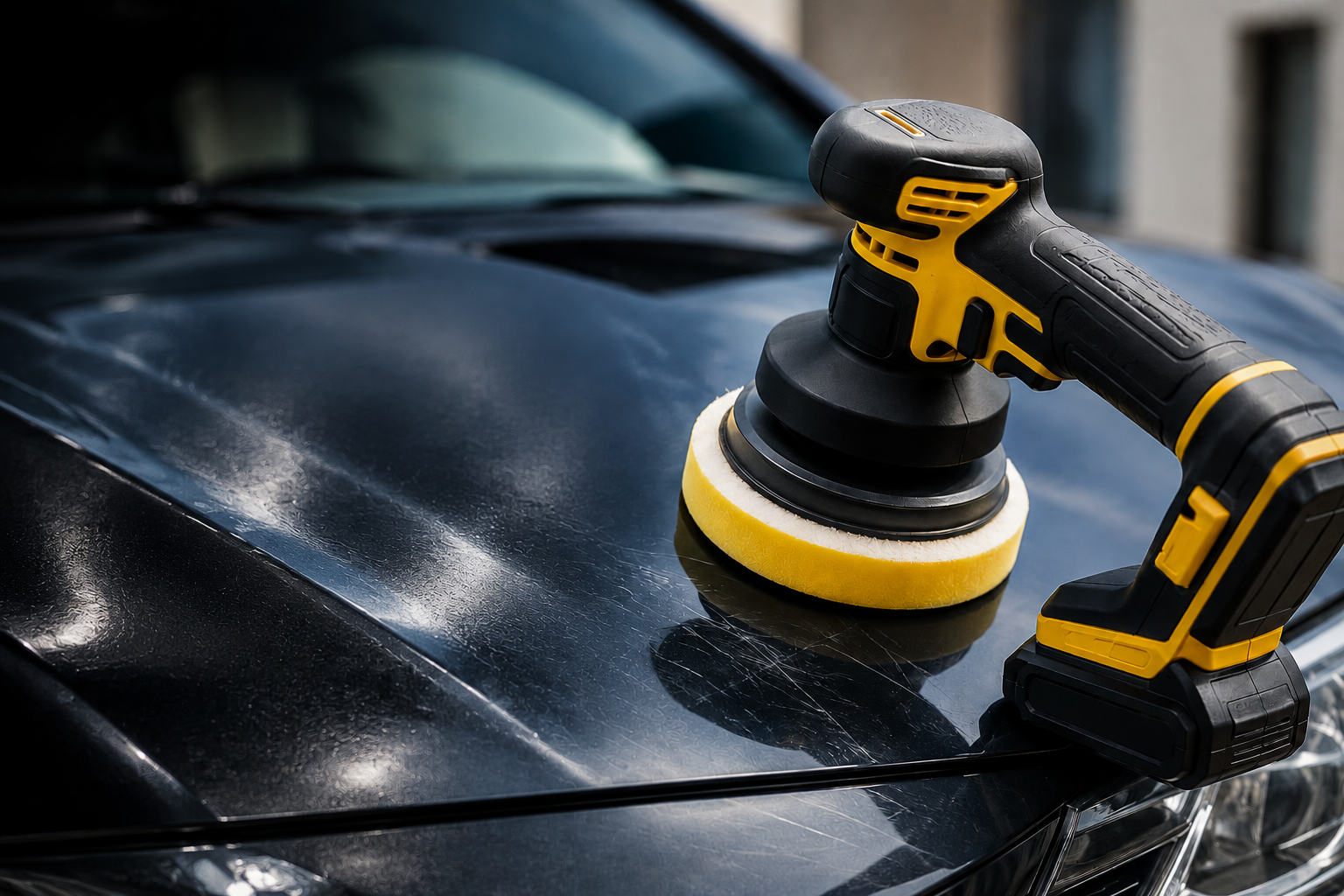
I’ve been swirl-hunting under shop lights for over fifteen years. Somewhere in that stretch I went from lugging a corded rotary buffer across the lot, tripping over extension cords, to running everything cordless. If you’d told me a battery-powered polisher could cut haze and lay down a mirror finish as well as my old corded rig, I would’ve laughed you out of the bay.
I was wrong. The cordless game caught up fast.
This guide is built the way I test everything else in my shop: hands on, panel by panel, comparing swirl removal, heat buildup, battery sag, and how the tool feels after twenty minutes of holding it over a hood. No spec-sheet guessing. Just what actually works when you’re the one holding the trigger.
I ranked these five from good to best. If you’re new to paint correction, start at #5 and work your way through the differences. If you already know your way around a foam pad, skip to #1.
How I Judged These Buffers
Before we get into the picks, here’s what I actually look for on a cordless polisher:
- Orbital throw — bigger throw means faster cutting, but more risk if you’re not careful
- RPM range — you want enough spread to go from heavy cutting to gentle finishing
- Battery runtime and heat — a buffer that dies or overheats mid-panel is useless
- Grip and balance — your wrist will tell you fast if a tool is nose-heavy
- Kit completeness — pads, cases, and backing plates you don’t have to buy separately
With that out of the way, let’s get into it.
#5. KIMO Cordless Car Buffer Polisher Kit (4-Inch)

This one’s my pick for anyone dipping a toe into DIY detailing for the first time. The 4-inch pad size is smaller than the rest of this list, and that’s actually a feature, not a limitation, if you’re working on trim pieces, mirrors, or tight body lines where a 6-inch pad just won’t sit flat.
I ran this on a customer’s hatchback that had some light oxidation on the rear bumper. Small panel, tight curves. The compact head got into spots my bigger buffers couldn’t touch without me tilting the pad and risking uneven pressure.
Where it falls short: on a full hood or roof, the smaller pad means more passes and more time. If you’re correcting an entire car, this becomes a workout. I’d call this a great “starter kit” or a solid backup tool for detail work, not your only buffer if you’re doing full vehicles regularly.
Good for:
- First-time DIYers testing the waters
- Small panels, mirrors, tight trim
- Anyone who wants a lightweight, easy-to-control tool
Not ideal for:
- Full-car correction jobs
- Heavy oxidation removal on large panels
#4. Cordless Car Buffer Polisher Kit (6-Inch, 21V)

- 【CORDLESS CAR BUFFER POLISHER】Our car polishing kit allows you to say…
- 【EFFICIENT POWER】The car buffers and polishers kit equipped with 50W of…
Step up to a 6-inch pad and a 21V motor, and now we’re talking about a tool that can actually handle a full car in a reasonable amount of time. I put this through a two-stage correction on a daily-driver sedan with moderate swirl marks in the clear coat, and it held up.
The 21V battery gave me enough runtime to finish a hood and both front fenders before I needed a swap. That’s roughly on par with what I expect from a mid-tier cordless buffer in this class.
One thing I always check on a 6-inch buffer: does it bog down under pressure? This one holds RPM reasonably well as long as you’re not leaning on it like you’re trying to strip paint. Let the pad do the work, keep your pressure light, and it stays consistent.
Garage note: the backing plate on this unit runs a little warmer than I’d like after 15+ minutes of continuous use on one panel. Nothing dangerous, just something to keep an eye on if you’re doing back-to-back panels without a break.
Good for:
- Full sedans and small SUVs
- DIYers ready to move beyond a starter tool
- Two-stage correction (cutting, then finishing)
#3. Cordless Car Buffer Polisher (6″ DA Orbital, Touchscreen, 21V, 2×4.0Ah)

Now we’re getting into the tools I actually reach for on paying jobs. This is a dual-action (DA) orbital, which matters if you care about protecting your paint while you work. A DA head oscillates and spins at the same time, so it’s far more forgiving than a straight rotary if your technique isn’t perfect yet.
The touchscreen speed control surprised me. I expected it to be a gimmick, but it actually makes dialing in RPM faster than fumbling with a dial while wearing detailing gloves. You glance down, tap, and you’re at the right setting for the pad and compound you’re running.
Dual 4.0Ah batteries mean you’re not stuck mid-job waiting on a charge. I ran this across an entire crossover, swapping batteries once, and never felt like I was racing a dying tool.
Real shop test: I used the higher speed range to knock down moderate oxidation on a faded roof, then dropped to a lower setting with a finishing pad to remove the haze that cutting always leaves behind. That two-step process is where this tool earns its spot on this list. It transitions between aggressive and gentle work without feeling like two different tools.
Good for:
- DIYers who want rotary-level cutting power with DA-level safety
- Full paint correction jobs, not just spot fixes
- Anyone tired of swapping tools mid-project
#2. Cordless Car Buffer Polisher (6″ DA Orbital, 21V, 2×3.0Ah, 25-Piece Kit)

- 【Newly Upgraded 2026 polisher for car detailing】Our cordless polisher…
- 【8-Speed Adjustable, LED Display】The buffer polisher supports…
This is the one I’d hand to a buddy who just bought his first project car and wants to do the whole correction himself, start to finish, without a shopping list of accessories after the fact.
The 25-piece kit is what pushes this to #2. You get multiple pad types (cutting, polishing, finishing), backing plates, a case, and enough accessories to actually run a full three-stage correction without ordering anything else. I’ve seen plenty of buffers that are great tools but leave you buying pads separately, and that always bugs me. This one doesn’t.
Like the #3 pick, it’s a DA orbital, so it’s forgiving on paint if your hand pressure isn’t perfectly consistent yet. The dual 3.0Ah batteries are a step down in capacity from the 4.0Ah pack on #3, but I still got through a full sedan without stopping to recharge mid-panel.
Where I tested it: a used car dealership prep job, three cars, back to back. The kit had every pad I needed already in the case. That’s a real time-saver when you’re on a schedule and don’t want to be digging through a toolbox mid-job.
Good for:
- DIYers who want a complete, no-extra-purchases kit
- Multi-car projects or dealership-style prep work
- Three-stage correction (cut, polish, finish) in one box
#1. SundpeyPRO Brushless Cordless Car Buffer Polisher (6″, 8000RPM)

- Lightweight & Cordless Design : SundpeyPRO car buffers and polishers kit…
- 8000RPM Brushless Motor: SundpeyPRO cordless car polisher is equipped with…
This is the buffer I keep closest to my bench, and it’s the one I grab first when a car rolls in with real correction needs, not just a quick once-over.
The brushless motor is the difference-maker here. Brushed motors lose power as they heat up over a long job. Brushless motors don’t have that same drag, so the tool keeps its torque steady from the first panel to the last. On a long correction session, that consistency matters more than almost anything else on the spec sheet.
8000RPM puts this at the top end of what you want for a 6-inch DA polisher. That headroom means it can chew through moderate-to-heavy oxidation on the high end, then drop down for a swirl-free finishing pass without straining.
I ran this on a decade-old truck with sun-baked, chalky clear coat, the kind of job that makes you second-guess whether the paint is even savable. Full cutting pass at the top of its RPM range brought back real gloss. Dropped the speed, swapped to a finishing pad, and the haze that cutting compounds always leave behind came right out.
Battery and grip: the brushless design also runs cooler, which stretches your runtime per charge. And the balance point sits right in your palm instead of out toward the pad, so your wrist isn’t fighting the tool after twenty straight minutes on a roof.
If I could only own one cordless buffer for the rest of my career, this is the one I’d keep.
Good for:
- Serious DIYers and side-hustle detailers
- Heavy oxidation and deep swirl correction
- Anyone who wants pro-level consistency without a compressor and cord
Use the tool below if you want a quicker answer based on your project type and experience level.
Find Your Buffer Polisher Match
Answer two quick questions and I’ll point you to the pick that fits your project.
1. What’s your experience level?
A Few Garage Rules Before You Buy
A buffer is only as good as the technique behind it. A few things I tell every DIYer who buys their first one:
- Let the tool do the work. Leaning on it doesn’t cut faster, it just builds heat and risks burning through clear coat.
- Keep the pad moving. Sitting in one spot, even for a few extra seconds, is how you get a hologram or a hot spot.
- Match pad to compound. A cutting pad with a finishing polish, or a finishing pad with heavy cutting compound, wastes both.
- Check your panel temperature by hand. If a section feels warm to the touch, move on and come back later.
- Keep a microfiber towel handy to wipe test spots and check your progress under good light, not shop fluorescents.
Which One Should You Actually Buy?
If you’re brand new, start with #5 or #4. If you’re serious about doing full correction jobs on your own cars, or you’re building out a side hustle, the top three on this list are where the real value sits. My personal pick, and the one I keep on my own bench, is the SundpeyPRO at #1.

Leave a Reply