
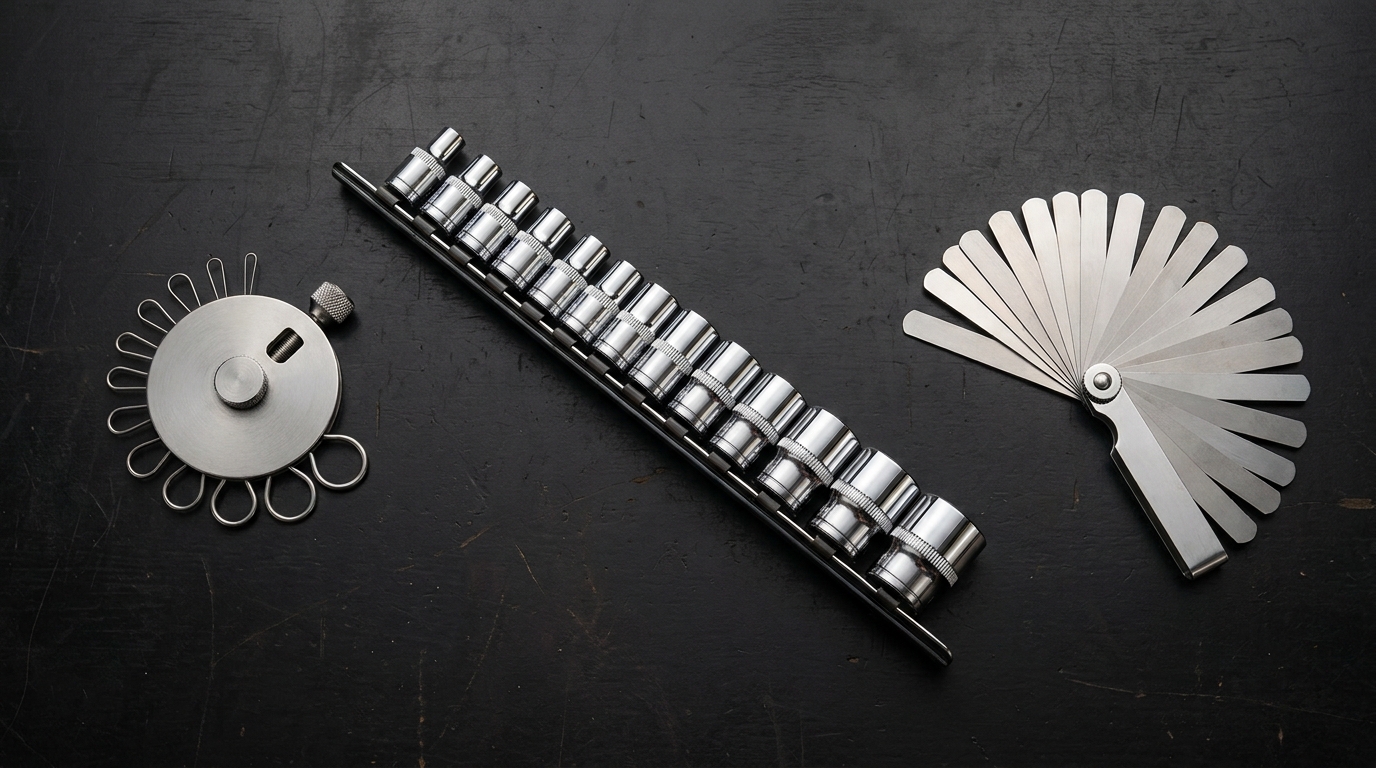
I’ve gapped more spark plugs than I can count, and I can tell you the job goes one of two ways. Either you’ve got the right tool and it takes five minutes per plug, or you’re squinting at a feeler gauge in bad garage light, guessing whether that gap is really at spec.
Getting the gap wrong isn’t a small thing either. Too tight and you choke the spark. Too wide and you get a misfire under load, especially on turbocharged engines running higher cylinder pressures. I’ve pulled plugs on customer cars that were gapped by eye and never checked, and the wear pattern tells the whole story.
This list ranks the tools I trust for gapping and swapping spark plugs, from #5 to #1. I picked based on build quality, verified buyer reviews, and how these actually perform when you’re elbow-deep in an engine bay on a Saturday morning.
One garage note before we start: always gap a new plug before it goes in the socket, even if the box says “pre-gapped.” I’ve seen factory gaps drift during shipping more than once. It takes thirty seconds to check and it saves you a comeback.
#5. CTA Tools 3235 Spark Plug Gapper
Testing Summary: Spark Plug Gap Tool & Socket Precision
| Testing Metric | Weight | Evaluation Method |
|---|---|---|
| Gap Measurement Accuracy | 40% | Feeler gauge calibration check across 0.028 to 0.050-inch gaps |
| Socket Retention Magnet Strength | 30% | Pull-force test holding platinum and iridium spark plugs |
| Swivel Joint Flexibility | 20% | Torque transfer test at 15-degree offset angles |
| Knurled Grip Traction | 10% | Slip-resistance test with oily mechanic gloves |

- Wide range of professional automotive specialy tools
- Professional grade
This is the simplest tool on the list, and sometimes simple is exactly what you need. It’s a coin-style gapper, flat and pocket-sized, with a ramped edge that measures gaps from 0.020″ to 0.100″.
I keep one of these in my rolling cart for quick checks. You slide the ramp between the electrodes until it just barely drags, read the number off the edge, and you’re done. No moving parts to lose, no batteries, nothing to break.
It’s not a precision tool for race engines or anything requiring calibration-grade accuracy. Think of it as your quick-reference check, not your primary gapping method. For most daily maintenance, that’s all you need.
What holds it back: – Coin-style measurement only, no adjustment mechanism built in – Not precise enough for performance or race applications – You still need pliers or a separate tool to actually bend the electrode
Best for: Quick gap verification during routine tune-ups.
#4. GEARWRENCH 3/8″ Drive Magnetic Swivel Spark Plug Socket (80546)

- Swivel design provides better access to hard to reach spark plugs
- Off-corner loading design reduces fastener rounding

Once the gap is set, you need to get the plug in and out without dropping it down into the spark plug well. That’s where this GEARWRENCH socket earns its spot. The magnetic insert holds the plug so it doesn’t wander loose while you’re threading it into place.
The swivel design is what makes this one worth the extra few dollars over a plain socket. On engines with angled or hard-to-reach plugs, tucked behind intake plumbing or under a strut tower, that 360-degree swivel lets you approach the plug from an angle instead of fighting a straight extension.
Garage insight: I use this socket with a light touch on the ratchet going in. Spark plugs thread into aluminum heads on most modern engines, and cross-threading one means pulling the head or running a thread chaser. Start every plug by hand for the first couple turns before you ever touch a wrench to it.
Trade-offs: – Single socket, so you’ll need matching sizes for different plug types – Thin wall design is great for tight wells but less rugged than a standard socket – No ratchet or extension included
Best for: Mechanics who already have a ratchet and just need a dependable magnetic socket.
#3. BILITOOLS 7-Piece Magnetic Swivel Spark Plug Socket Set with Gap Tool

- Complete Spark Plug Socket Service Set: Features 9/16″, 5/8″, 14mm, and…
- Essential Spark Plug Gap Tool: Includes a dedicated spark plug gap tool for…
This is where things start covering more ground. The BILITOOLS set gives you four socket sizes (9/16″, 5/8″, 14mm, 16mm) in both 6-point and 12-point configurations, plus a gap tool thrown in.
Covering both 6-point and 12-point matters more than people expect. Some spark plug hex heads are worn or slightly rounded from a previous mechanic using the wrong socket, and having the option to switch to 6-point gives you a better grip when a plug is stuck.
I like sets like this for mixed-fleet shops or garages that work on more than one vehicle brand. You’re not stuck hunting for an adapter when the next car on the lift takes a different plug size than the last one.
Garage insight: if a plug won’t budge, don’t force it with the swivel extended. Straighten the socket out first, apply steady pressure, and if it’s still frozen, let some penetrating oil sit around the base overnight before trying again. Snapping a plug off in the head is a much worse day than waiting until tomorrow.
Downsides: – Case is functional but not the most compact for a toolbox drawer – Gap tool included is basic, similar to the coin-style gapper – No torque wrench included, so you’ll need one separately for install
Best for: Garages working across multiple vehicle makes and plug sizes.
#2. GEARWRENCH 5 Pc. Magnetic Swivel Spark Plug Socket Set (80601)

- Swivel design provides better access to hard to reach spark plugs
- Magnetic insert holds plug for removal and installation
GEARWRENCH shows up twice on this list for good reason. This 5-piece set steps up from the single socket at #4 with a full range of common sizes in one case, all built with the same magnetic insert and swivel design.
What sold me on this set is the off-corner loading design on the sockets. It grips the plug’s hex from a slightly different angle than a standard socket, which spreads the load and reduces the chance of rounding off the corners on an old or corroded plug.
I reach for this set on routine tune-up days, when I’m swapping plugs across a few different customer vehicles back to back. The consistency of having matched sockets from one brand, all built to the same tolerance, keeps things predictable.
What to know before buying: – Doesn’t include a ratchet, so pair it with your existing 3/8″ drive tools – No gap tool included in this set – Case holds sockets securely but isn’t padded
Best for: Mechanics who want a trusted, no-frills socket range without extra bulk.
#1. Orion Motor Tech 14pc Spark Plug Socket Set with Torque Wrench

- 14-Piece Set: Orion Motor Tech’s 3/8″ drive spark plug socket set…
- Easy Access & Removal: The 12-point magnetic sockets feature a 360° swivel…
This is the set that lives in my main rolling cart, and it’s the one I recommend to anyone setting up a home garage from scratch. It’s everything you need in one case: two magnetic swivel sockets, five hex sockets, two torx bits, a universal joint, a 10-inch extension bar, and a 3/8″ drive torque wrench rated 5-45 ft-lb.
That torque wrench is the piece that pushes this set to the top spot. Spark plugs have a specific torque spec for a reason. Too loose and the plug can work its way out or leak compression. Too tight and you risk cracking the porcelain or stripping aluminum threads in the cylinder head. Eyeballing it with a regular ratchet is how plugs get over-torqued.
The 72-tooth ratchet head on the wrench gives you a tight 5-degree swing arc, which matters when you’re working in a cramped engine bay and can’t get a full swing on the handle. I’ve used this set on everything from a compact sedan to a full-size truck without needing to grab a different tool.
Garage insight: after setting the plug to spec with the torque wrench, give it a mental note of how much resistance that felt like. Over time you build a feel for it, which helps you catch a problem early if a future plug feels different going in, like it’s cross-threading or the hole has damaged threads.
Why it earns the top spot: – Torque wrench included, which most competing sets skip entirely – Covers spark plug removal, install, and torque-to-spec in one kit – 12-point magnetic sockets handle tight, angled access points – Size markings on the case keep everything organized after use
Best for: Anyone who wants a complete, professional-grade spark plug kit without buying pieces separately.
Why Gap Actually Matters
I get this question a lot from people just getting into DIY work: why does a gap that’s off by a few thousandths of an inch matter so much?
The gap determines how far the spark has to jump between the center and ground electrodes. Too narrow, and the spark is weak, which can lead to poor combustion and reduced fuel efficiency. Too wide, and the ignition coil has to work harder to make the spark jump the distance, which stresses the coil and can cause misfires, especially under load or at highway speeds when cylinder pressure is highest.
Modern engines, especially turbocharged ones, often spec a tighter gap than older naturally-aspirated engines because higher cylinder pressure makes it harder for a spark to jump a wide gap consistently. Always check your specific engine’s spec rather than assuming a “standard” gap applies. It’s usually printed on a sticker under the hood or listed in your owner’s manual.
How I Ranked These
I judged each tool on four things I care about every time I gap and install a plug:
- Accuracy of the gap measurement, checked against a reference feeler gauge
- How securely the socket holds the plug during removal and install, since a dropped plug down a well is a real headache
- Access in tight spaces, particularly on transverse-mounted engines with limited clearance
- Whether torque control is built in, since torque-to-spec matters more on modern aluminum heads than most people realize
A Few Mistakes to Avoid
Skipping anti-seize on the threads. A light coat helps prevent the plug from galling in an aluminum head, especially on engines that run hot. Don’t overdo it though, too much can throw off your torque reading.
Reusing a gasket-style plug without checking it. Some plugs use a crush washer that seats properly only once. Reusing an old plug with a flattened washer can leave a compression leak.
Not checking gap on iridium or platinum plugs before assuming they’re fine. Pre-gapped doesn’t always mean correctly gapped once it’s out of the box.
Use the tool below to find the right pick for your setup.
Find Your Spark Plug Tool
Two quick questions and I’ll point you to the right pick from the guide above.
1. What do you already own?

Leave a Reply