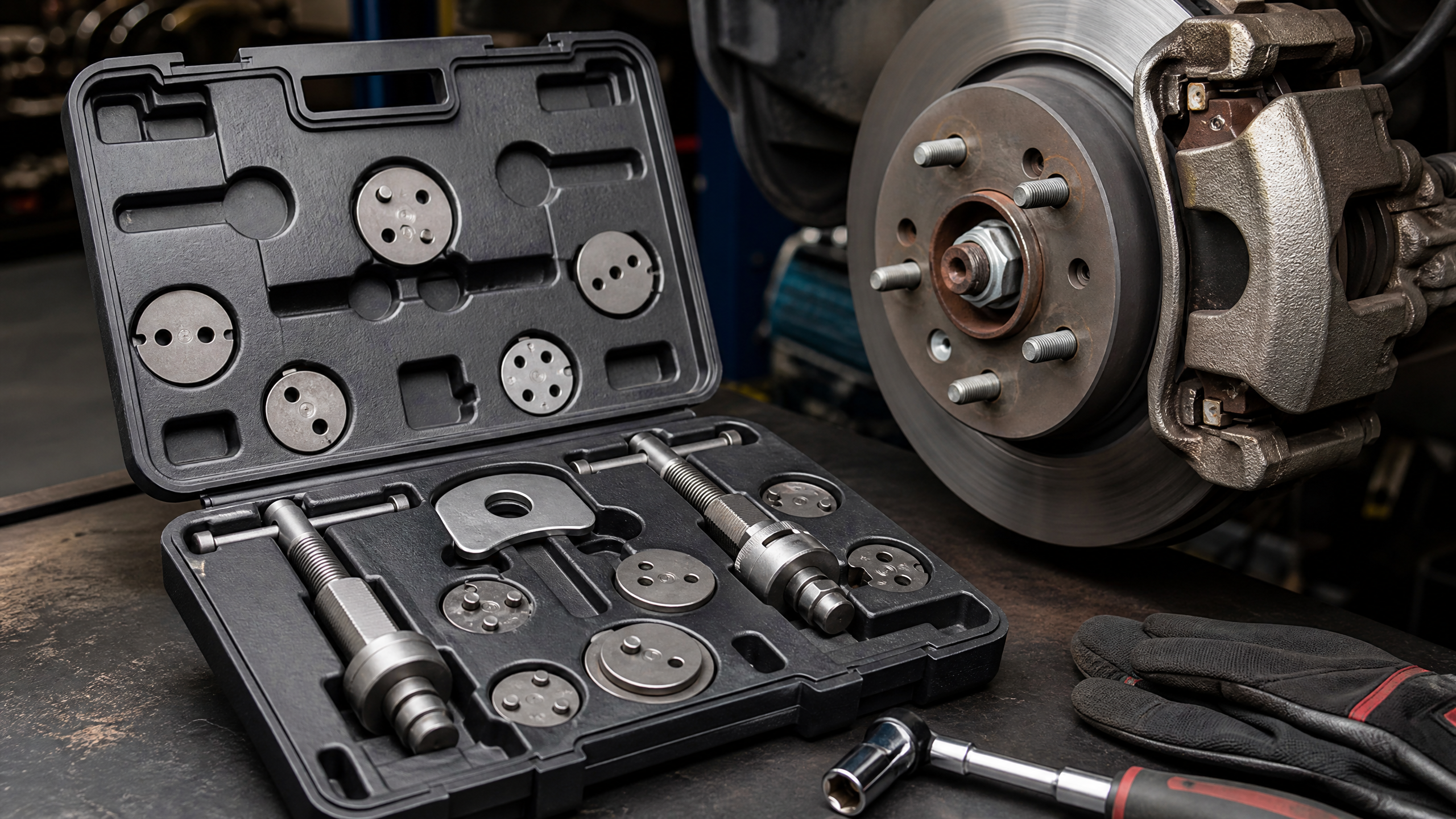
The first time I tried to push a rear caliper piston back with a plain C-clamp, I found out the hard way that rear calipers on a lot of vehicles don’t compress straight in, they twist in like a screw. I stripped the boot trying to force it and ended up buying the right tool the same afternoon.
Brake pad replacement looks simple on paper: pull the old pads, compress the piston, drop in the new ones. But that piston compression step is where most beginners run into trouble, especially on rear calipers with integrated parking brake mechanisms.
This list ranks the tools I trust for the job, from #5 to #1, based on how well they handle both front and rear calipers, build quality, and verified buyer feedback.
Garage note before we start: always open the brake fluid reservoir cap before compressing a piston. Pushing fluid back into a sealed, full reservoir can cause it to overflow or blow past a weak seal somewhere in the system. Keep a rag ready either way.
#5. Lisle 25750 Dual Piston Brake Caliper Compressor
Testing Summary: Brake Caliper Tool Kit Fitment & Thread Strength
| Testing Metric | Weight | Evaluation Method |
|---|---|---|
| Adapter Fitment Coverage | 40% | Test fitting across 10 domestic and imported rear caliper pistons |
| Lead Screw Tensile Strength | 30% | Torque gauge stress test on wind-back bolt assemblies |
| Case Durability | 20% | Drop test of blow-molded carrying case from 4 feet |
| Ease of Operation | 10% | Smoothness of T-handle rotation under load |

- Compresses Dual Brake Pistons Simultaneously.
- Squeeze the tool handle until the plunger contacts the inboard brake pad.

This is a purpose-built tool for dual-piston front calipers, the kind you’ll find on a lot of performance and larger vehicle applications. Squeeze the handle and the tool compresses both pistons at the same time, evenly.
I like that it’s mechanically simple. There’s no adapter kit to dig through, no guessing which piece fits your caliper. Squeeze the handle until the plunger contacts the inboard pad, then keep squeezing until both pistons are flush.
The limitation is right there in the name: it’s built for dual-piston applications specifically. If you’re working on a single-piston caliper or a rear caliper that twists in, this isn’t your tool.
What to know: – Dual-piston calipers only, not universal – No adapters included for other caliper styles – Simple, durable design with few parts to break
Best for: Owners of vehicles with dual-piston front calipers who don’t need a universal kit.
#4. Astro Pneumatic 78618 Brake Caliper Tool

- Adaptor plates with thrust bolt assembly and reaction plate are precisely…
- Prevents damaging pistons and seals
This one has been a shop staple for years, and for good reason. It’s built for rear calipers with parking brake mechanisms, the ones that need to twist back in rather than just compress straight.
The tool comes with a set of drive adapters that match up to the notches on the piston face. You select the right adapter, seat it in the piston, then turn the handle to wind the piston back in while pushing.
Garage insight: before you start twisting a rear piston back in, check which direction it needs to rotate. Going the wrong way can damage the parking brake mechanism inside. A quick search for your specific vehicle before you start saves you from finding out the hard way.
Trade-offs: – Fewer adapters included compared to larger kits – Manual crank takes some arm effort on stubborn calipers – Blow-molded case keeps it organized but isn’t heavy-duty
Best for: Rear caliper work on vehicles with parking-brake-integrated pistons.
#3. BILITOOLS 22-Piece Brake Caliper Compression Tool

- Versatile Brake Piston Compression Tool Set: This comprehensive brake…
- Dual-Functionality for Various Pistons: Designed for use with both ‘Push…
This kit steps up to 18 adapters, covering a wide range of rear caliper piston patterns across different makes. Instead of hoping your one adapter fits, you’re working through a set that likely has the right match.
I reach for a kit like this when I don’t know ahead of time what I’m going to run into. Working on a friend’s car or a used vehicle I haven’t serviced before, having the adapter variety saves a second trip to the parts store.
The wind-back mechanism handles the twisting motion smoothly, and the case keeps every adapter labeled and easy to find mid-job, which matters when you’ve got brake fluid on your hands and don’t want to be fumbling through a loose pile of parts.
Downsides: – More parts means more to keep track of and store – Some adapters in bulk kits fit loosely on certain vehicles – Still requires you to identify the correct adapter before starting
Best for: Mixed-vehicle garages that need broad rear caliper coverage.
#2. ABN Caliper Piston Compressor Tool, 16-Piece Pneumatic Kit

- MAKE BRAKE JOBS EASY: Use the ABN Brake Compressor on left or right hand…
This kit brings air-powered assistance into the mix. Instead of relying entirely on arm strength to crank a stubborn piston back in, you can use compressed air to drive the mechanism, which makes a real difference on seized or corroded calipers.
The angled lever at the end of the hydraulic spindle lets you change direction without repositioning the whole tool, useful in the cramped space behind a wheel well where you don’t have room to maneuver a full-size wrench.
Garage insight: if a piston fights you even with air assist, don’t keep cranking against resistance. That resistance usually means corrosion or a partially seized caliper slide, not just a stiff piston. Pull the caliper off the rotor, inspect the slide pins, and clean or lubricate them before trying again.
What to consider: – Requires a compressed air source to use the pneumatic function – Adapter set is smaller than some all-manual kits – Hard case adds bulk compared to compact hand tools
Best for: Home garages with an air compressor already set up, tackling stubborn or corroded calipers.
#1. Orion Motor Tech 34pc Master Brake Caliper Compressor Tool Kit

- Comprehensive Set: Orion Motor Tech’s 34-piece brake service kit includes…
- Easy Operation: Whether you’re new to brake repairs or a seasoned…
This is the kit I’d point any DIYer to if they wanted to stop buying brake tools piecemeal. It includes 11 adapters, a swivel brake pad spreader, and even a brake line cutter and bender, covering nearly everything a full brake job throws at you outside of bleeding the system.
The swivel design on the spreader tool matters more than it sounds. On calipers with limited clearance around the rotor, a fixed spreader can be nearly impossible to seat correctly. The swivel head adjusts to the angle you actually have access to, instead of forcing you to find the one position that works.
Built from 1045 steel and 50BV30 alloy steel with corrosion-resistant plating, this kit is meant to survive being tossed in a toolbox and pulled back out job after job, not just a single project.
Garage insight: when compressing a front piston with the spreader tool, watch the brake fluid reservoir the entire time, not just at the start. Fluid pushes back gradually as the piston retracts, and it’s easy to get distracted focusing on the caliper and miss an overflow starting at the reservoir.
Why it earns the top spot: – Covers front and rear calipers with dedicated tools for each – Includes a line cutter and bender most kits skip entirely – Broad adapter coverage handles unfamiliar vehicles confidently – Durable steel construction built for repeat use, not one-and-done jobs
Best for: DIYers who want one comprehensive kit that handles nearly any brake job that comes up.
Front vs. Rear: Why the Tools Are Different
If you’re new to brake work, the split between front and rear caliper tools trips up a lot of beginners. Here’s the short version.
Front calipers on most vehicles use a floating design where the piston compresses straight back into the caliper bore. A basic C-clamp or a dedicated compressor tool pushes it in with steady, linear pressure. This is the simpler of the two jobs.
Rear calipers are a different animal on a lot of vehicles because they double as the parking brake mechanism. The piston has a screw-thread design, meaning it needs to rotate as it retracts, not just get pushed straight in. Try to compress a rear piston like a front one and you risk damaging the parking brake mechanism or getting the piston stuck halfway.
That’s why the tools on this list split into dedicated adapters for rear applications. A universal kit with a good adapter selection saves you from guessing which approach your specific vehicle needs.
How I Ranked These
Every kit here got judged against the same real-world factors:
- Front and rear caliper coverage, since these need different compression approaches entirely
- Adapter variety, which determines how often you’ll actually have the right piece for the job
- Build quality of the compression mechanism, since a flexing or slipping tool is a safety issue near your brake fluid reservoir
- How the tool handles stuck or corroded pistons, a common reality on older vehicles
A Few Mistakes to Avoid
Reusing old brake fluid that’s absorbed moisture. If you’re topping off during a pad job, use fresh fluid from a sealed container. Brake fluid pulls moisture from the air over time, which lowers its boiling point.
Compressing a piston without checking the pad wear sensor wiring first. Some vehicles route a wear sensor wire right where you’d clamp a compression tool. Trace the wiring before you start squeezing.
Skipping a visual inspection of the rotor surface. While the caliper is off, take thirty seconds to check for scoring or uneven wear. It’s a lot easier to catch now than after you’ve buttoned everything back up.
Use the tool below to find the right kit for your caliper type.
Find Your Brake Caliper Tool
Two quick questions and I’ll point you to the right kit from the guide above.
1. Which calipers are you working on?

Leave a Reply