
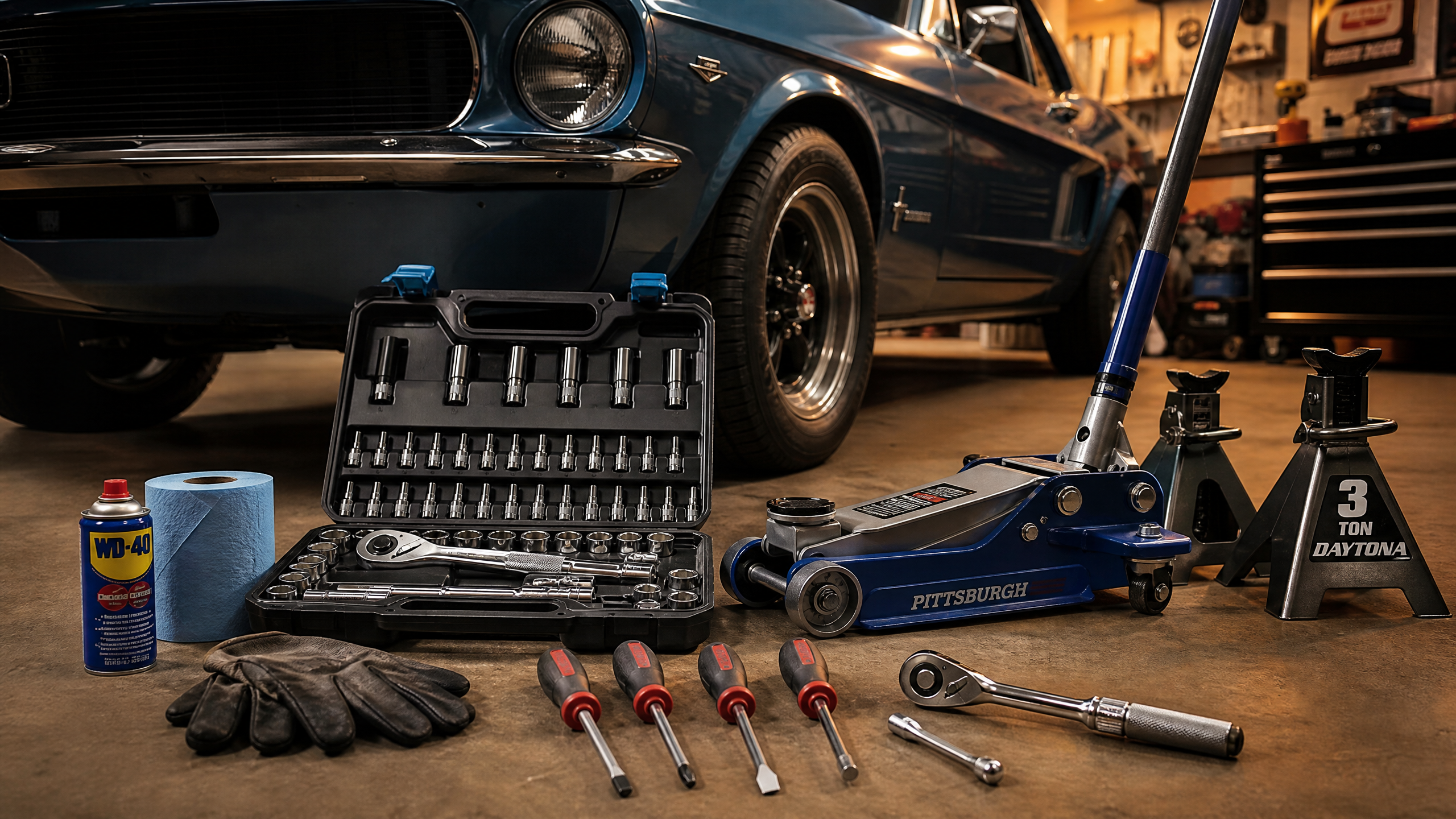
I remember the first time I tried to change my own brake pads. I had a rusty ratchet set from a garage sale and a jack that looked like it came out of a war movie. It took me four hours and I still had to call a buddy to borrow a torque wrench I didn’t know I needed.
Every mechanic starts somewhere, and most of us start under-equipped. The good news is you don’t need a $3,000 toolbox to start working on your own car. You need a short list of tools that actually get used, week after week, on real jobs.
I’m ranking these #10 to #1, building up to the tool I’d tell any beginner to buy first if they could only buy one thing.
Garage note up front: before you touch anything electrical or under the hood, know where your battery terminals are and always disconnect the negative terminal first if you’re doing wiring work. That one habit prevents a lot of sparked fingers and blown fuses.
#10. IRWIN VISE-GRIP 4-Piece Pliers Set

- Anti-pinch, non-slip ProTouch Grips provide comfort, control, and less hand…
- Nickel chromium steel construction for overall strength and durability

Pliers don’t get much love, but you’ll reach for them constantly. This set gives you diagonal cutters, slip joint, long nose, and groove joint pliers, which covers about 90% of what a beginner needs.
I use the long nose pliers constantly for pulling cotter pins and reaching into tight spaces where my fingers won’t fit. The groove joint pliers handle hose clamps and stubborn fittings without chewing them up.
Best for: General grabbing, cutting, and bending tasks around the garage.
#9. GEARWRENCH Rechargeable LED Work Light

- 500 lumen rechargable work light with charging stand
- Front facing dual 250 & 500 lumen rating with COB technology
You cannot fix what you cannot see. Half the frustration beginners feel under a car comes down to bad lighting, not bad wrenching skills.
This light hangs from a hook, sits on a magnetic base, or clips to a fender, which matters when you’re working solo and need both hands free. Rechargeable means no scrambling for batteries mid-job.
Garage insight: position your light behind the part you’re working on, not directly on it. A light shining straight at a bolt creates a glare that hides the exact edge you’re trying to see.
Best for: Any job under the hood or under the car, especially in a dim garage.
#8. TOPDON TopScan Lite OBD2 Scanner

- Bi-Directional Control, Quickly Locate Problems: Turn your phone into a…
- Flexible Subscription, Choose Advanced Features as Needed: TopScan Lite…
This is the tool that turns guessing into diagnosing. Modern cars throw codes for a reason, and plugging a scanner into that port under the dash tells you exactly what system triggered the check engine light instead of throwing parts at the problem.
I always tell beginners: plug into the OBD-II port before you start troubleshooting anything electrical or engine-related, even if the check engine light isn’t on. Pending codes and freeze frame data can catch a problem before it fully surfaces, showing you the exact engine conditions, RPM, and load the moment a fault happened.
This scanner also supports basic resets, so you can clear a code after a repair and confirm it doesn’t come back.
Best for: Diagnosing check engine lights and confirming a repair actually fixed the problem.
#7. BIG RED Torin 3-Ton Steel Jack Stands
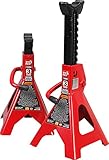
- Lightweight jack stands are used to support your vehicle after lifting with…
- This car jack stand is constructed of high-grade forged steel with a welded…
A floor jack lifts your car. It should never hold your car up while you’re underneath it. That’s what jack stands are for, and skipping them is one of the most dangerous shortcuts a beginner can take.
These stands have a multi-position ratchet bar that locks into place once you’ve set your height, giving you a solid, mechanical connection instead of relying on hydraulic pressure alone.
Garage rule I never break: jack up the car, set the stands, then lower the car onto the stands and remove the jack entirely. Never work under a vehicle supported only by a jack.
Best for: Any job that requires getting underneath the car safely.
#6. Torin T83006W Blackjack Hydraulic Floor Jack

- Hydraulic trolley floor jack is constructed with heavy duty steel…
- Features a 3 ton (6,000 lb) capacity with a minimum lifting height of…
Pair your jack stands with a jack that can actually lift the car high enough to work under. This one has a 3-ton capacity and a lifting range up to nearly 21 inches, which covers most cars, trucks, and SUVs.
The single piston quick-lift pump gets you to height fast without a dozen pumps on the handle. Steel casters let you roll it into position instead of wrestling it across the garage floor.
Best for: Lifting the vehicle before setting jack stands for any under-car work.
#5. TEKTON 3/8″ Drive Micrometer Torque Wrench

- Includes 1-pc. 3/8 in. drive torque wrench; Storage case; Product manual…
- Wrench emits a click that can be heard and felt when the preset value is…
Bolts have a spec for a reason. Over-tighten a lug nut or a caliper bracket bolt and you can strip the threads or crack a component. Under-tighten it and it can work loose while you’re driving.
This wrench covers 10 to 80 ft-lb, which handles most of what a beginner tackles: wheels, brake components, suspension hardware. It clicks audibly and gives you a tactile feel when you hit your target torque, so you’re not guessing.
Garage insight: always torque in the sequence specified for your application, especially on wheels and cylinder heads. A star or crisscross pattern spreads the clamping force evenly instead of warping the part you’re tightening.
Best for: Any job with a torque spec, which is most of them.
#4. DEWALT 168-Piece Mechanics Tool Set
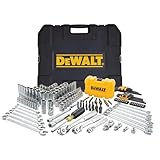
- PRECISION PERFORMANCE – Help prevent rounding of fasteners with sockets…
- WORK IN TIGHT SPACES 72-tooth count rachets provide a 5 degree arc swing…
This is the backbone of a beginner’s toolbox. It includes three 72-tooth ratchets, deep and shallow sockets in both SAE and metric, and a full set of combination wrenches, all in a case that keeps everything organized.
The 72-tooth ratchet head matters more than people expect when you’re starting out. It gives you a 5-degree swing arc, meaning you can turn a bolt in tight spaces where a full swing isn’t possible.
I recommend a set like this over buying tools piecemeal because you’ll actually have the right size when you need it, instead of running to the store mid-job.
Best for: The foundation of any home garage, covering the bulk of bolt sizes you’ll encounter.
#3. GEARWRENCH 232-Piece Mechanics Tool Set with 3-Drawer Storage Box

- 72-tooth teardrop shaped head with on/off switch allows more access in…
- Quick release design makes it easy for rapid socket removal
If you’re serious about building out a full garage setup from day one, this is worth the jump up from a smaller starter set. It includes 90-tooth ratchets with just a 4-degree swing arc, tighter than the DEWALT set above, plus a full bit socket offering with hex, torx, and external torx sizes.
The 3-drawer storage box is what separates this from a soft case. Independent sliding drawers with locking side flaps mean your tools stay put even if you need to move the whole box around the garage or toss it in a truck bed.
Garage insight: off-corner loading sockets, which this set includes, grip the flat sides of a bolt head instead of just the corners. That reduces the chance of rounding off a fastener that’s already a little worn.
Best for: Building a comprehensive, organized toolbox that can grow with you.
#2. Innova 3340 Professional Automotive Digital Multimeter
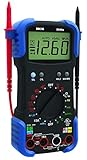
- Designed to pinpoint engine problems; tests alternator diodes, duty cycle…
- Features auto-ranging, auto shut-off and over-load protection
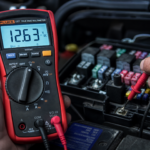
A huge share of frustrating car problems come down to electricity you can’t see: a battery that won’t hold a charge, a corroded ground, a dead sensor. This multimeter is built specifically for that kind of troubleshooting.
Beyond standard voltage and resistance readings, it measures RPM, dwell, and temperature, and includes an inductive pickup for reading engine speed without connecting directly into the ignition circuit.
Garage insight: when checking for a parasitic battery drain, set the meter to DC amps and connect it in series between the negative battery terminal and the cable, never in parallel like you would for a voltage check. Getting this backwards can blow the meter’s fuse or damage the meter entirely.
Best for: Diagnosing electrical gremlins, testing batteries and alternators, and checking sensors.
#1. A Full Socket, Ratchet, and Wrench Set (Start Here)

- Low profile ratchet: up to 25% thinner head* for access in tight spaces…
- All in one mechanics set: contains a full assortment of sockets, ratchets…
If I could only tell a beginner to buy one thing, it’s the foundational mechanics tool set from #4 or #3 on this list. Everything else on this list supports that core set. Your torque wrench needs sockets to attach to. Your jack and jack stands get you access to bolts that a socket set removes. Your multimeter and scanner diagnose problems that a wrench then fixes.
Before you buy specialty tools, make sure your basics are solid: a full range of SAE and metric sockets, a couple of ratchets in different sizes, and a set of combination wrenches. That combination handles the overwhelming majority of jobs a beginner takes on, from oil changes to brake jobs to swapping an alternator.
Garage insight: buy tools in sets when you’re starting out, not individually. A matched set from one manufacturer fits together consistently, and you avoid the gap-filling problem of realizing mid-job that you own every socket size except the one you need right now.
Why this tops the list: every other tool on this ranking depends on it. It’s the one purchase that makes every future repair possible.
Building Your Garage in Order
If you’re starting completely from zero, here’s the order I’d buy in:
- Mechanics tool set (sockets, ratchets, wrenches) — the foundation
- Jack and jack stands — needed for most under-car work
- Torque wrench — protects everything you tighten
- Work light — you can’t fix what you can’t see
- OBD2 scanner and multimeter — diagnose before you repair
- Pliers set — fills in the small grabbing and cutting tasks
You don’t need all six on day one. Buy what your next project actually requires, and the garage builds itself over time.
Use the tool below to figure out what to buy first based on your situation.
What Should You Buy First?
Tell me where you’re starting and what you’re working on.
1. What do you already have?



Leave a Reply