Electrical problems are the ones that make grown mechanics sweat. A worn brake pad tells you exactly what’s wrong the second you look at it. A parasitic drain killing your battery overnight could be coming from a dozen different circuits, and you won’t find it by guessing.
I’ve chased more phantom electrical gremlins than I want to admit, and every time, the difference between a fast diagnosis and a wasted weekend came down to having the right multimeter and knowing how to actually use it.
This list ranks the multimeters I trust for automotive work, from #5 to #1, based on accuracy, build quality, safety rating, and how well they handle the specific demands of chasing shorts and drains in a vehicle’s wiring.
Garage note before we start: when checking for a parasitic draw, never connect your multimeter in parallel like you would for a voltage check. For current readings, the meter goes in series, between the disconnected negative battery cable and the terminal. Connecting it wrong can blow the meter’s internal fuse instantly.
WIDE APPLICATIONS: This AstroAI digital multimeter features 6000 counts…
MULTIFUNCTION: Features smart functions, Low battery prompt, Data…
This is where I point beginners who want a capable meter without spending pro-tool money. It’s True RMS with 6000 counts of resolution, auto-ranging, and covers the full spread of AC/DC voltage, current, resistance, continuity, capacitance, and temperature.
The LED intelligent jack system is a nice touch for anyone new to multimeters. Switch the dial and the correct input jack lights up, so you’re not second-guessing which port your probe belongs in before you touch a live circuit.
I keep one of these in my glove box for quick roadside checks: battery voltage, alternator output, fuse continuity. It’s not the meter I reach for on a deep diagnostic dive, but for the price, it covers a wide range of everyday automotive checks.
Where it’s limited: – Not rated for the CAT III 1000V environments some pro meters handle – Build quality is solid but not built for daily drop-and-abuse shop conditions – Backlight and display are good, but not best-in-class in bright sunlight
Best for: Beginners and DIYers who want broad functionality without a big price tag.
Designed to pinpoint engine problems; tests alternator diodes, duty cycle…
Features auto-ranging, auto shut-off and over-load protection
This is a meter built specifically for the engine bay, not adapted from general electrical work. Beyond standard voltage and resistance, it adds RPM measurement, dwell angle, and a temperature probe, features a general-purpose meter simply doesn’t have.
The included inductive pickup reads engine RPM without connecting directly into the ignition circuit, including on coil-on-plug vehicles. That’s genuinely useful for diagnosing rough idle or misfire conditions alongside your scan tool.
Garage insight: use the dwell angle function when troubleshooting older points-style ignition systems or when checking duty cycle on certain solenoids and injectors. It’s a feature most general multimeters skip entirely, but automotive techs rely on it more than you’d expect.
Trade-offs: – Automotive-specific features add bulk you won’t use for general electrical work – Auto-ranging is convenient but occasionally slower to settle than manual ranging – Color LED battery check is handy but not a substitute for a proper battery load test
Best for: Engine and ignition-specific diagnostics beyond basic voltage and resistance checks.
Klein Tools built their name on tools designed by electricians for electricians, and that shows in the MM400. It’s auto-ranging and covers AC/DC voltage, current, capacitance, frequency, duty-cycle, diode testing, and continuity, plus temperature via an included thermocouple probe rated to 1000°F.
I like this meter for chasing shorts because the display is genuinely easy to read in a dim engine bay, and the housing is built to survive a drop onto concrete, which happens more often than any of us like to admit.
Garage insight: for continuity checks on a suspected short, always work with the circuit fully de-energized and the fuse pulled first. Testing a live circuit for continuity can give you a false reading and, worse, can damage the meter if there’s voltage present where you’re expecting none.
What to know: – No dedicated automotive features like RPM or dwell – Continuity and resistance share the same dial position, requiring a button press to switch between them – Slightly pricier than general-purpose meters at this resolution
Best for: Chasing shorts, opens, and continuity issues with a trusted, professional-trade brand.
Product Overview The compact 35XP-A Digital Multimeter offers all the right…
It measures temperature, plus capacitance for motor run/start test, and…
This is a meter that crosses over from HVAC and plant maintenance work into automotive diagnostics well, particularly for capacitance testing and fine resolution down to 0.1 microfarads, useful when you’re testing components like AC blend door actuators or certain relay circuits.
Amprobe has a long track record in industrial test equipment, and the 35XP-A carries that build quality into a compact handheld form. It’s the kind of meter that ends up in a lot of professional test kits precisely because it doesn’t cut corners on internal components.
Garage insight: when testing a suspected bad ground, measure voltage drop across the ground connection under load, not just resistance with the circuit off. A ground that reads fine with an ohmmeter can still cause problems under actual current draw. Running the circuit and checking for unexpected voltage drop catches problems a static resistance check misses.
Trade-offs: – Marketed more toward HVAC and plant maintenance than automotive specifically, though the core functions overlap well – No automotive-specific features like RPM or dwell – Interface is functional but less flashy than some newer meters
Best for: Anyone who wants professional-grade accuracy and capacitance testing without automotive-only limitations.
True-RMS and a 6000-count display in a compact meter
40 MΩ resistance measurement capability
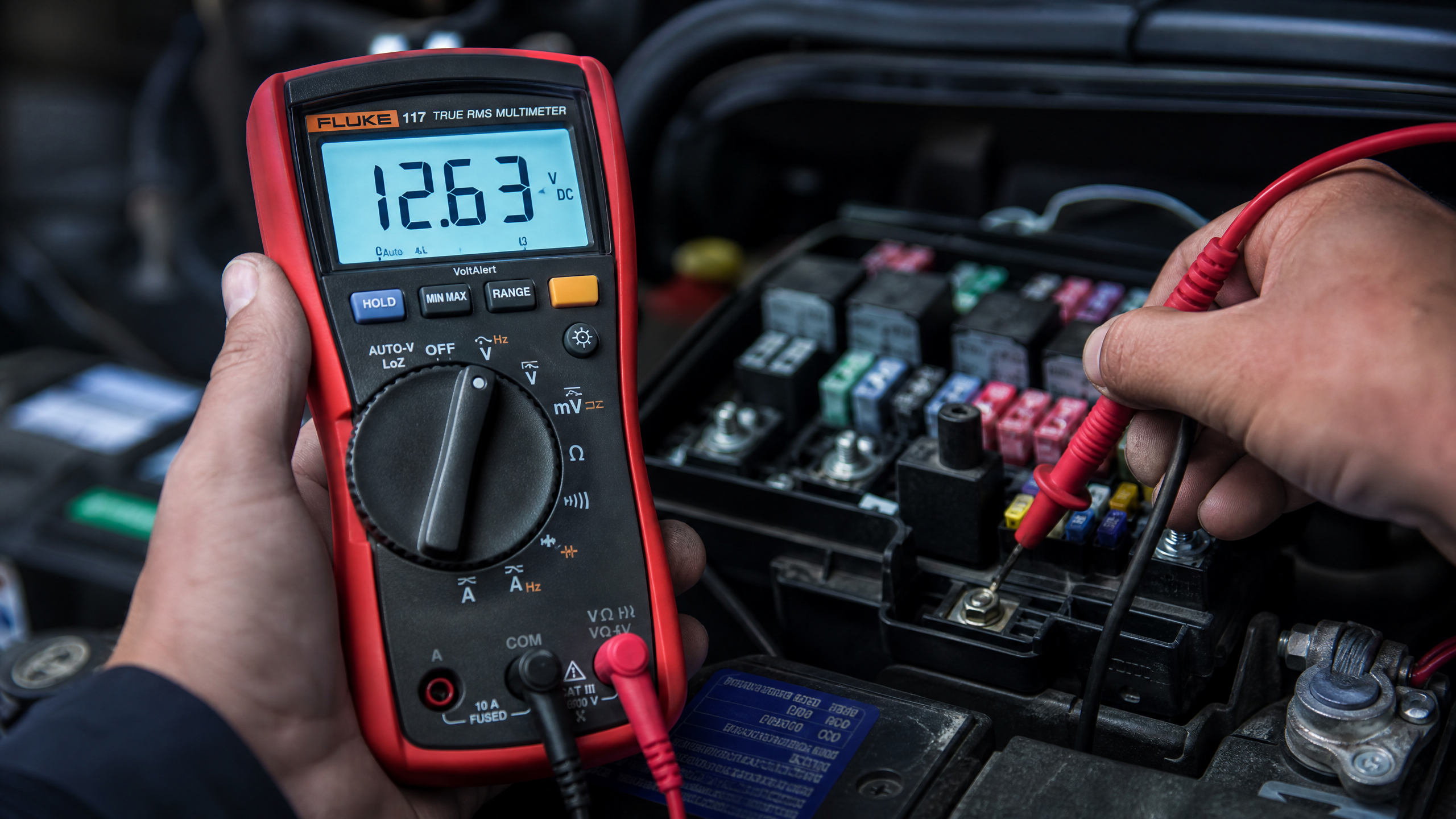
Fluke earned its reputation the hard way, by building meters that survive years of daily shop abuse without drifting out of accuracy. The 115 is the compact, general-purpose model, and it’s the meter I trust most when I need a reading I can stake a diagnosis on.
It displays True RMS voltage and current with 6000-count resolution, tests diodes, frequency, continuity, and capacitance, and adds Min/Max/Average recording to catch signal fluctuations you’d otherwise miss watching a live display. That matters when you’re chasing an intermittent short that only shows up under vibration or load.
The large white LED backlight genuinely helps in a poorly lit garage or under a dash where factory lighting doesn’t reach. Combine that with CAT III 600V safety testing, and this is a meter rated for real automotive electrical work, not just bench testing.
Garage insight: use the Min/Max function when chasing an intermittent electrical gremlin. Clip the meter onto the suspect circuit, set it to record, and go drive the car or wiggle the harness the way the customer described the fault happening. A voltage spike or dropout that lasted a fraction of a second gets caught by the meter even if you never saw it happen live.
Why it earns the top spot: – Longevity that customers report decades of reliable use from older Fluke models – True RMS accuracy that holds up on noisy automotive electrical signals – Min/Max/Average catches intermittent faults a standard reading would miss – CAT III 600V safety rating built for real-world testing conditions
Best for: Anyone who wants the most trusted, accurate multimeter for serious automotive electrical diagnostics.
This is a technique I use constantly and one every beginner should learn early. A voltage drop test finds resistance in a circuit that a static ohm reading can miss entirely.
Here’s how it works: with the circuit powered on and under normal load, you measure voltage between two points that should, in a perfect connection, read close to zero. A headlight ground circuit, for example, should show almost no voltage drop between the bulb’s ground wire and the actual chassis ground. If you’re seeing half a volt or more, you’ve found resistance, usually from corrosion, a loose connection, or a damaged wire, even if a static resistance check on that same connection looked fine with the power off.
Garage insight: this technique is how I find most parasitic corrosion issues on older vehicles, especially around ground straps and battery terminals that look clean on the surface but have corrosion building up underneath the connection point. A five-minute voltage drop test across a few key grounds can save hours of chasing a phantom electrical gremlin.
How I Ranked These
Every meter here got tested against the same real diagnostic criteria:
Accuracy and resolution, checked against a known reference source
Safety rating, since automotive electrical work involves live circuits and battery current
Automotive-specific usefulness, whether that’s RPM measurement or simply a rugged housing that survives shop conditions
How well it catches intermittent faults, since a lot of real-world electrical gremlins don’t show up on a single static reading
Common Multimeter Mistakes to Avoid
Leaving the meter set to measure current when you touch it to a voltage source. This is the single fastest way to blow a fuse inside your meter. Always double-check your dial setting and probe placement before touching a live circuit.
Assuming a zero-ohm reading means a good connection. Corroded or partially loose connections can sometimes still read low resistance while failing badly under actual current load. When in doubt, check voltage drop under load instead of just static resistance.
Skipping the fused current input warning. Most meters have a warning label near the amp input jack about maximum current. Automotive circuits, especially starter and charging circuits, can exceed what a handheld meter’s fuse is rated for. Use a proper clamp meter for high-current circuits instead.
Use the tool below to find the right multimeter for your diagnostic needs.
Find Your Automotive Multimeter
Two quick questions and I’ll point you to the right meter from the guide above.
Alex Mercer is a dedicated automotive researcher, DIY mechanic, and the lead creator behind CarsRevamp. Having spent years diagnosing electrical issues, performing routine fluid flushes, and installing aftermarket modifications on a variety of domestic and import vehicles, Alex focuses on breaking down complex car repair manuals into simple, actionable steps. His goal is to empower everyday drivers to handle their own vehicle maintenance and upgrades safely and confidently.









Leave a Reply