
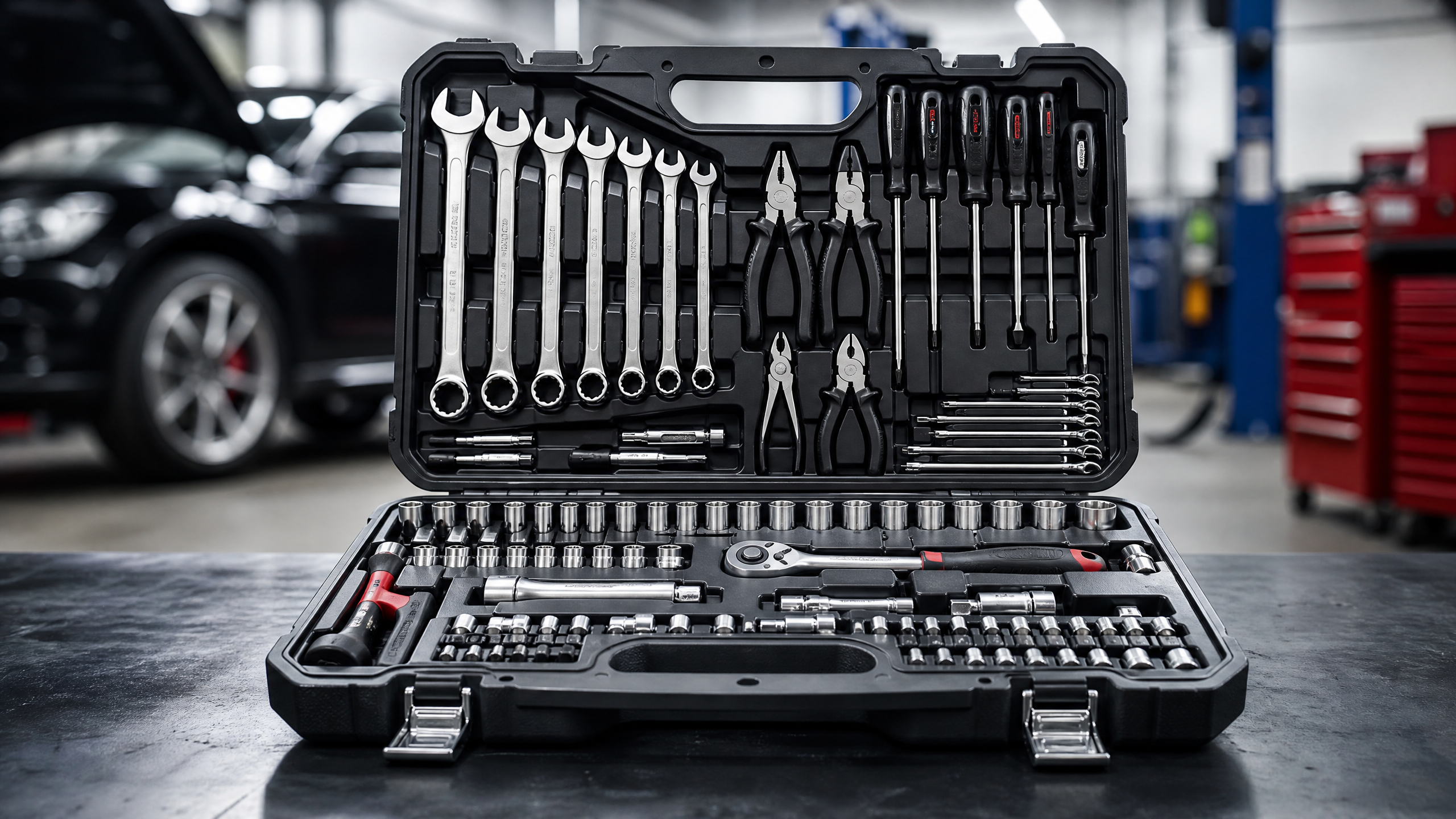
Essential Tools Every Car Owner Needs: DIY Maintenance Kit Guide
My first toolbox was a red plastic tackle box with a socket set so cheap the chrome was already flaking off the ratchet handle. It got me through oil changes and not much else — the first time I tried to break loose a stuck lug nut, the ratchet mechanism just gave up. I’ve replaced almost everything in that original kit at least once, usually after learning the hard way why the cheap version wasn’t worth it.
This guide is built in tiers on purpose. You don’t need a full mechanic’s chest to change your own oil or swap a battery. You need the right dozen or so pieces, bought once, in decent quality, so they’re still working the tenth time you reach for them.
Tier 1: The Basics Everyone Should Own
This is the stuff that handles 80% of what a car owner actually runs into — a dead battery, a loose interior panel, checking your own fluids.
Tier 1 Kit
- Socket set, 3/8″ drive, SAE and metric — most American cars mix both standards under the hood, so don’t buy metric-only or SAE-only (shop)
- 10mm socket (extra one) — buy at least two, because it’s the single most commonly used size and also the one that vanishes into the void of every garage floor (shop)
- Screwdriver set — a handful of flathead and Phillips sizes, plus one stubby version for tight spaces (shop)
- Digital tire pressure gauge — the little pencil-style analog gauges drift out of accuracy fast (shop)
- Jumper cables or a portable jump-starter pack — the battery pack version is worth the extra cost, since you don’t need a second car around (shop)
- Basic OBD-II code reader — plugs into the port under your dash and tells you why the check engine light is on, instead of guessing (shop)
- Nitrile gloves and shop rags — cheap, and they save your hands and your car’s interior from grease (shop)
- Flashlight or headlamp — a headlamp specifically, so both hands stay free (shop)
Tier 2: For Real DIY Maintenance
Once you’re ready to do your own oil changes, brake pads, or filters, this is where the money actually goes toward tools that save you real shop labor costs.
Tier 2 Kit
- Torque wrench, 3/8″ drive, 10–80 ft-lb range — over-torquing a drain plug or lug nut is one of the most common DIY mistakes, and this is the fix (shop)
- Ramps or a floor jack + jack stands (pair) — never trust a jack alone to hold a car up while you’re underneath it, full stop (shop)
- Oil filter wrench — sized to your specific filter, since a generic strap wrench slips on some filter housings (shop)
- Drain pan — a wide, low-profile one clears easier under a lifted car than a deep bucket (shop)
- Funnel set — different sizes for oil, coolant, and washer fluid; don’t cross-contaminate by using the same one for everything (shop)
- Wire brush and battery terminal cleaner — corrosion on battery terminals causes more “mystery” electrical problems than people realize (shop)
- Multimeter — for checking battery voltage, fuses, and basic wiring issues before you start guessing and swapping parts (shop)
Tier 3: For the Owner Who Wants to Go Further
This tier is for people who’ve done a few brake jobs already and are ready to tackle bigger stuff — suspension work, more involved electrical diagnosis, bigger fasteners that need real leverage.
Tier 3 Kit
- Breaker bar — for stuck lug nuts and rusted fasteners a standard ratchet won’t budge (shop)
- Impact driver or impact wrench — electric or air-powered, makes quick work of anything seized (shop)
- Flare wrench (line wrench) set — a regular open-end wrench rounds off brake line fittings; a flare wrench grips more of the fitting’s flats and prevents that (shop)
- Pry bar set — for stubborn trim, seized brake calipers, and suspension bushings (shop)
- Torque wrench, larger range (up to 150 ft-lb) — for lug nuts and bigger suspension bolts where your Tier 2 wrench maxes out (shop)
- Full trim removal tool set — more shapes and sizes than the basic kit, for deeper interior and body work (shop)
Build Your Own Toolkit
Not everyone needs every tier. Pick the level that matches what you actually plan to do, and I’ll total up a rough starting budget.
Toolkit Builder
Storage Matters More Than People Think
A good tool you can’t find is a bad tool. You don’t need a $500 rolling cabinet on day one — a foam-lined toolbox or even a labeled tackle box keeps sockets from rolling around and going missing. I finally switched to foam organizer trays a few years back, and I genuinely save ten minutes a job just not hunting for the right size socket.
A Quick Note on Quality Over Quantity
A 200-piece mechanic’s set sounds impressive in a red plastic case, but a lot of those pieces are odd specialty bits you’ll never touch. I’d rather own 25 tools I trust completely than 200 where half of them are guesses about what someone might someday need. Buy the pieces you’ll actually use, in a quality that won’t round off a bolt head or snap under real torque, and add specialty tools only when a specific job calls for one.
Prices are rough averages for mid-quality tools and will vary by brand, region, and whether you catch a sale.


Leave a Reply