
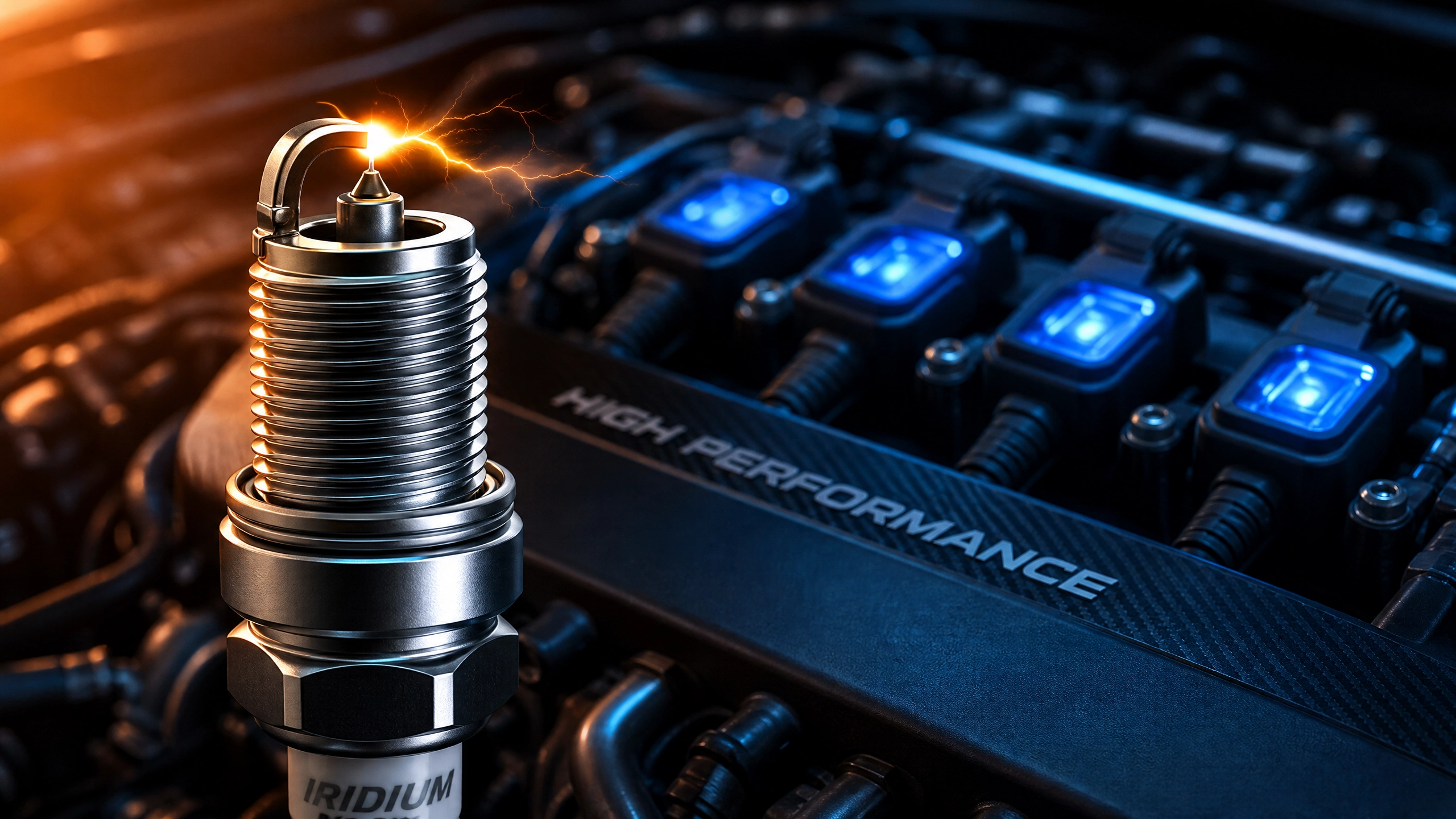
Most drivers never think about their spark plugs. Not once. They’ll obsess over tire pressure, argue about oil brands, and rotate their tires like clockwork, but the plugs just sit there, quietly doing their job, until they don’t.
You’ll know the moment it happens. The engine starts idling like a washing machine stuffed with bricks. Or you try to pass a semi on the highway and the car stutters and bucks instead of pulling smooth. That’s not a “check engine light eventually” problem. That’s your ignition system waving a white flag.
I’ve been wrenching on cars for years, on my own project builds and on friends’ daily drivers that just needed to survive the commute. And if there’s one thing I’ve learned, it’s that the ignition system is never just a maintenance item. It’s a performance part, whether your car is stock or pushing 500 horsepower through a turbo.
I remember chasing a nasty high-RPM misfire on a turbo build of mine. I’d already thrown money at injectors and a bigger turbo, but I left the stock coils and basic copper plugs in place. The car ran fine at idle and fell apart the second I leaned on it. Swapped in a proper coil-on-plug setup, dropped in colder iridium plugs with a tighter gap, and the engine woke up like someone flipped a switch. That one job taught me to stop treating ignition parts as an afterthought.
This guide covers what I’ve learned the hard way: which plug material actually fits your engine, why heat range can make or break a turbo build, how ignition systems evolved into what’s under your hood today, and how to gap and maintain plugs without wrecking them. Grab a coffee. Let’s get into it.
Spark Plug Materials: Copper, Platinum, and Iridium
The metal used on the center electrode is the single biggest factor in how a spark plug performs and how long it lasts. Walk into any auto parts store and you’ll see copper, platinum, and iridium options sitting side by side, usually with a big price gap between them. That price difference is there for a reason.
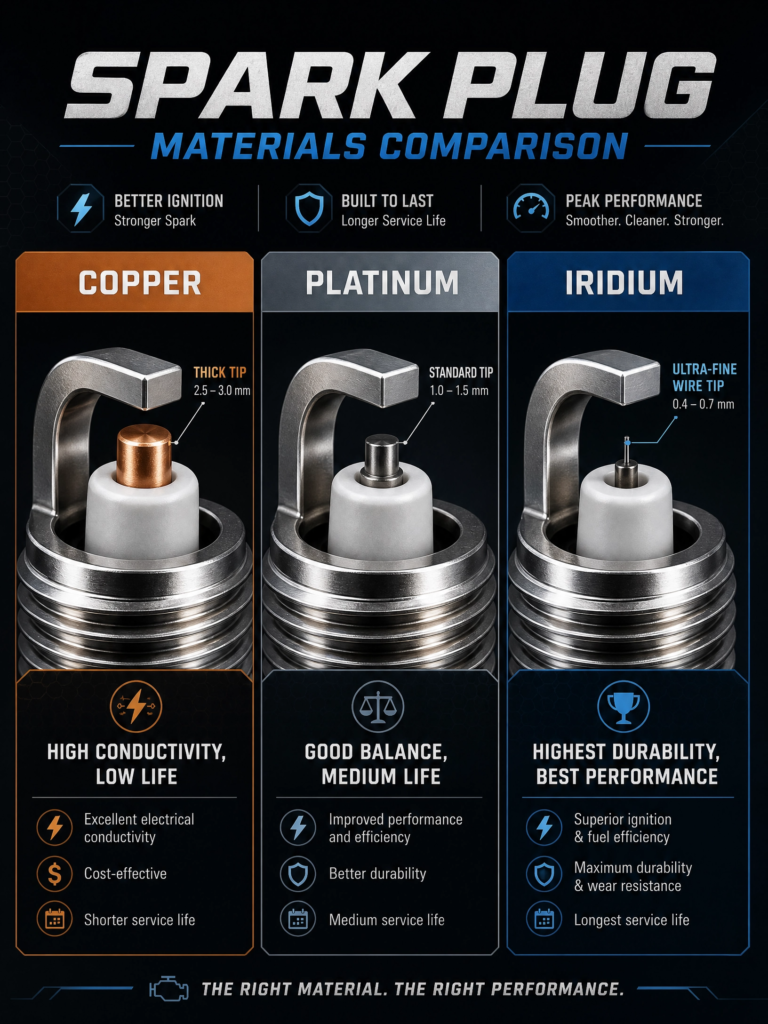
Copper spark plugs are the old-school standard, and they’re still around because copper conducts electricity beautifully. A copper plug throws a strong, fat spark with very little resistance. That’s exactly why you’ll still find them in drag cars and dedicated race engines, where the plug gets swapped every few runs anyway.
The catch is durability. Copper is a soft metal, and a soft metal sitting in a 2,000-degree combustion chamber wears out fast. I’ve pulled copper plugs out of daily drivers at 20,000 miles looking like they’d been through a war. Great conductor, short lifespan. Fine for racing, rough for a car you drive every day.
Platinum spark plugs showed up to fix that longevity problem. Manufacturers weld a small platinum disc onto the center electrode (and sometimes the ground electrode too, in “double platinum” plugs), and platinum shrugs off heat and electrical erosion way better than copper does. These plugs routinely run past 60,000 miles before they need attention.
The tradeoff is that platinum doesn’t conduct quite as well as copper. For a commuter car or a family SUV that just needs to start every morning and sip fuel efficiently, that tradeoff is the right one to make.
Iridium spark plugs are where things get interesting, and they’re the reason I run them in almost everything I own now. Iridium is roughly six times harder than platinum and about eight times stronger, with a melting point over 1,200 degrees Fahrenheit higher. That strength lets manufacturers shave the center wire down to a fraction of the thickness of a copper or platinum tip.
Here’s why that tiny wire matters so much: a thinner electrode concentrates the electrical arc into a much smaller, more focused point, almost like a lightning rod pulling a strike to one exact spot. That focused spark needs less voltage to fire, which means your ignition coils aren’t working as hard every single time they fire. Less strain on the coils, a cleaner burn, and a plug that can realistically last 100,000 miles in the right application. That’s why iridium has become the default choice in most modern engines, especially anything with forced induction.
| Material | Conductivity | Longevity | Best Application |
|---|---|---|---|
| Copper | Excellent | Low (~20k miles) | High-performance racing, older vehicles |
| Platinum | Good | Medium (~60k miles) | Daily drivers, extended maintenance intervals |
| Iridium | Very Good | High (~100k miles) | Modern engines, maximum efficiency, forced induction |
Spark Plug Recommendation Quiz
Here is a personalized tool to help you find your ideal spark plug based on your driving style and vehicle needs:
🔧 Find Your Perfect Spark Plug
Answer a few quick questions to get personalized recommendations
Heat Range: Cold vs. Hot Spark Plugs Explained
Heat range trips up more DIY guys than almost anything else in the ignition system, and I get it. The name is misleading. “Heat range” has nothing to do with how hot the spark itself burns. It’s about how fast the plug pulls heat away from its tip and dumps that heat into the cylinder head.
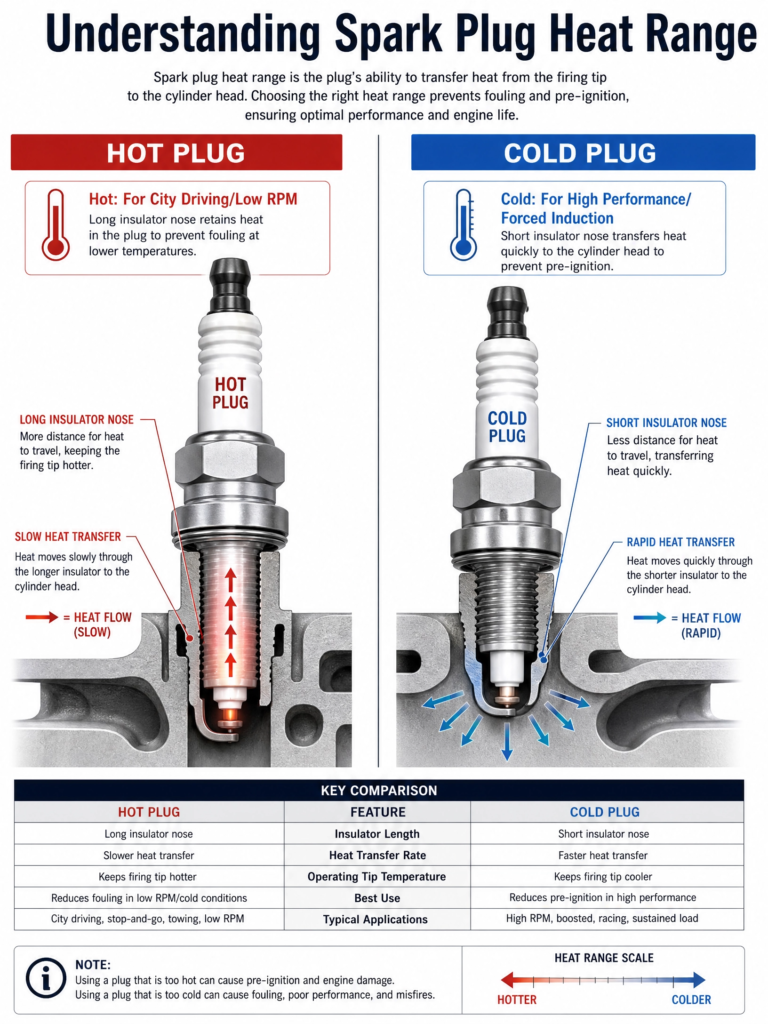
A hot spark plug has a longer insulator nose. A longer nose means heat has to travel further before it reaches the cylinder head, so the tip runs hotter overall. That extra heat is actually useful in certain situations, since it helps burn off carbon buildup instead of letting it foul the plug. Hot plugs make sense in engines that spend a lot of time idling or cruising at low RPM, like a city commuter car that’s stuck in traffic half its life.
A cold spark plug has a shorter insulator nose, so heat moves out of the tip and into the cylinder head much faster. The firing tip stays cooler under load. That matters because high-compression engines, and especially turbocharged or supercharged engines, generate serious heat inside the cylinder. A cold plug is built to survive that environment.
Now here’s the part that should scare you a little, because I’ve seen the aftermath of this mistake. If you drop a hot commuter-grade plug into a tuned turbo engine, that long insulator tip can’t shed heat fast enough. The tip starts glowing red-hot inside the cylinder, basically turning into a glow plug. That glowing tip ignites the air-fuel mixture before the spark even fires. That’s called pre-ignition, and it is violent. I’m talking about a glowing piece of metal igniting fuel early enough to punch an actual hole straight through the top of your piston. I’ve seen pistons pulled out of engines with a hole burned clean through the crown from exactly this mistake. It’s not a “might cause a rough idle” problem. It’s a “your engine is now scrap” problem.
The general rule I follow when tuning anything with more power than stock: step down one heat range colder for roughly every 75 to 100 horsepower you add over factory output. If you’re not sure where your build lands, talk to whoever tuned the engine or check the plug manufacturer’s application chart before you guess.
Anatomy of a Modern Ignition System: From Distributors to Coil-on-Plug
Ignition systems have come a long way, and understanding that history helps explain why your modern car runs so much smoother than your dad’s old sedan did.
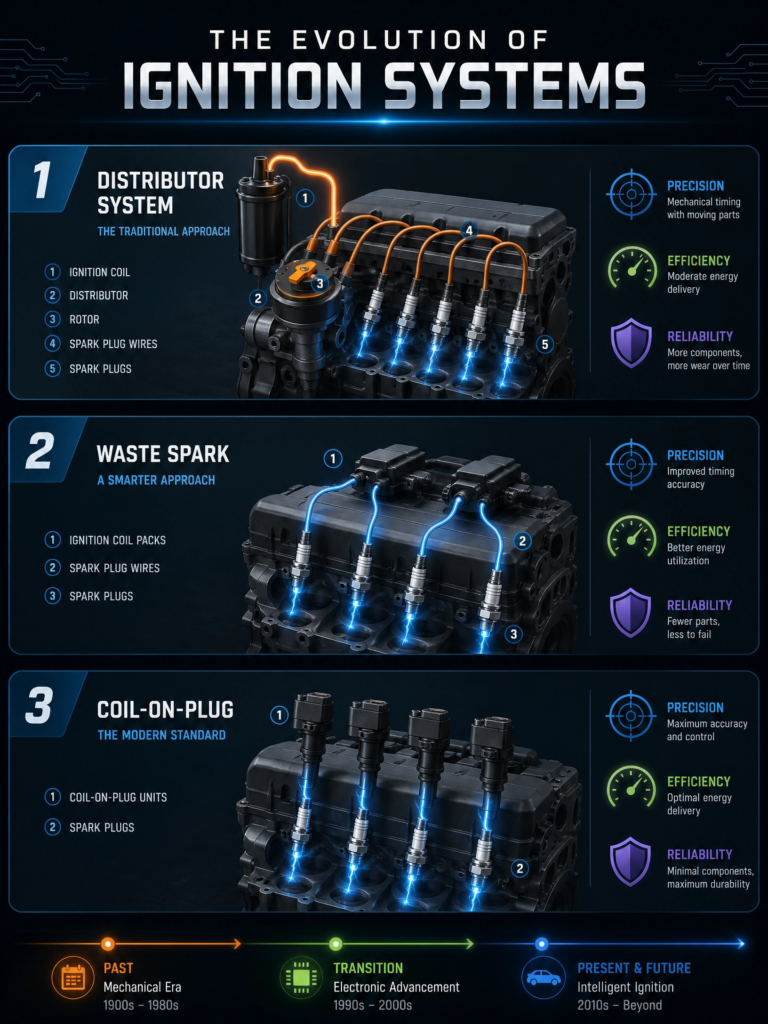
Distributor systems were the original setup. One ignition coil generated the spark, sent it to a distributor cap, and a spinning rotor inside the cap routed that high voltage out to each spark plug wire in firing order. It worked, but it had a lot of moving mechanical parts, and moving parts wear out. Add in the resistance from long spark plug wires, and you had a system that was simple but far from precise.
Distributorless ignition systems (DIS) came next, and the most common version was the “waste spark” design. One coil pack fires two spark plugs at the same time, one cylinder sitting in its compression stroke and the other sitting in its exhaust stroke. The cylinder in compression actually does the work, while the one in exhaust just “wastes” its spark. Crude, but it got rid of the distributor and its wear points.
Coil-on-plug (COP) is what you’ll find on virtually every modern engine today, and for good reason. Each cylinder gets its own dedicated coil, sitting right on top of its spark plug. No spark plug wires means almost no electrical resistance and far less risk of electromagnetic interference messing with your sensors. Since each coil fires independently, your engine’s computer can fine-tune ignition timing cylinder by cylinder. That precision is a big part of why modern engines idle smoother, make more power, and burn less fuel than anything from twenty years ago.
High-Performance Ignition System Upgrades
If you’re chasing more power out of an engine, upgrading the ignition system needs to be part of that plan, not an afterthought you bolt on later. A bigger turbo or more boost means a denser air-fuel mixture packed into the cylinder, and a denser mixture is genuinely harder to ignite cleanly.
Performance ignition coils are usually the first upgrade worth making. Aftermarket coils put out noticeably higher voltage than stock coils, which gives you a stronger, more complete burn of the air-fuel mixture. On my own turbo project, swapping to upgraded coils cleaned up the throttle response almost immediately, and those high-RPM misfires I mentioned earlier disappeared completely. That one part made a bigger difference than I expected going into it.
CDI boxes (capacitive discharge ignition) are another piece worth knowing about if you’re building something serious. A CDI box stores up a higher primary voltage and dumps it into the coil all at once, giving you a hotter, sharper spark. You’ll see these more often on race-prepped engines than on a daily-driven street car, but if you’re running big boost or a high-compression build, it’s worth researching whether your setup would benefit.
A word of caution here: don’t just throw the most expensive coils and a CDI box at a stock engine expecting miracles. These upgrades shine when they’re matched to an engine that’s already been built or tuned to need them. On a completely stock motor, you’re more likely to waste money than gain meaningful power.
Ignition Efficiency Calculator:
Here is a tool that estimates fuel savings and ROI from ignition upgrades.
⚡ Ignition Efficiency Calculator
Estimate fuel savings and maintenance costs from upgrading your ignition system
How to Gap Spark Plugs for Performance
Even the best plug money can buy is useless if the gap is wrong. The “gap” is the physical distance between the center electrode and the ground electrode, and getting it right is one of those small details that separates a smooth-running engine from one that misfires under load.
A wider gap exposes more of the air-fuel mixture to the spark, which can improve combustion efficiency and fuel economy. But a wider gap also demands more voltage to jump that distance. If your ignition coils can’t keep up, you get misfires instead of better mileage.
On turbo and supercharged engines, there’s another problem called spark blowout. Higher cylinder pressure can literally blow the spark out before it properly ignites the mixture, similar to how wind can snuff out a candle flame. The fix is usually to tighten the gap, which reduces the spark’s exposure to that pressure and makes ignition more reliable, even though you’re sacrificing a little bit of that wider-gap efficiency.
Now, here’s where I need you to put down whatever cheap gapping tool came in a $5 blister pack from the parts store. Never use a coin-style gapping tool that you wedge between the electrodes to pry the gap open or closed. I’ve watched guys do this in my own garage, and it almost always ends the same way: that wedge action snaps the fragile, brittle iridium firing tip clean off. Iridium tips are thin by design, remember, and they have zero tolerance for being pried on.
Here’s the right way to do it:
- Use a wire-style feeler gauge, not a flat blade or coin-style tool. The wire slides into the gap without putting lateral pressure on the electrode.
- Check the gap by sliding the correct wire size between the electrodes. It should pass through with very slight drag, not loose and not jammed.
- Adjust only the ground electrode, using a bending tool or the notch built into your gapping tool. Never touch or apply pressure to the center electrode.
- Re-check the gap after every adjustment, since a small bend changes the spacing more than you’d expect.
Take your time with this step. A snapped electrode tip means a $15 plug just became scrap metal, and you still have to drive to the store for a replacement.
Ignition System Maintenance for Efficiency
Keeping your ignition system in good shape isn’t complicated, but it does take a little care, and skipping one step can turn a routine plug swap into an expensive repair bill.
Before you even think about pulling old plugs, grab a can of compressed air or a shop vac and clean out the spark plug tubes first. I cannot stress this enough. Those tubes sit deep in the cylinder head, and they collect dirt, sand, and tiny pebbles over the years, especially if you live somewhere dusty or drive off-road. If you unscrew the plug without clearing that debris first, all that grit drops straight down into your open cylinder the moment the plug comes loose. That sand will scratch your cylinder walls, and you’ll be dealing with compression loss and oil consumption that has nothing to do with the new plugs you just installed. Thirty seconds with a shop vac saves you from a teardown later.
Watch for these warning signs that your ignition components are wearing out:
- Engine misfire – the car stumbles or hesitates under hard acceleration
- Rough idle – the engine shakes or feels unsteady sitting at a red light
- Poor fuel economy – incomplete combustion is burning gas without turning it into power
- Check engine light – codes like P0300 (random misfire) or P0301 (cylinder 1 misfire) point straight at ignition trouble
- Hard starting – especially noticeable on cold mornings, when weak spark struggles to light a cold, dense mixture
When you do pull the old plugs, take thirty seconds to actually look at them before tossing them in the trash. The tip tells you what’s happening inside that cylinder. A tan or light gray tip means the engine is burning clean and the air-fuel mixture is dialed in correctly. A black, sooty tip points to a mixture running too rich, often from a fouled injector or a bad oxygen sensor. A white, chalky tip can mean the engine is running too lean or too hot. Don’t just swap the plugs and walk away. Read them first.
One more thing while you’re in there: keep your hands and tools clean, and don’t let dirt or grease fall into the coil wells when you pull the coils off. I always lay a clean shop rag over the valve cover area before I start pulling parts, just to catch anything that drops. It takes ten seconds and saves you from chasing a mystery problem later.
Bringing It All Together
The ignition system doesn’t get much attention until something goes wrong, but it’s doing more work than almost any other part under the hood. Picking the right plug material for how you actually drive, matching the heat range to your engine’s power level, gapping plugs correctly, and keeping debris out of those plug tubes will keep your engine running the way it’s supposed to.
I’ve torn apart enough engines to know that most “mystery” misfires and rough idles trace back to one of these basics getting overlooked. Whether you’re chasing lap times or just want your car to start reliably on a cold morning, the spark is where it all begins. Get that part right, and everything downstream gets a whole lot easier.





Leave a Reply