
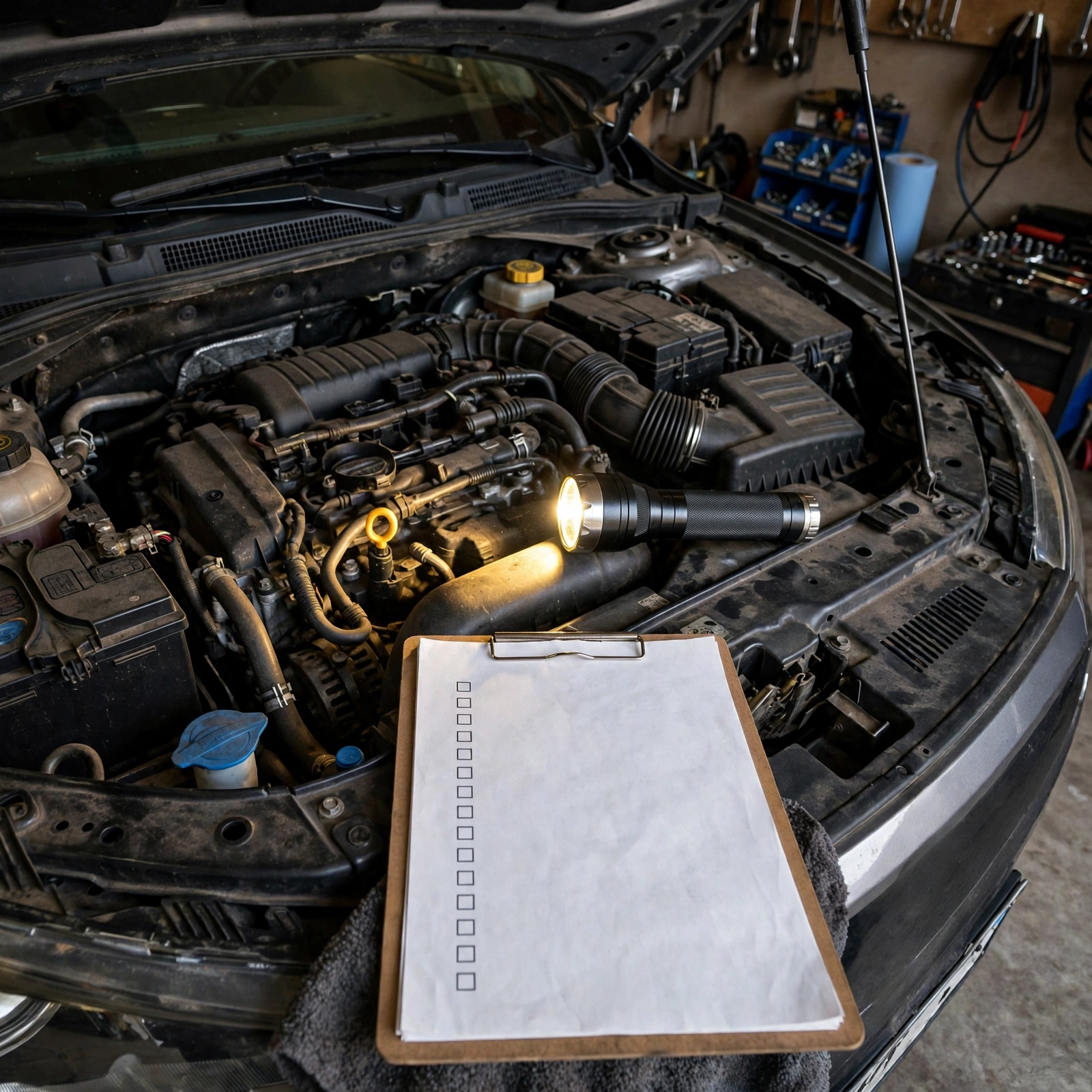
That One Time I Ignored a $12 Hose
I was under my Mazda in the garage last winter, hands greasy, flashlight rolling away, and I smelled something sweet. Coolant. Just a whiff. I almost ignored it. That little sniff turned into a pinhole in a heater hose that would’ve cost me a head gasket — $500 to $1,200 if I’d let it cook on the freeway.
That’s why I do this 10-minute under-hood check on the first Saturday of every month. Same coffee, same rag, same route around the engine. It catches stuff while it’s cheap.
You don’t need to be a pro. You just need a pattern. Here’s mine.
Why 10 Minutes Once a Month Actually Works
Most under-hood failures don’t blow up out of nowhere. They whisper first. A belt glazes. A reservoir drops a half inch. The battery gets crusty white fuzz. If you look monthly, you spot the whisper.
I’ve caught these with this exact checklist:
- Low coolant from a seeping water pump weep hole — $45 pump now vs. $900 overheating tow later
- Cracked serpentine belt with 3 ribs missing — $35 belt and a 14mm socket on the tensioner, not a roadside dead alternator
- Brake fluid that went black and low — pads were worn, master was starting to bypass
Do it cold, in your driveway, on level ground. Hot coolant burns. Like, ER-level burns. Wait at least 30 minutes after driving.
What You Need Within Arm’s Reach
I keep a tiny kit in a milk crate. You probably own most of it:
- Flashlight — your phone works, but a real penlight shows color better
- Clean rags or blue shop towels — old t-shirt cut up is fine
- Nitrile gloves — coolant and oil are nasty on skin
- 10mm socket and ratchet — that’s 80% of battery terminals and engine covers
- Tire pressure gauge — yeah, while you’re out there anyway
- Small notebook or use the tracker tool below
The 10-Minute Checklist — Same Order Every Time
Do it clockwise. Start driver side, end driver side. You’ll never miss a spot.
1. Engine Oil — 60 seconds
Pull the dipstick, wipe it, re-insert fully, pull again. Check on level ground, engine off for 5 minutes. You want between the dots, closer to full, honey-brown on gas engines, darker is okay on diesel but not chunky or gray.
If it’s milky brown like coffee creamer, stop — that’s coolant in oil. Tow it, don’t drive. If it smells like gas, you might have a leaking injector. If it’s low by a quart every month, look for spots on the driveway.
- Add spec oil only — 0W-20 on most newer Toyotas/Hondas, 5W-30 on my older Mazda
- Oil filler cap should be tight, 25 ft-lbs max by hand — don’t crank it with pliers
2. Coolant Level and Cap
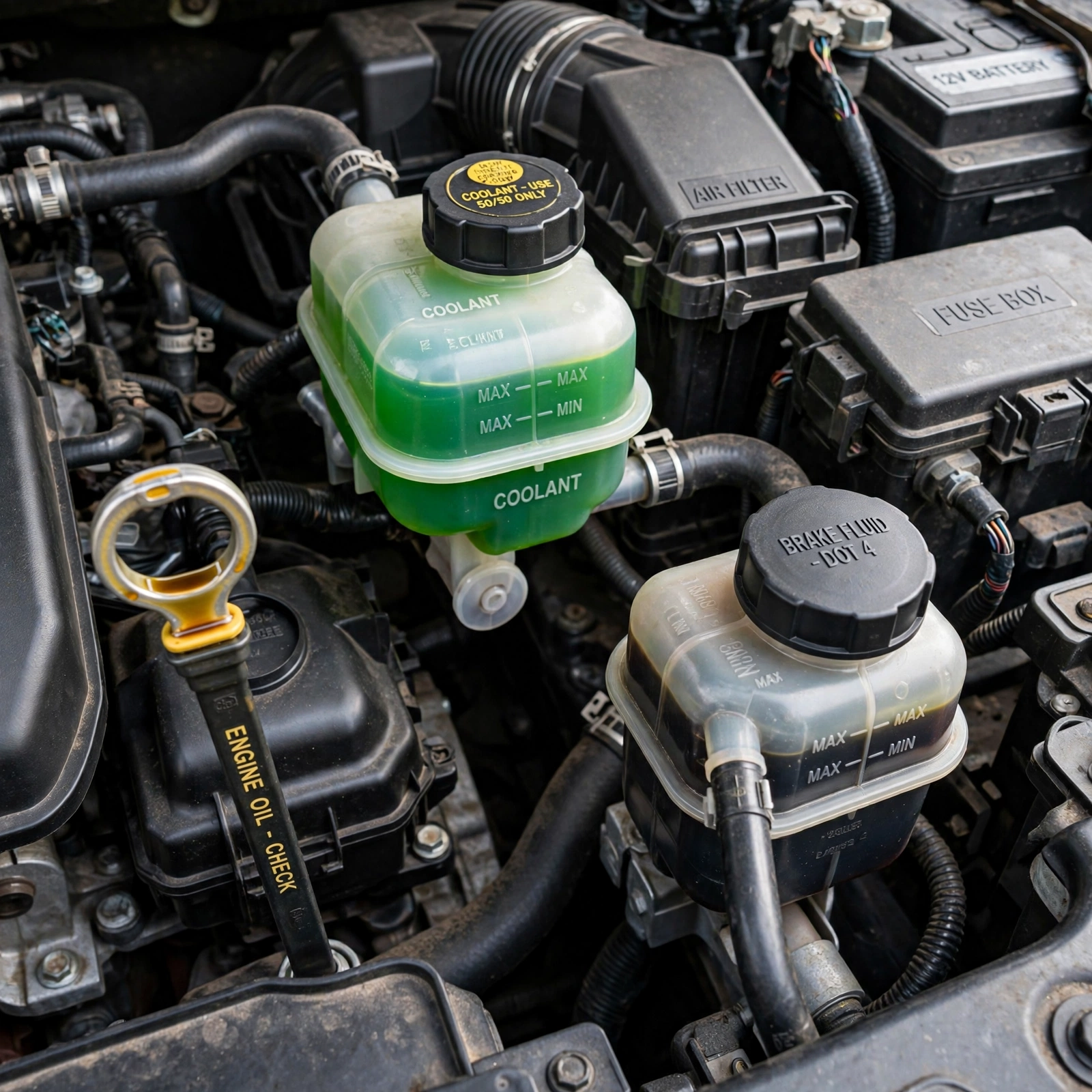
Look at the overflow reservoir, not the radiator. You should see MIN / MAX lines. When cold, level should be near MIN or a bit above. If it’s empty cold, you’ve got a leak.
Check color too. Green, orange, pink — whatever your car uses, it should be clear, not rusty brown. If you see oil floating in coolant, that’s a big red flag for head gasket.
- NEVER open a hot radiator cap. 15 psi hot coolant is 250°F and will scald.
- Radiator cap is usually 13-16 psi. If the rubber seal is torn, replace it — $9 part, $800 save.
- Clean dirt off the cap and reservoir before opening. One grain of sand can jam a thermostat or score a water pump seal.
3. Brake Fluid — Eyes Only at First
The brake fluid reservoir is on the driver side firewall, small, with a black or yellow cap that says DOT 3 or DOT 4. Fluid should be clear to light amber, and between MIN and MAX.
If it’s dark brown or black, moisture got in and lowered the boiling point. That’s how pedal goes to floor on a mountain downhill. If level drops, your pads are worn thinner and caliper pistons pushed out further — or you’ve got a leak.
- Safety: Brake fluid ruins paint to bare metal in minutes. If you spill, flood with water immediately, don’t wipe.
- Clean dirt off the cap before opening — you do NOT want grit in ABS valves. Those valves are $800+ and hate dirt.
- Use a flare wrench (11mm) if you ever open bleeder screws, not an open-end — you’ll round them off.
4. Power Steering and Washer Fluid
Many new cars are electric steering — no fluid. If you have a reservoir, it’s usually stamped ATF or power steering fluid. On some it says Use Dexron VI. Level cold, check hot range if you just drove.
Washer fluid is easy. Top it off. I use -20°F winter mix even in summer — it cleans bugs better. Cap is blue on 90% of cars.
5. Serpentine Belt — The $35 Part That Strands You
Flashlight on the belt with engine off. Look for cracking, fraying, glazing (shiny), missing ribs. Press it mid-span — you should get less than 1/2 inch deflection on older manual tensioners. Modern auto tensioners self-adjust, but check the tensioner arm pointer — if it’s past the wear mark, belt is stretched.
I found my belt glazed last March. Squealed on damp mornings. Swapped it in 10 minutes with a 14mm or 15mm socket on the tensioner. Belt route sticker is under the hood — take a phone pic before removal.
- Torque for most tensioner pulleys: 25-35 ft-lbs (34-47 Nm) if you replace the tensioner itself
- If belt is wet with oil or coolant, find the leak first — new belt will slip again
6. Hoses — Squeeze Test
Squeeze radiator upper and lower hoses when cool. They should be firm, not mushy or crunchy. Check clamps — spring clamps are better than worm-drive, but if a worm clamp is there, make sure it’s not cutting into the rubber. Look at heater hoses near the firewall — they hide leaks.
Any green crust or white powder around a hose end? That’s dried coolant seep. Tighten or plan a replacement.
7. Battery — The White Fuzz Lie
Battery terminals love corrosion. White/green fuzz means acid vapor escaping. It creates resistance and you’ll get a slow crank one morning.
- Disconnect negative first, positive second. Clean with baking soda and water, wire brush.
- Terminal nuts are 10mm. Snug, don’t Hulk it: 6-8 ft-lbs (8-11 Nm) for most side-post, 8-10 ft-lbs for top-post. Over-tight cracks the case.
- Check tie-down — battery should not move if you shake it. A bouncing battery shorts on the hood. I use 10mm deep socket for the hold-down J-bolts, torqued 8-12 ft-lbs.
- Resting voltage 12.6V is full, 12.2V is 50% dead. Running it should be 13.8-14.5V if alternator charges.
8. Air Filter — 30-Second Look
Pop the airbox — usually clips or two 10mm bolts or Phillips screws. Lift filter, hold to sun. If you can’t see light through it, it’s toast. I found a mouse nest in mine once. Leaves, droppings, the works. Mice love airboxes in fall.
Replace every 15k-30k miles or yearly if you drive dusty roads. A clogged filter costs 2-3 mpg and fouls spark plugs. Re-install with arrow pointing to engine (air flow direction).
9. Underneath Peek — Leaks Without a Lift
You don’t need to jack it up. Lay your phone flashlight under the front, take a pic. Look for drips. Color tells story:
- Red/pink — transmission or power steering
- Green/orange/pink slick — coolant
- Brown/black — oil
- Clear water — A/C condensation, normal if under passenger side in summer
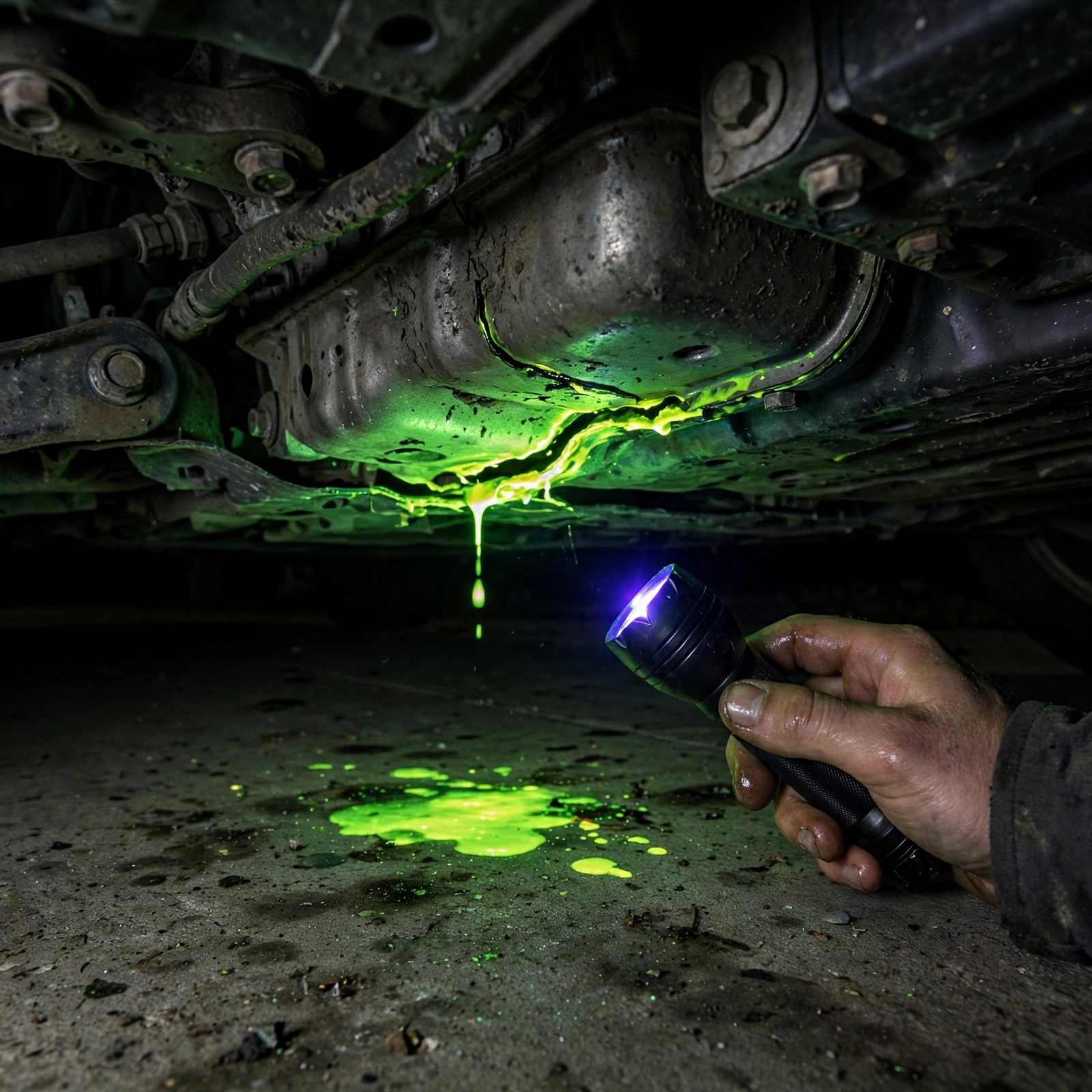
If you suspect a slow leak, buy a UV dye kit for $12 — add to oil or coolant, drive a day, check at night with UV light. It glows like crime scene stuff. Super obvious.
10. The Look-and-Sniff Wrap-Up
Step back. Look at the whole bay. Wires hanging? Rodent chew marks? Plastic shielding dragging? Then sniff. Sweet = coolant, burnt toast = electrical, burnt oil = valve cover leak dripping on exhaust, sulfur = battery overcharging.
Start the car, let it idle 30 seconds, listen. No squeal, no tick that gets louder with rpm, no hissing (vacuum leak). Glance at dash — no new lights? You’re done.
My Monthly Routine (Copy This)
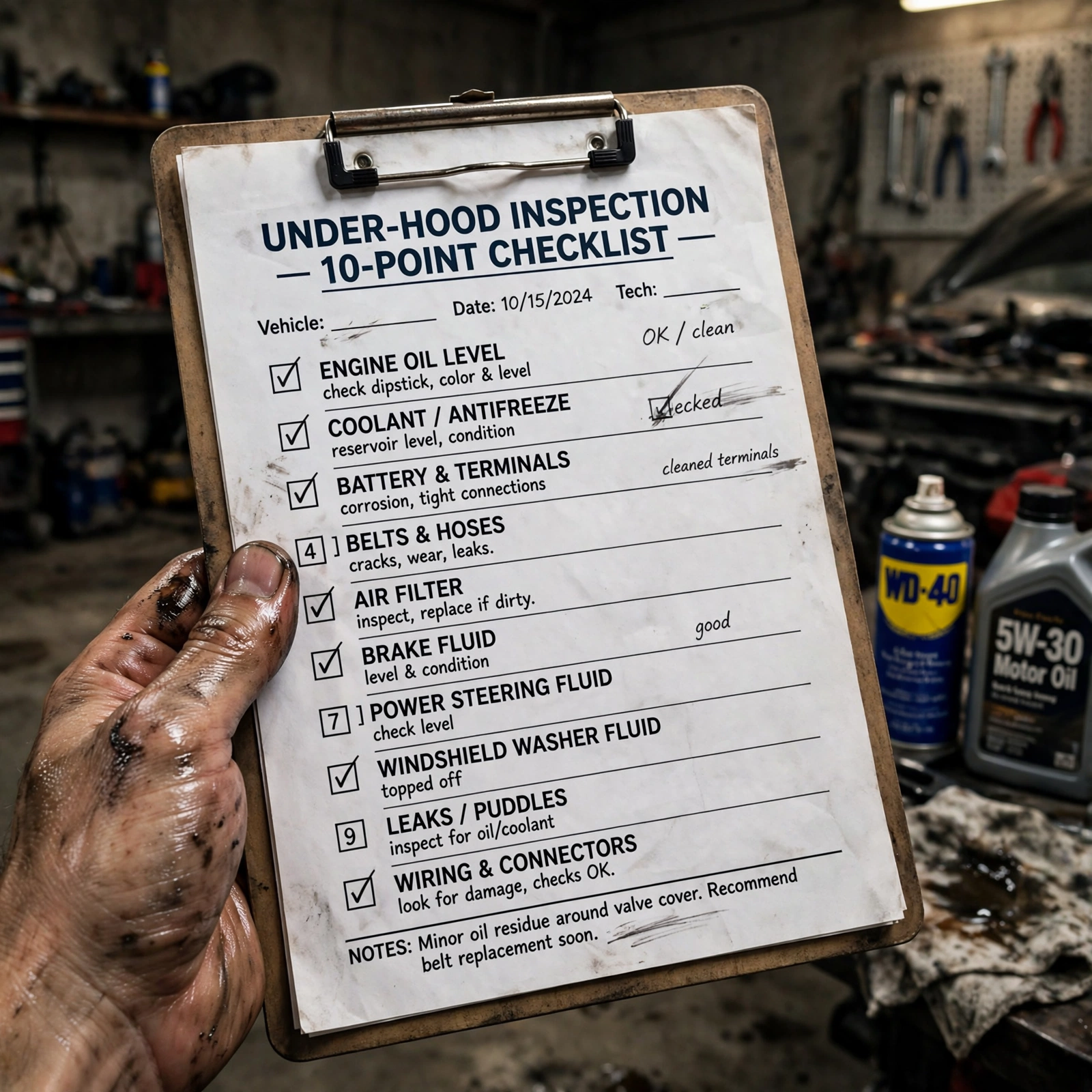
| Order | What | Tool | What Good Looks Like |
|---|---|---|---|
| 1 | Oil | Rag | Between dots, amber-brown, no milk |
| 2 | Coolant | Eyes | Cold at MIN, hot at MAX, clear color |
| 3 | Brake Fluid | Flashlight | Clear-amber, above MIN, cap clean |
| 4 | PS / Washer | Funnel | PS to cold mark, washer topped |
| 5 | Belt | Eyes, 14mm | No cracks,ribs intact, tensioner in range |
| 6 | Hoses | Hand squeeze | Firm, no mush, no green crust |
| 7 | Battery | 10mm, brush | No fuzz, tight tie-down, 12.6V |
| 8 | Air Filter | 10mm / clips | Light passes, no nests |
| 9 | Leaks | Phone light | Dry pavement, no color spots |
| 10 | Sniff/Listen | Nose + ears | No sweet/burnt smell, no squeal |
Fix-Now vs. Watch List
Not everything needs panic. Here’s how I sort it:
- Fix now: Brake fluid low or dark, coolant empty when cold, battery loose, belt missing ribs, oil over low mark or milky. Those leave you stranded or wreck the engine.
- Watch this month: Slightly low PS fluid, washer empty, tiny pink seep at hose clamp, air filter gray but light still passes. Add to list, re-check in 2 weeks.
If brake fluid is low AND your pads are near minimum — 2-3mm — topping fluid hides wear. Check pad thickness with a flashlight through the wheel. Lug nuts are 80-100 ft-lbs on most cars (108-135 Nm), 19mm or 21mm socket. Don’t guess torque on lugs.
Two Mistakes That Turn Cheap Into Expensive
I’ve done both, so you don’t have to.
Mistake 1: Topping brake fluid to hide pad wear. I did this on my old Accord. Fluid looked low, I topped DOT4. Two weeks later metal-on-metal. Pads were gone, rotors scored. Lugs were 21mm, caliper bracket bolts 80 ft-lbs. If I’d checked pads at the same time — flashlight through spoke, look for 3mm material — I’d have spent $40 on pads, not $240 on rotors.
Mistake 2: Over-tightening the oil cap and battery. First oil change I did, I cranked the plastic oil cap with channel locks. Cracked it, vacuum leak, whistling. Battery I torqued like a lug nut — cracked the lead post. Now I do hand tight plus a quarter turn on oil cap, 6-8 ft-lbs on terminals. Snug is safe.
When to Move Up Your Monthly Date
If you tow, drive dirt roads, or sit in Phoenix heat, cut interval to 2 weeks. Dust kills air filters. Heat evaporates battery water and pressure-tests cooling systems.
Road trips? Do this check the day before you leave, not morning-of. You’ll want time to grab a hose or belt. Auto parts stores love a Saturday morning panic buyer.
Bottom Line: Make It Boring
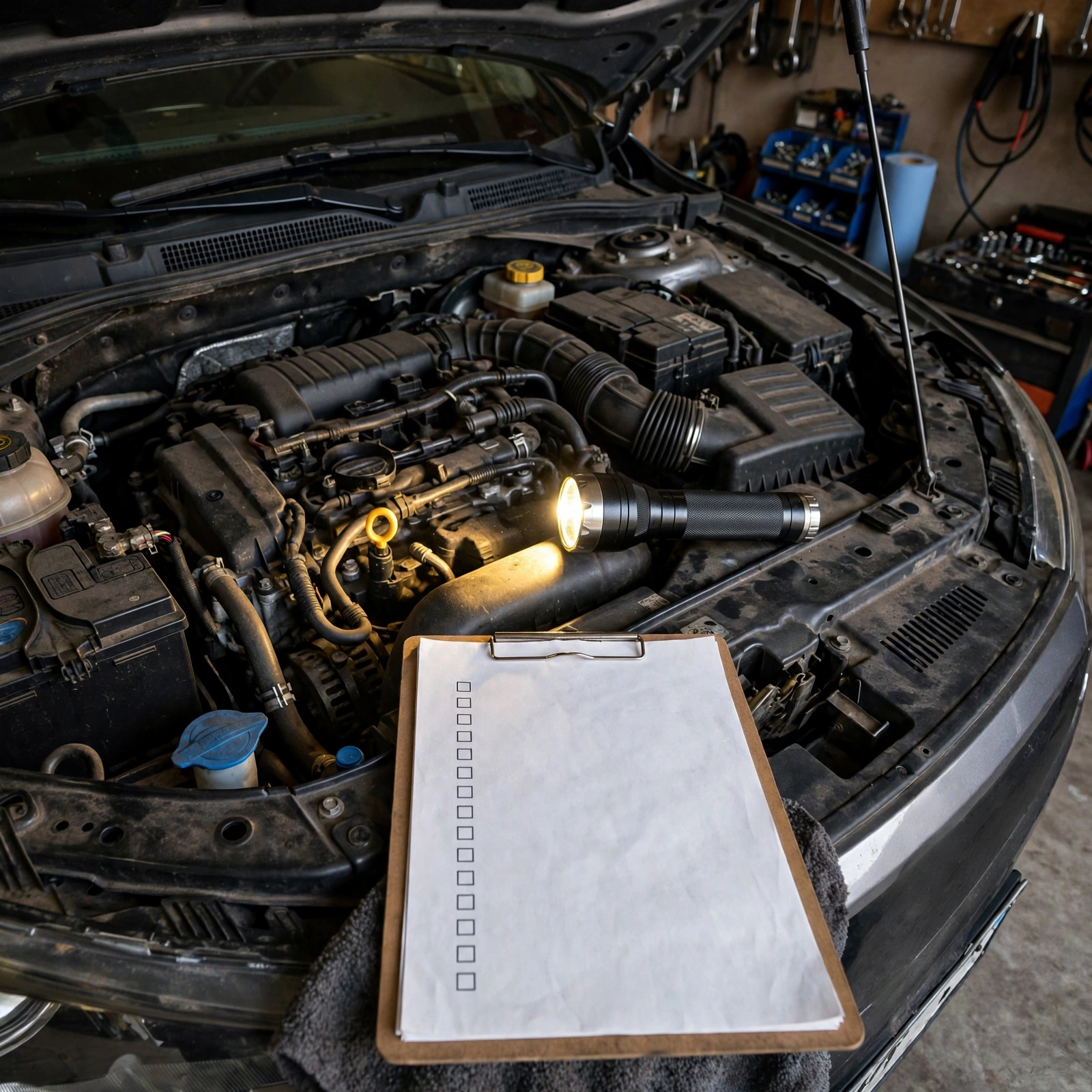
The best car maintenance is boring. Same 10 minutes, same path, clipboard on the fender. My rag lives on the battery, my flashlight on the airbox. I check, I write two lines in notes, I go back to coffee.
Since I started this, I haven’t had a surprise tow in 4 years. I’ve replaced $12 clamps instead of $600 radiators, $35 belts instead of $400 alternator + tow bills, and one $18 radiator cap instead of… well, you know.
Set a phone reminder: first Saturday, 10-minute pop-the-hood. Your future self — with clean hands and a full wallet — will thank you.



Leave a Reply