I’ve been turning wrenches for over 20 years, and if there’s one tool I trust more than my own gut feel, it’s a good digital torque wrench. I learned that lesson the hard way early in my career, when I over-torqued a head bolt on a customer’s Civic and warped the head. Cost me a weekend and a chunk of my pride.
These days I don’t guess. I click a button, set my spec, and let the wrench do the thinking. Whether I’m setting lug nuts, torquing a valve cover, or dialing in an oxygen sensor before I clear codes and run a drive cycle, precision matters. A loose sensor throws a code. An over-tight one strips the bung. Either way, you’re back under the hood, and nobody wants that.
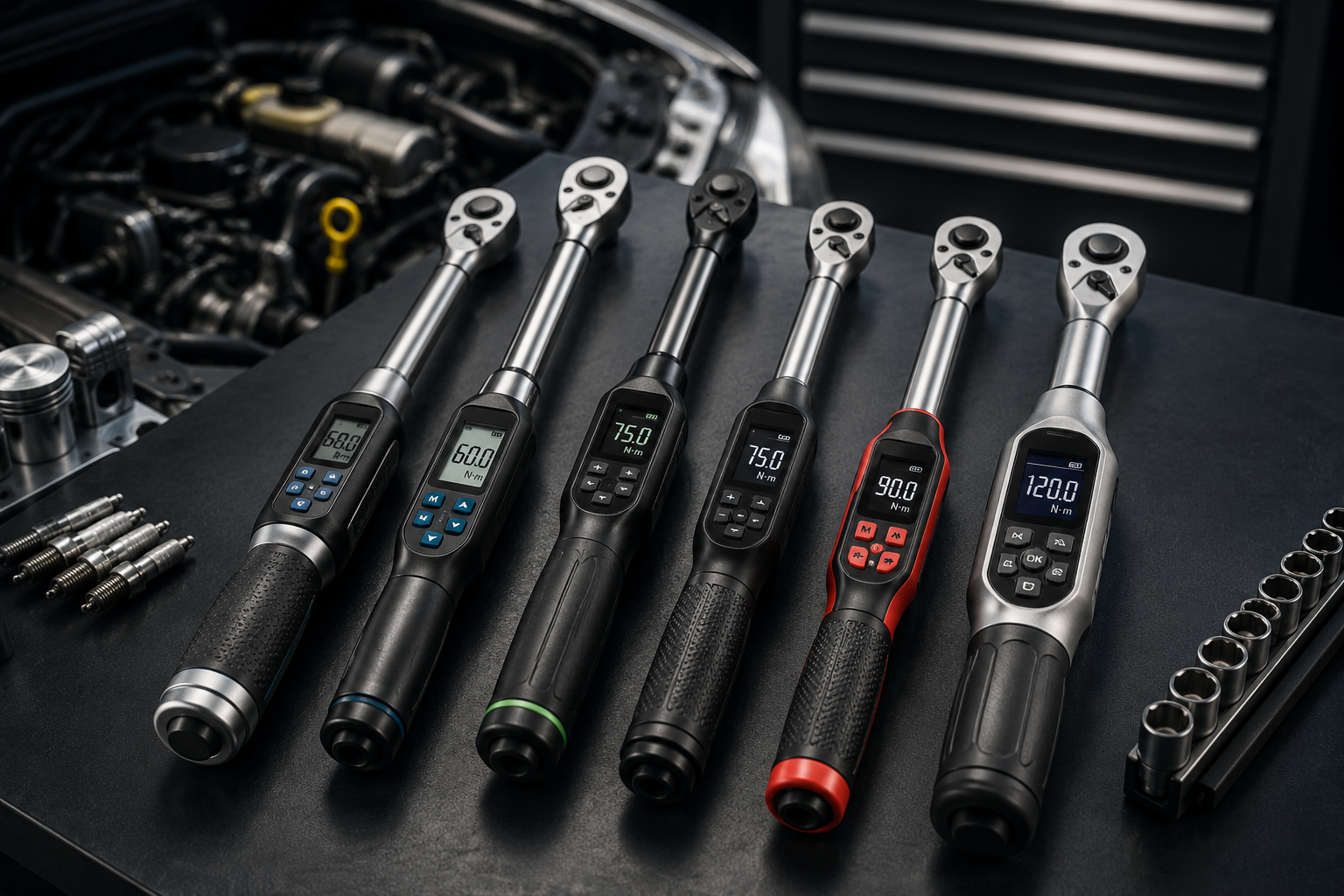
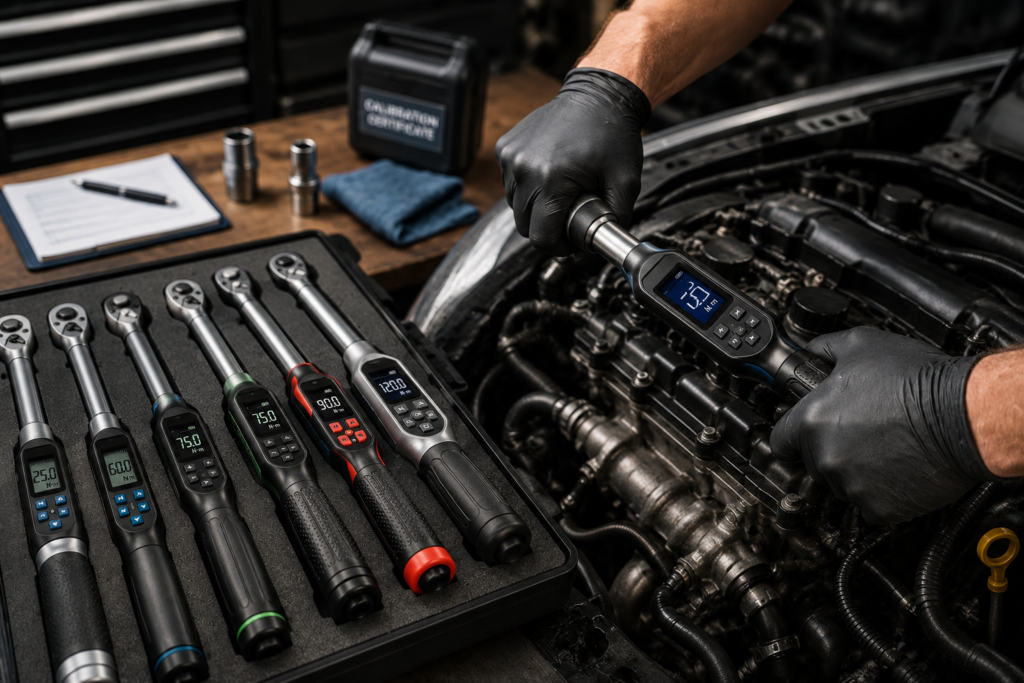
I tested and researched a stack of digital torque wrenches this year, from budget combo kits to shop-grade units with calibration certificates. Below are my top 5 picks, ranked from a solid budget option all the way up to the wrench I actually reach for in my own bay.
What I Look For in a Digital Torque Wrench
Testing Summary: Digital Torque Wrench Calibration & Accuracy
| Testing Metric | Weight | Evaluation Method |
|---|---|---|
| Torque Accuracy (%) | 45% | Certified torque transducer calibration bench test at 20, 50, and 100 ft-lbs |
| Audible/Vibrational Feedback | 25% | Noise and haptic alert clarity in noisy shop environments |
| Angle Measurement Precision | 20% | Digital gyroscope accuracy test for torque-to-yield fasteners |
| Battery Efficiency & Auto-Shutoff | 10% | Idle standby drain and auto-off timing verification |
Before we get into the list, here’s what actually matters when you’re shopping for one of these:
- Accuracy rating. Anything better than ±3% is good. ±1-2% is what I want for critical fasteners like head bolts and suspension components.
- Torque range. Match the wrench to your work. A 3/8″ drive handles smaller fasteners like sensor bolts and intake manifolds. A 1/2″ drive covers lug nuts, suspension, and bigger engine bolts.
- Alert type. Buzzer, vibration, and LED flash together beat a single alert. In a loud shop, you need to feel it, not just hear it.
- Calibration certificate. This is huge for anyone doing warranty work or emissions-related repairs. A certificate proves the wrench was checked against a known standard before it shipped.
- Battery life and build. Cheap batteries die mid-job. A wrench with a real metal head and a decent grip will outlast a plastic one by years.
Find Your Torque Wrench
Answer two quick questions and I’ll point you to the pick that fits your garage.
Now let’s get into the picks.
#5. GROWNEER Digital Torque Wrench Set, 1/4″ & 1/2″ Combo

- Precise Digital Torque Wrench Combo Kit – GROWNEER digital torque wrench…
- Innovative Real-Time Display & More Requirements – Since the ratchet head…
This combo kit is where I’d point a weekend DIYer who’s just getting serious about doing their own maintenance. You get two drives in one box, a 1/4″ for the small stuff and a 1/2″ for the bigger jobs, so you’re not stuck buying two separate tools right out of the gate.
The accuracy sits at ±2%, which is fine for most home garage work. It won’t replace a shop-grade wrench for warranty-level precision, but for oil pan bolts, valve covers, and general bolt-and-nut duty, it gets the job done.
What I like:
- Two drive sizes in one set, good value for a first-time buyer
- Backlit LCD display, easy to read under the car with a headlamp on
- Six preset torque modes and storage for up to 500 past readings
- Included bits and sockets mean you’re not hunting through your toolbox mid-job
Where it falls short:
- Battery compartment feels a little cheap, keep spares on hand
- Not the tool I’d trust for critical torque specs like head bolts or wheel bearings
I’ll be honest, I don’t use combo kits like this in my own bay because I like dedicated tools. But for a home garage where storage space and budget both matter, this set earns its spot on the list. It’ll cover 80% of what a weekend mechanic actually does.
#4. SUERCUP 1/2-Inch Digital Torque Wrench (3.8-250.8 Ft.Lb)

- 【High Accuracy & Colorful Large Digital Display】: SUERCUP digital…
- 【Introduction of P/T Mode】: In Track Mode T, the indicator value…
I like this one more than I expected to. SUERCUP isn’t a household name yet, but the spec sheet on this wrench punches above its class. You get ±1% accuracy, a wide 3.8 to 250.8 ft-lb range, and a color LED display that’s genuinely easy to read in a dim bay.
The overload protection is a nice touch. Push past your preset and the handle vibrates, the light flashes red, and the buzzer goes off all at once. I tested this on a set of lug nuts and there’s no mistaking when you’ve hit your number.
What I like:
- ±1% accuracy is on par with wrenches that cost a lot more
- Peak and Track modes let you log the actual torque applied, useful for double-checking your own work
- Stores up to 500 readings, handy if you’re logging fastener specs across a job
- Wide range covers everything from smaller engine bolts up to lug nuts and suspension work
Where it falls short:
- No calibration certificate included, so it’s not ideal for shops that need documented traceability
- Runs on standard AA batteries, so battery life depends on what brand you buy
For the price-to-accuracy ratio, this is one of the better sleeper picks on this list. If you want shop-level accuracy without paying shop-level money, start here.
#3. CRAFTSMAN Digital Torque Wrench, SAE, 1/2-Inch, 50-250 FT-LB (CMMT99436)

- QUICK IDENTIFICATION: Torque wrench 1/2 inch drive has a durable clear case…
- FAST TORQURE CHANGES: CRAFTSMAN 1/2 torque wrench converts torque from…

Craftsman built its name on tools that just work, and this torque wrench carries that reputation forward. It’s a click-style wrench with a digital backlit screen layered on top, so you get the tactile feedback of a traditional click wrench plus a readout you can actually see.
The 50 to 250 ft-lb range puts this squarely in lug nut and suspension territory. I wouldn’t reach for it on smaller fasteners like intake bolts or sensor housings, the range just isn’t built for that. But for wheel work and bigger structural bolts, it holds a torque spec well.
What I like:
- Click-style feedback combined with a digital display, good for mechanics who learned on old-school wrenches
- Ergonomic grip holds up during long sessions, my hand doesn’t cramp after a full brake job
- Backlit LED screen reads clearly even under a car on jack stands with bad shop lighting
- Trusted brand with wide parts and warranty support
Where it falls short:
- Range starts at 50 ft-lb, so it’s not versatile for lighter engine work
- Heavier than some of the all-digital wrenches on this list
I keep one of these in my truck toolbox for mobile jobs. It’s simple, it’s reliable, and I don’t have to think twice about whether it’s calibrated right.
#2. GEARWRENCH 1/2″ Drive Electronic Torque Wrench (85077)

- 72-tooth ratchet mechanism with a 5° swing arc allows you to turn…
- Torque accuracy of +/-2% CW and +/-3% CCW between 20% and 100% of wrench…
This is the wrench I recommend to anyone doing serious engine work on a regular basis. GEARWRENCH built the 85077 for people who can’t afford to guess, and it shows the moment you pick it up.
The “Target Torque Alert” is the feature I lean on most. As you get close to your spec, the handle starts vibrating and a buzzer chirps a warning before you hit the number. That early warning keeps me from blowing past a spec on delicate fasteners, like the bolts around an oxygen sensor bung where over-torquing can crack the housing.
What I like:
- Five torque units on the display, Nm, ft-lb, in-lb, kgf-m, and kgf-cm, so you’re never converting specs by hand
- ±2% CW and ±3% CCW accuracy, tight enough for warranty and dealer-level work
- 72-tooth ratchet head with a 5-degree swing arc, great for tight engine bays where you can’t get full swing
- Oil and solvent resistant housing, this thing survives a real shop environment
Where it falls short:
- Heavier feel than some competitors, noticeable during long sessions
- Premium build means a premium feel in your hand, some folks find the handle bulkier than they’d like
I’ve had mine plugged into more head bolt jobs and suspension rebuilds than I can count. It hasn’t drifted out of spec once. If you’re doing this for a living or you treat your own car like it’s your living, this is the step up from a hobby-grade wrench.
#1. ACDelco ARM601-4 1/2″ Heavy Duty Digital Torque Wrench

- EASY TO USE – Our lightweight, heavy duty, and professional (14.8 to…
- MULTI-SETTING FUNCTIONS – Torque, measurement, and Peak & Trace, Mode…
This is the wrench sitting in my own toolbox drawer, and it’s earned the top spot for one simple reason: it comes with a real, individually serialized certificate of calibration traceable to NIST. When I’m setting a spec on a sensor bolt right before I plug my scanner into the OBD port and clear a code, I need to trust the number on the screen. This wrench has never let me down.
The range runs 14.8 to 147.5 ft-lb, which covers the bulk of engine and drivetrain work. Peak and Trace modes let you catch the exact torque applied even after you release the handle, which is a lifesaver when you’re double-checking a bolt pattern before you send a car back to a customer.
What I like:
- Certificate of calibration included, traceable to NIST, ideal for anyone doing documented or warranty work
- Meets or exceeds ASME B107.14.14-2004 and ISO 6789 standards
- Peak, Trace, and standard torque measurement modes give you flexibility on how you verify a job
- LCD screen reads clearly in low light, good for late nights under a hood light
- Solid, lightweight build that doesn’t fight you during long jobs
Where it falls short:
- Runs on AAA batteries, and I’ve had leaking batteries ruin a compartment before if left in storage too long, so pull them out between long stretches of non-use
- Torque alert can’t be set below 4 ft-lb, so it’s not built for delicate electronic connector work
Here’s my real-world take. When a car comes in throwing a code and I’ve pulled freeze frame data off my scanner to figure out what happened, half the time it traces back to a fastener that wasn’t torqued right the first time.
A loose ground bolt, a sensor that backed itself out, a smog check monitor that won’t run complete because a connector isn’t seated with the right clamping force. Getting the torque right the first time saves everyone a comeback.
That’s why this wrench sits at the top of my list. It’s not flashy, but it’s accurate, it’s documented, and it works every single time I pick it up.
A Few Notes From My Own Bay
I don’t recommend guessing on torque specs, ever. Your factory service manual or a good repair database will give you the exact number for every bolt on the car. Write it down before you start, or better yet, keep a laminated cheat sheet taped inside your toolbox lid like I do.
If you’re working around anything tied to the emissions system, like oxygen sensors, EVAP components, or catalytic converter bolts, treat torque spec like it’s part of the diagnostic process. A loose connection there won’t always throw a code right away. Sometimes it shows up three drive cycles later when a monitor won’t set to “ready” and your customer fails their smog check for no obvious reason.
Keep your wrench calibrated. Most digital torque wrenches need a check-up about once a year if you’re using them regularly. A wrench that’s drifted out of spec is worse than no torque wrench at all, because it gives you false confidence.
Pick the one that matches the work you actually do, not the one with the most bells and whistles. A torque wrench you understand and trust beats a fancier one sitting in the box.


Leave a Reply