
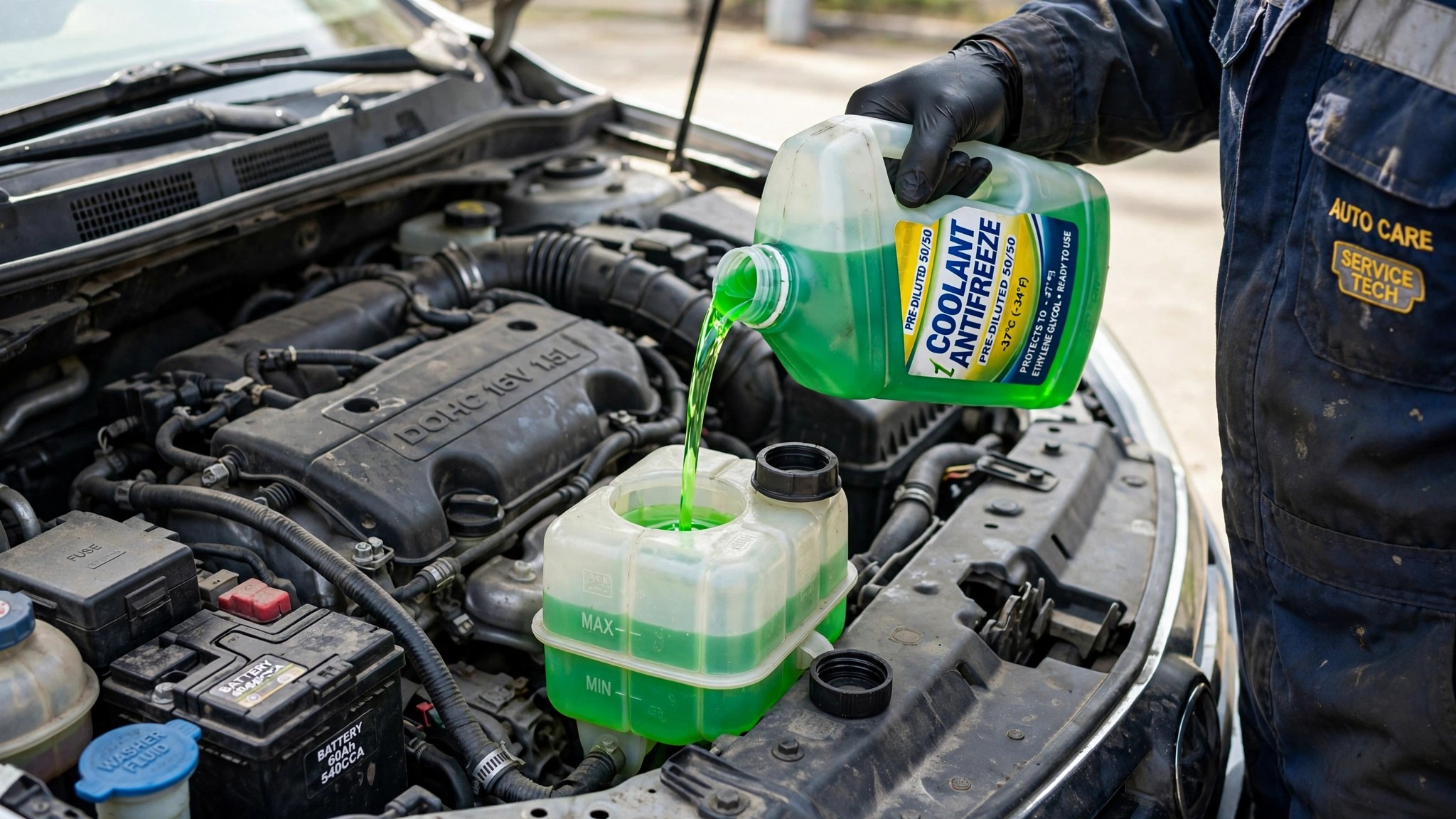
Your engine burns fuel at over 1,000 degrees. Without coolant, that heat would seize pistons in minutes. Coolant is simple to top up, but tricky to choose, because the wrong bottle can clog your heater core and eat your water pump. Here’s what to look for.
Coolant vs Antifreeze: Same Thing?
Yes, for practical purposes. Antifreeze is the pure glycol concentrate. Coolant is that concentrate mixed with water, usually 50/50. People say coolant when they mean the ready-to-pour mix in your overflow tank.
It has three jobs. It lowers freezing point to about -37°C, raises boiling point to about 129°C with a 15 psi cap, and carries corrosion inhibitors that protect aluminum heads, iron blocks, and rubber hoses. Plain water cools well, but it freezes, boils quickly, and lets rust grow inside your radiator.
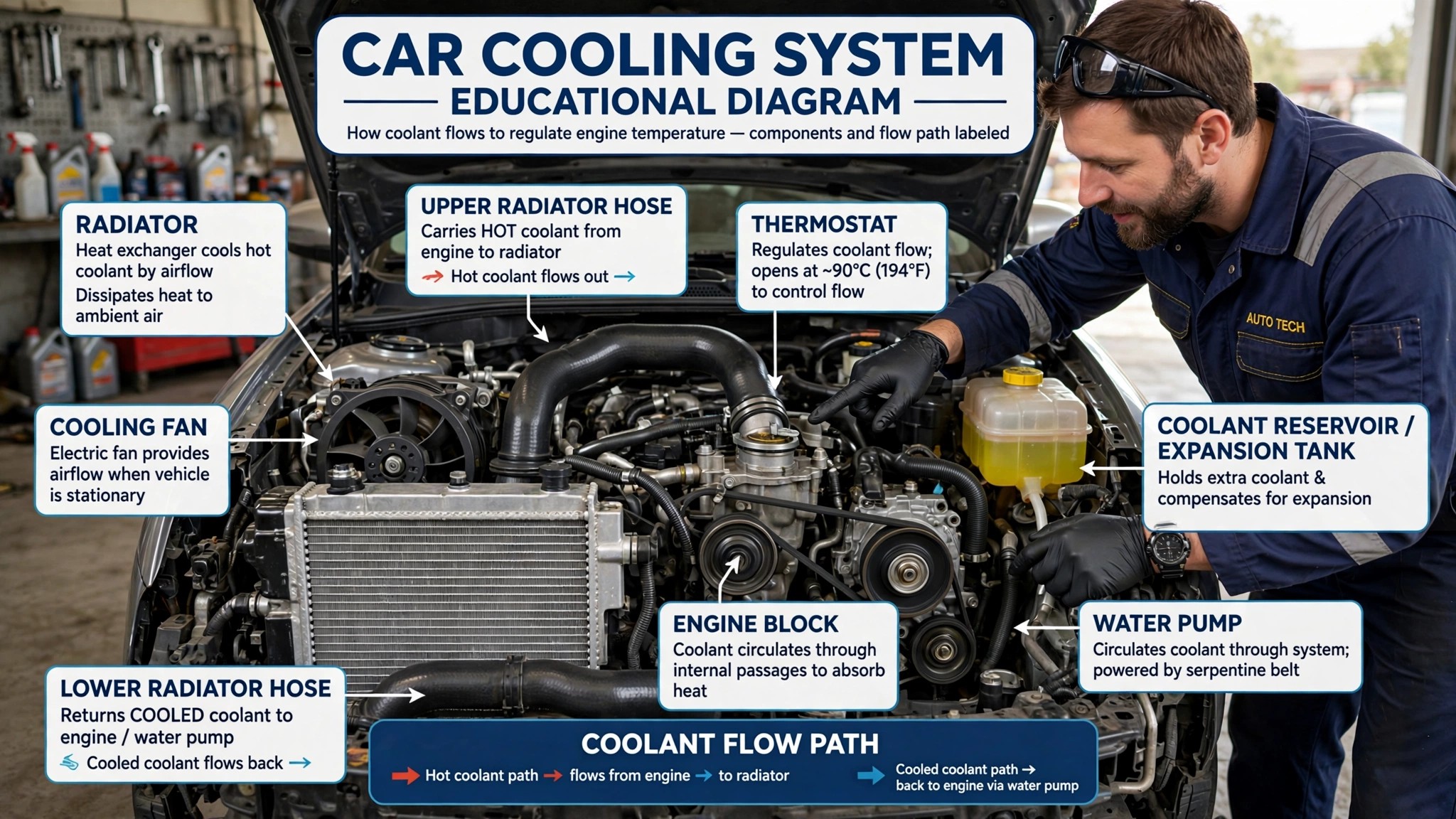
The Three Coolant Families
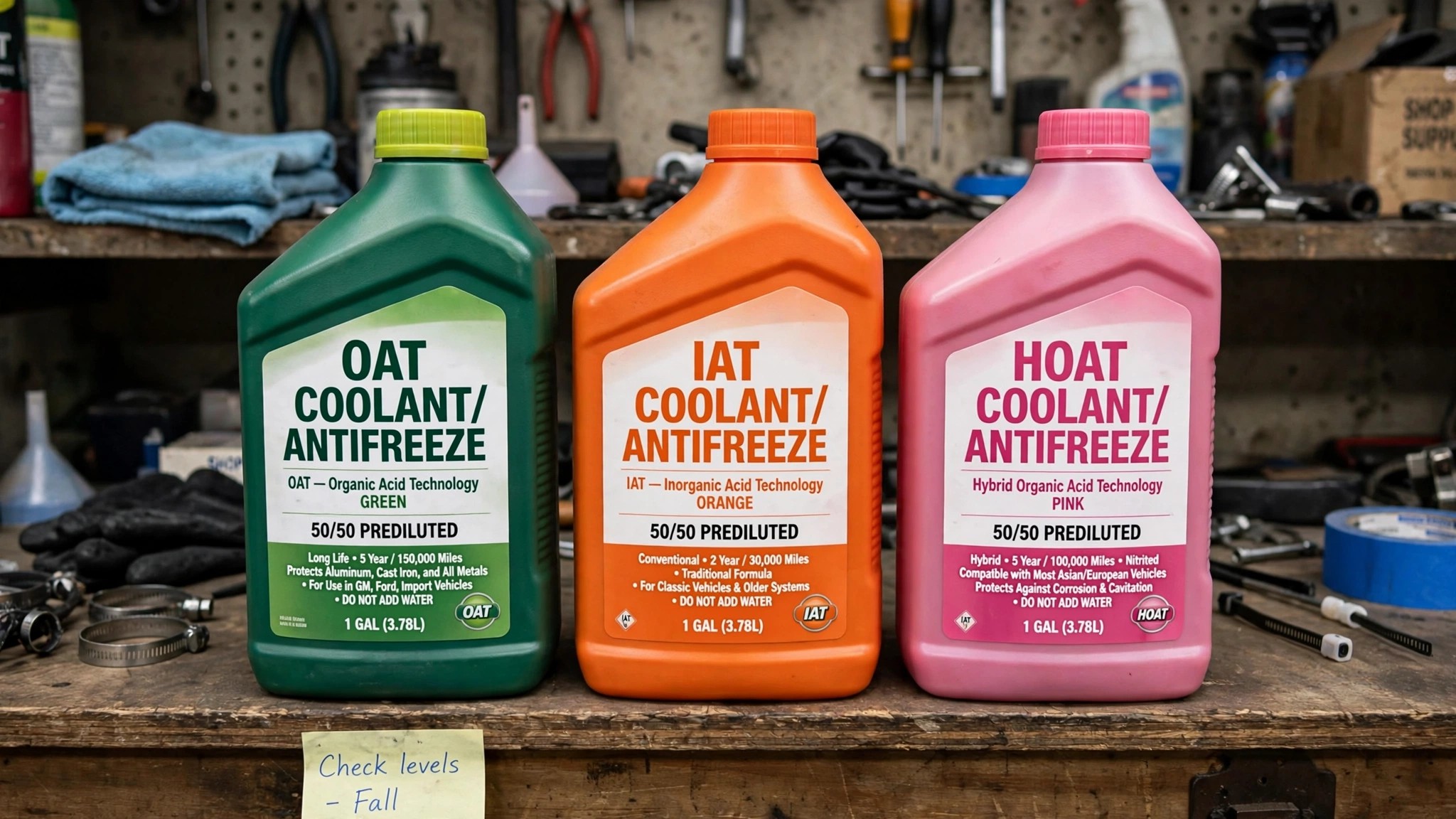
IAT — Inorganic Acid Technology
The old green bottle from the 80s and 90s. Uses silicates and phosphates that coat metal fast. Good for older brass/copper radiators. Life is short, about two years or 30,000 miles, because those silicates fall out of suspension. If your car is pre-1995 and still has original style radiator, IAT is what it came with. In a modern aluminum engine, IAT can leave silicate dropout that blocks narrow passages.
OAT — Organic Acid Technology
No silicates, uses organic acids like sebacate and 2-EHA. Lasts five years or 150,000 miles. Common colors are orange, red, pink, and sometimes dark green. GM Dex-Cool is OAT orange. Toyota uses pink OAT, VW uses purple G13 OAT-based. OAT is gentle on water pump seals and great for aluminum, but it takes longer to build a protective layer, so if you have a rusty system, it won’t cover rust quickly.
HOAT — Hybrid OAT
A mix of both. A little silicate or phosphate for fast protection, plus organic acids for long life. Colors are yellow, turquoise, gold, or pink. Ford yellow, Chrysler HOAT, BMW blue-green, Mercedes turquoise are all HOAT variants. Life is five years or 100k-150k miles. Most cars built between 1998 and 2013 use HOAT from factory.
Why Color Is Misleading
There is no government rule for coolant color. One brand can make green OAT, another makes green IAT. What counts is the spec code.
- GM 6277M = Dex-Cool OAT orange
- Ford WSS-M97B44-D = Yellow HOAT
- VW G12++ / G13 / G12 Evo = Purple/lilac HOAT/OAT
- Toyota 00272SLLC2 = Pink OAT super long life
- Hyundai MS 591-08 = Green or blue Asian OAT
- BMW 82-14-1-467-704 = Blue-green HOAT
Your owner’s manual lists one of these. The bottle must say it meets or exceeds that spec. If it just says “works in all cars,” put it back. Universal coolants exist, but good ones still list the exact specs they meet.
🧪 Coolant Finder & Mix Calculator
Mix Ratio Helper
Concentrate or Premix?
Concentrate is 100% glycol. You must mix with distilled water, not tap. Tap water has calcium and magnesium that form scale on hot surfaces. Premix is already 50/50 and ready to pour. It costs more per gallon but removes mixing errors.
| Mix | Freeze | Boil (with cap) | Best Use |
|---|---|---|---|
| 40% glycol / 60% water | -24°C | ~102°C | Very hot climates |
| 50/50 | -37°C | ~129°C | Most cars, best balance |
| 60/40 | -52°C | ~132°C | Extreme cold, not over 70% |
Never exceed 70% glycol. More glycol actually cools worse and can turn to gel in cold. If you live where it hits -40°C, 60/40 is max.
When to Check and Change
- Monthly: With engine cold, look at translucent overflow bottle. Level between MIN and MAX. If low, top with correct type.
- Yearly: Use test strips for pH and freeze point, or a refractometer. If it looks rusty, has oil film, or particles floating, plan a flush.
- Change: IAT every 2 years, OAT/HOAT every 5 years or per manual. If you bought used and have no history, flush and start fresh so you know what’s inside.
Warning signs: temp gauge climbs fast in traffic, heater blows cold at idle but hot when you rev, sweet smell in cabin, white crust around hose clamps, coolant loss with no puddle — that last one can be a head gasket weeping into cylinder.
How to Top Up Without Getting Burned
- Never open radiator cap when hot. System holds pressure and will spray 100°C fluid.
- Add to overflow tank, not radiator, unless manual says otherwise.
- Use same chemistry already in there. If you don’t know, drain and flush twice with distilled water, then refill with correct spec.
- After filling, run engine with heater on full hot for 10 minutes with cap off overflow to burp air. Watch level, top again when cold.
What Happens If You Mix Wrong
Mixing IAT silicates with OAT can make silicates drop out as gel. That gel lodges in radiator tubes and heater core. Result is overheating plus no cabin heat in winter. Fix is to drain, fill with distilled water, run 10 minutes, drain again, repeat, then fill with correct spec. Two water flushes usually clear it.
Buying Checklist
- Write down year, make, model, engine code
- Open manual, find coolant spec page
- Buy one gallon premix for top-ups, plus one gallon concentrate if you plan a full flush and have distilled water
- Keep a liter in trunk for long trips
- Label what you put in with date and mileage on tape on overflow bottle
Testing Your Coolant at Home
You don’t need a shop to know if coolant is still good. Buy coolant test strips for $8. Dip in cold coolant, compare color for pH and glycol percent. pH should be 8-10. Below 7 means acidic and it is eating metal. Refractometer is more accurate: one drop tells freeze point within 2 degrees. If freeze point is weaker than -25°C in a cold region, top with concentrate, not premix.
Look inside overflow bottle with flashlight. Any oil film rainbow on top? That could be transmission cooler leaking into radiator or head gasket. Any rusty particles? That means inhibitor package is dead and iron is rusting. White crust around hose ends is dried coolant from seep — tighten clamp or replace hose before it blows on highway.
Electric and Hybrid Cars Need Coolant Too
EVs still have coolant for battery and power electronics. It is often low-conductivity OAT, not same as engine coolant. Don’t mix engine coolant into battery loop. Hybrids have two loops: one for engine, one for inverter/battery. They can use different specs. Check manual — using wrong conductivity can trigger isolation fault codes.
How to Flush Properly
If you need to change type, do a full flush. Drain radiator, open block drain if accessible, close, fill with distilled water, run with heater on hot for 10 minutes, drain again. Repeat until water runs clear. Then fill with correct coolant at 50/50. Never use garden hose water with minerals. Never use chemical flush unless system is badly rusted and you plan to flush twice after — chemicals can loosen too much at once and block heater core.
Emergency Top-Up
Stuck roadside with low coolant and no correct bottle? In emergency, top with distilled water to get to shop, but don’t drive long with weak protection. If you must add different chemistry to reach shop, keep drive short, then flush soon. Keep a liter of correct premix in trunk — it weighs nothing and saves a tow.
Coolant Leaks: Where to Look
Common leak points: radiator plastic end tanks crack after 8-10 years, water pump weep hole drips when seal fails, heater hoses at firewall, thermostat housing gasket, and overflow cap that no longer holds pressure. Pressure test is best way to find small leak. Pump system to 15 psi and watch for drip. If you lose pressure with no external drip, check for white smoke on startup — coolant burning in cylinder.
Seasonal Tips
Before winter, check freeze protection. Before summer, check fan operation, radiator fins for bugs and dirt, and that overflow tank cap seals. A weak cap lowers boiling point by 10-15°C and can cause overheating in traffic even with good coolant.
Coolant looks simple because it’s colored, but it’s chemistry protecting a $4,000 engine. Spend five minutes matching the spec and you avoid a clogged radiator, dead water pump, or head gasket job. Check level cold once a month and you’re ahead of most drivers.
FAQ: Coolant Questions
Can I use water in summer? Only to get to shop. Water boils faster, causes rust, and has no lubricants for water pump.
Why is my coolant low with no leak? Could be evaporating from bad cap that doesn’t hold pressure, or burning via head gasket. Check for white smoke, milky oil cap.
How do I know if I have air pocket? Heater blows cold at idle but hot at 2,000 rpm, temp gauge swings up and down, gurgling behind dash. Bleed procedure in manual usually says to raise front of car, run with heater hot, and open bleed screw.
Can I mix pink and green? Only if both are same chemistry. Most pink OAT and green IAT are not compatible. If unsure, flush.
One more thing many shops skip: coolant filter or lack thereof. Most cars don’t have filter, so particles circulate until they settle in heater core. That’s why flush matters. Also check radiator cap pressure rating — usually 13-16 psi for cars, up to 21 psi for trucks. Wrong cap rating changes boiling point. A cap that can’t hold pressure will cause overflow and you will keep losing coolant even with no leak. Replace cap every 4 years, it’s $10 insurance.
Related posts:
 The Ultimate Year-Round Car Maintenance Checklist: Oil, Brakes, Fluids & More
  The Complete Guide to Engine Oil: Types, Viscosity, and When to Change for Peak Performance
  Headlight Restoration Guide: Remove Haze and Improve Night Vision
  How to Keep Your Car From Overheating in Traffic: 5 Checks Before Summer
Leave a Reply