
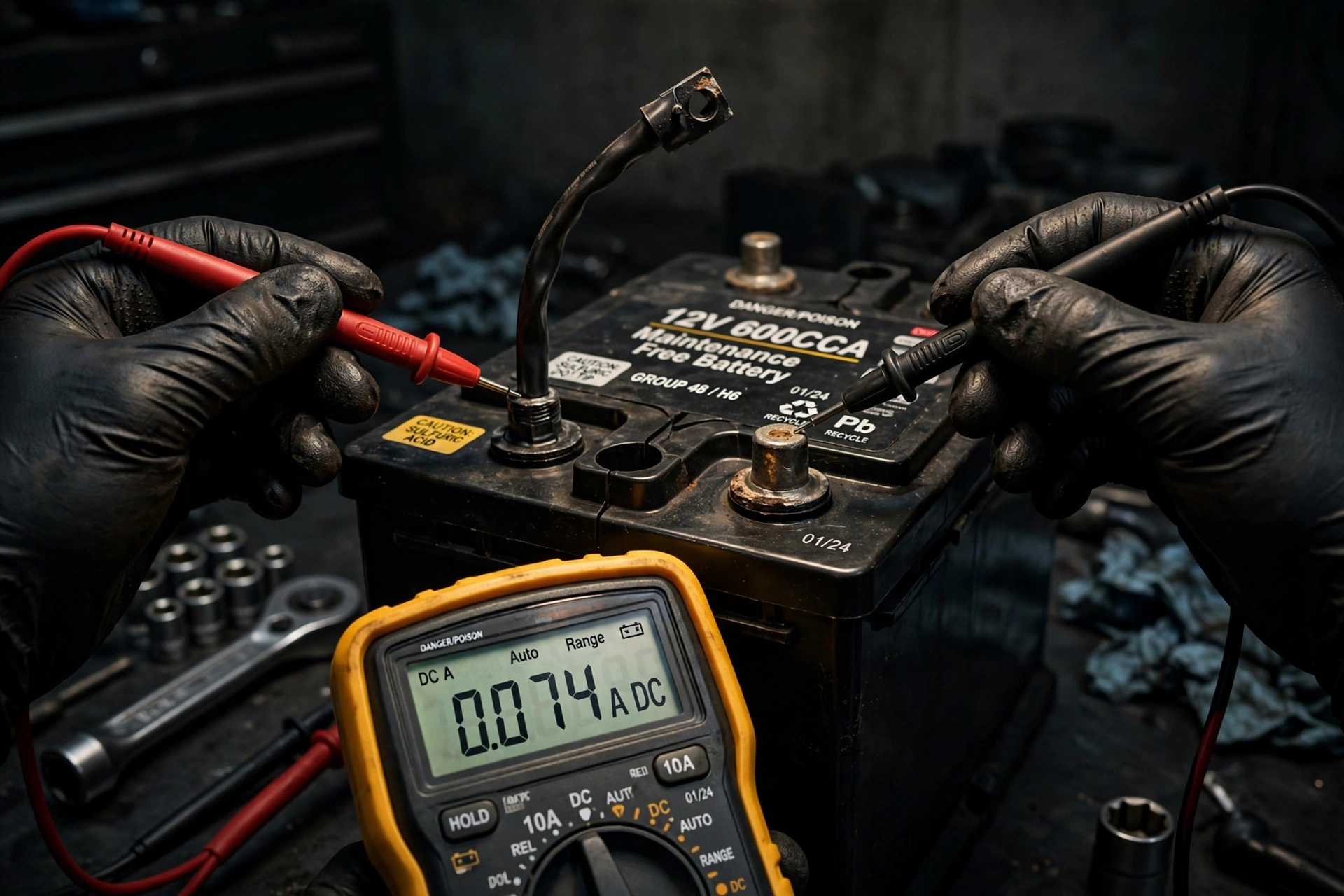
It was 6:12 a.m., 18 degrees out, and my 2016 Mazda 3 was dead. Again. Not slow-crank dead. Full-on click-click-nothing dead. I’d just bought a new Interstate battery three weeks earlier, so I knew it wasn’t the battery. I jumped it, drove to work cursing, and by the next morning? Same thing. If you’re reading this at 6 a.m. with jumper cables in your hand, I get it.
I learned the hard way that a battery that dies overnight is almost never a bad battery. It’s a parasitic drain — something that stays awake after you’ve locked the doors and gone to bed. Modern cars have 30+ computers that need a little memory power, but anything over about 50 milliamps is stealing your battery while you sleep. You don’t need a shop to find it. You need a decent multimeter, a 10mm wrench, and about an hour of patience.

What Counts as Normal Parasitic Draw?
Every car draws a little power when it’s off. Your clock, radio presets, security system, keyless entry — they all sip. On most vehicles built after 2010, the normal sleep current is 20 to 50 mA. My Mazda settles at 28 mA after about 12 minutes. My buddy’s F-150 with all the modules? Around 35 mA. If you’re seeing 75, 150, or 500 mA, something isn’t going to sleep.
Here’s the quick math I wish someone had told me earlier: A healthy 70Ah battery with only 50% usable before voltage drops too low to start — so about 35Ah usable — will die in roughly 35Ah / 0.05A = 700 hours. That’s almost a month. But crank that draw up to 350 mA from a stuck glove box light? 35 / 0.35 = 100 hours. Four days. At 750 mA? You won’t make it overnight.
Tools You’ll Actually Need (And Safety First)
You don’t need a $400 Fluke, but don’t use that $9 harbor freight special either. I use an AstroAI DM6000AR or any multimeter with a 10A DC fused port.
- Digital multimeter with 10A DC capability (10A fused minimum)
- 10mm wrench or socket — most battery terminals are 10mm. Japanese cars sometimes 10mm on terminals, 12mm on hold-down. GM often 8mm side terminal.
- Needle-nose pliers and trim tool for fuses
- Safety glasses + nitrile gloves — batteries make hydrogen gas
- Memory saver or small jump pack if you don’t want to lose radio codes
How to Test Parasitic Draw the Right Way
This is where most YouTube videos skip steps. If you just yank the negative off and slap a meter in, you’ll wake every module up and get a false reading.
Step-by-Step Setup
- Close all doors, trunk, glove box. Turn everything off. Roll the driver window down (so you can reach in later without opening a door). Remove key fob 15+ feet away.
- Pop the hood and locate the fuse boxes — there’s usually one under the hood and one under the dash driver side.
- Set multimeter to DC Amps, move red lead to 10A socket, black to COM.
- Disconnect the NEGATIVE battery terminal (10mm). Not positive — safer that way.
- Connect meter in series: one lead to the negative battery post, other lead to the disconnected negative cable. You are now the bridge.
- You’ll see 1-3A at first — that’s normal. Modules are awake. Wait 20-45 minutes without touching anything. Many cars need 30 min to sleep. Don’t open doors or you restart the timer. Some folks latch the door and hood switches manually with a screwdriver to fake a closed state.
- After the wait, read the sleep draw. If it’s 50mA or less, your drain is intermittent or you have a weak battery. If it’s 75mA+, you’ve got a culprit.
This is why I leave the meter hooked up on my fender with alligator clips. You’ll feel silly standing in the garage staring at it, but it saves you from chasing ghosts.

The 7 Parasitic Drains You Can Find With a Multimeter
Once you’ve confirmed you have excess draw, keep the meter connected and start pulling fuses one at a time. When the draw drops by a big chunk, you found the circuit. Note: pulling some fuses will wake the network up — wait 2-3 minutes after reinserting before moving to the next.
1. Glove Box, Dome, and Vanity Mirror Lights (My Mazda’s Killer)
Yep, my ultimate problem was embarrassingly simple. The glove box switch was misaligned by about 2mm. The light stayed on 24/7. Each incandescent bulb draws 500-700 mA. Two vanity mirror lights? Add another 600 mA. You’ll see the car interior glowing faintly in that second photo — that’s exactly what happened, but my glove box was closed.
Check: Put your phone on video, stick it in the closed glove box. Or feel for heat after an hour parked. Pull the 10A ROOM fuse under dash — draw should drop to normal.
2. Aftermarket Stereo, Amp, or Backup Camera
The single biggest aftermarket drain. I’ve seen cheap amps pull 250-400 mA even when the head unit is off because the remote turn-on wire was tied to constant 12V instead of accessory. Dash cams hard-wired to always-on are just as bad. If you installed anything last month and now your battery dies, start here.
Check: Look for fuse taps on constant power. Pull the aftermarket radio fuse or inline fuse on amp power wire. Draw should plummet.
3. Power Seat, Power Liftgate, or Stuck Relay
Power seat modules and liftgate latches get water in them. A stuck relay can be intermittent — that’s why your battery sometimes dies and sometimes doesn’t. A relay coil itself draws 120-180 mA when stuck closed. On Toyotas and Hondas, the AC clutch relay is notorious for sticking on.
Check: Listen for faint buzzing after shutdown. Feel relays in under-hood box — warm relay = stuck. Swap a suspect relay with an identical part number next to it. Tool size: relays pull straight out, no tools needed.
4. Alternator Diode Leakback
This one fooled me on a Chevy Colorado I helped with. Alternator tests fine for charging (14.2V running) but a bad diode leaks backward overnight. You’ll see 200-800 mA draw that disappears when you disconnect the alternator’s B+ wire.
Check: After your baseline draw, disconnect the large charge wire from alternator (usually 12mm or 13mm nut, battery disconnected!). Reconnect battery through meter. If draw drops, alternator is your thief.
5. Keyless Entry / Body Control Module Not Sleeping
Modern cars have a BCM that should sleep. If a door latch switch fails, it thinks the door is open and stays awake, keeping CAN bus active. That keeps several modules alive at 200-400 mA. Mazda 3 and Ford Focus are famous for driver door latch microswitch failure.
Check: Watch your interior lights after locking — do they time out after 30 seconds or stay on? Use your multimeter on door latch wires, or just pull the BCM or DOOR LOCK fuse and watch.
6. Bluetooth, Telematics, and OnStar-style Modules
Bluetooth modules search forever if corrupted. I’ve seen a bad Ford SYNC module pull 650 mA, and older BMW TCU modules up to 800 mA. Aftermarket OBD2 dongles (insurance trackers, cheap scanners) are notorious — some draw 70-150 mA themselves.
Check: Unplug any OBD2 dongle first — that’s a 10-second test. If draw persists, pull fuse for INFOTAINMENT or TELEMATICS.
7. Corroded Trailer Wiring or Trunk Light Harness
Trailer connectors get full of road salt. Water wicks into the harness and creates a resistive path to ground — not a dead short that blows a fuse, but a 100-300 mA leak. Same with trunk wiring flex point where harness bends at the hinge. You’ll see green corrosion.
Check: Inspect trailer plug with flashlight. Disconnect trailer module connector in spare tire area. For trunk flex, peel back rubber boot and wiggle while watching meter.
Comparison Table: Normal vs. Abnormal Draw & What It Means
I keep this taped inside my toolbox lid. It’s saved me hours of guessing whether a reading is actually bad.
| Circuit / Component | Typical Sleep Draw | Failed / Stuck Draw | How Quickly It Kills a 70Ah Battery |
|---|---|---|---|
| Normal Total Vehicle (all modules asleep) | 20-50 mA | — | 29-70 days |
| Single Incandescent Dome/Glove Box Bulb | 0 mA (off) | 500-700 mA | 2-3 days overnight |
| Aftermarket Amplifier (remote wired wrong) | 0-5 mA | 250-400 mA | 4-6 days |
| Stuck Relay Coil (AC, Fuel Pump, Seats) | 0 mA | 120-180 mA per relay | 8-12 days |
| Alternator Diode Leak | 0-3 mA | 200-800 mA | 2-5 days |
| BCM Staying Awake (bad door switch) | 0 mA | 200-400 mA whole network | 4-7 days |
| OBD2 Dongle / Dash Cam Always-On | 0 mA | 70-350 mA | 5-20 days |
| Corroded Trailer Wiring | 0-2 mA | 100-300 mA | 6-14 days |
Chart Explanation: Why a Little Drain Becomes a Big Problem in Cold Weather
Imagine a simple line chart with two lines over a 72-hour period. The X-axis is hours parked, 0 to 72. The Y-axis is battery state of charge from 100% to 0%. The first line labeled “Normal 30mA Draw” slopes gently downward, still at about 92% after 3 days. It looks almost flat. The second line labeled “Faulty 400mA Draw” plunges. At hour 12 (overnight) it’s already at 75%, hour 24 at 50%, hour 36 at 25% — and below 40% most cars won’t crank. In cold temps below 32°F, battery capacity shrinks by 20-35%, so that 400mA line hits the no-start zone even faster, around 18-20 hours. That’s exactly what I experienced in 18-degree weather. The cold didn’t cause the drain; it just made a moderate drain lethal overnight.
When you use the calculator below, you’ll see the same math play out. A 70Ah battery is really ~60Ah in winter, and only half of that is usable before voltage collapses.
12.6-12.8 = full
Check label – Group 48/H6 ~70Ah
So You Found the Circuit — Now What?
Once that fuse pull makes your meter drop from 340 mA to 28 mA, don’t celebrate yet. You found the circuit, not necessarily the component. Look up the fuse diagram — that one 15A fuse might feed dome light, map light, and trunk light. You’ll need to unplug each component on that circuit until the draw drops again.
For my Mazda, the ROOM 15A fuse feeds interior lights, keyless, and cluster. Once I pulled it and saw draw drop, I unplugged the glove box light harness (one Phillips screw, about 5 minutes) and retested. Bingo. That plastic switch tab was worn down.
If it’s a module like a Bluetooth unit, replacement is often simple: 10mm bolts, electrical connector, no programming on many older models. On newer cars you may need a dealer to code a new BCM — ask before you buy. Sometimes a software update fixes a module that won’t sleep. Check TSBs — I found Mazda had a TSB for BCM sleep on early 2016s.
When It’s Not a Parasitic Drain at All
Let me be honest: twice I chased a drain that wasn’t a drain.
- Weak battery that self-discharges: If your battery is more than 4 years old and shows 12.2V after a full charge, it’s sulfated inside. Load test it. Most auto parts stores do this free. CCA should be at least 80% of rated.
- Alternator ripple: Bad diodes can cause AC ripple that confuses modules and keeps them awake. With engine running, set meter to AC Volts across battery — more than 0.5V AC ripple = bad alternator.
- Short trips only: If you drive 6 minutes to work, you use 3-5 Ah to start but only put back 2 Ah. Over a week, you’re slowly killing it. Take a 30-minute highway drive weekly, or trickle charge.
If your battery keeps dying overnight, don’t throw parts at it. Measure first. Wait for sleep. Pull fuses. You’ll find the thief — and you’ll feel that little rush when your multimeter finally drops back down to 0.028A and you know you’ve got it. Trust me, there’s no better feeling than a car that actually starts at 6 a.m. in January.
What did yours end up being? Drop me a note — I bet I’ve seen it before.


Leave a Reply