
Why I Stopped Guessing My Rotation Schedule
Rotate too little and you get noisy cupping, squirrelly braking, and a set of tires that dies at 30k instead of 50k. Rotate too often and you’re just burning Saturday hours and lug nut threads.
5k vs 8k: What Actually Matters?
The real battle isn’t 5,000 vs 8,000 on paper. It’s your drive type, your tire compound, and how hard you turn.
- 5,000 miles — best for FWD, performance summer tires, aggressive city driving, and AWD vehicles. If you brake late and turn hard, this is your number.
- 6,000-7,500 miles — sweet spot for most RWD trucks and SUVs with all-season tires and lots of highway miles.
- 8,000 miles — only OK if you’re 90% highway, RWD or light FWD commuter, and you check pressures monthly. I still don’t love it for FWD.
How Tread Actually Wears
You’ve got 10/32″ to 11/32″ new. Legal minimum is 2/32″. The front tires on a FWD car do everything — steer, brake, and drive. The rears just tag along.
| Drivetrain | Front Wear Rate | Rear Wear Rate | My Recommended Interval |
|---|---|---|---|
| FWD | Fastest – edges + center | Slow, even | 5,000 miles |
| RWD | Moderate – shoulder wear from turning | Fast – center if over-inflated | 6,000-7,500 miles |
| AWD | Fast | Fast, but slightly less | 5,000 miles, never skip |
Front-Wheel-Drive Wear Pattern: Why It’s Brutal
If you own a Civic, Corolla, Accord, Camry, CR-V, RAV4 — you’re FWD. Here’s what you’ll see if you don’t rotate:
- Outer edge feathering on fronts from cornering loads
- Center wear faster if you run 36+ PSI in fronts
- Rear tires get cupped or flat-spotted because they never change direction
- Car pulls a bit under hard braking because grip is uneven
When replacing only two tires, many tire and vehicle manufacturers recommend installing the pair with deeper tread on the rear axle to help maintain stability in wet conditions. Follow the tire maker’s and vehicle maker’s guidance, and replace tires that are below the legal or safe tread limit.

Choose the Rotation Pattern Specified for Your Tires and Drivetrain
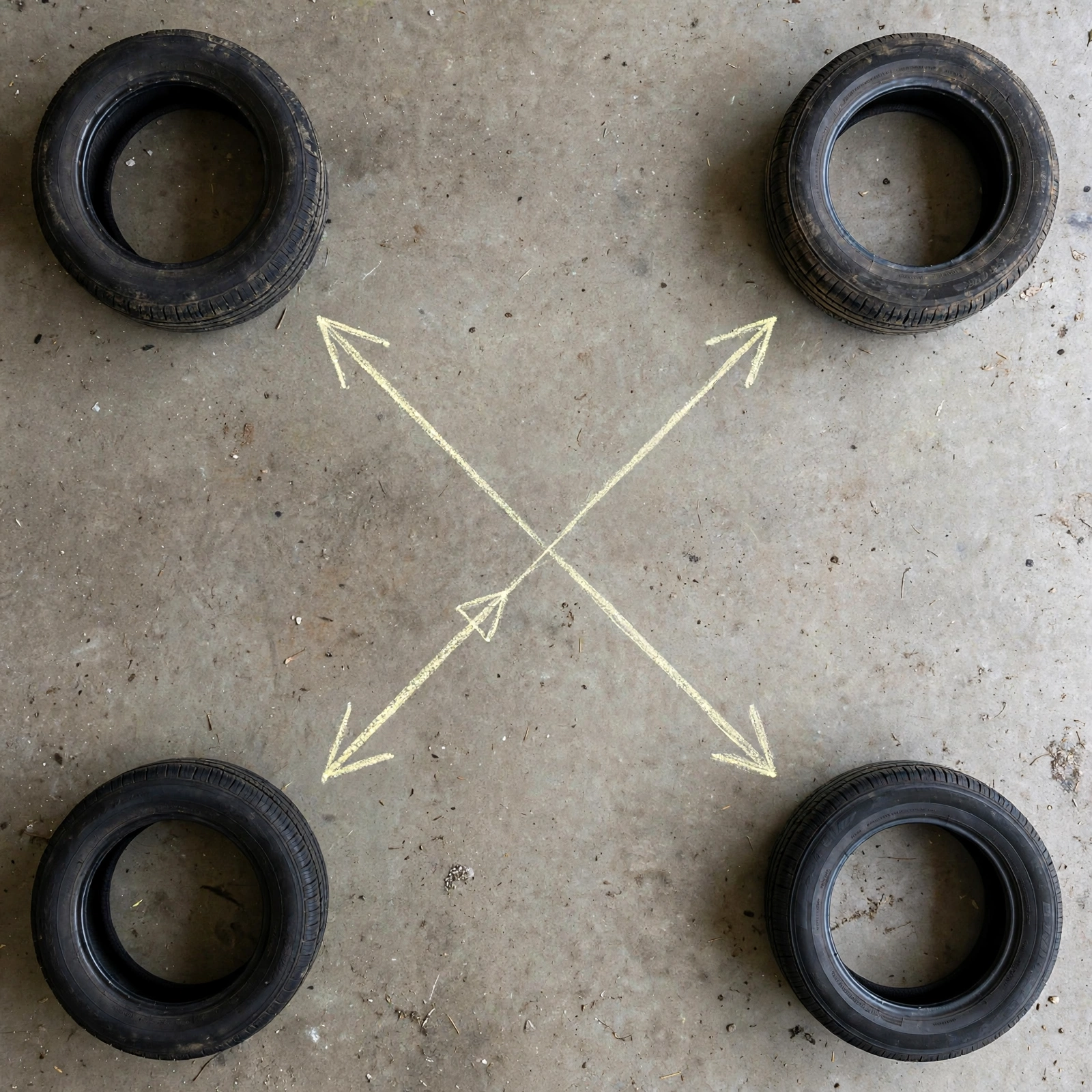
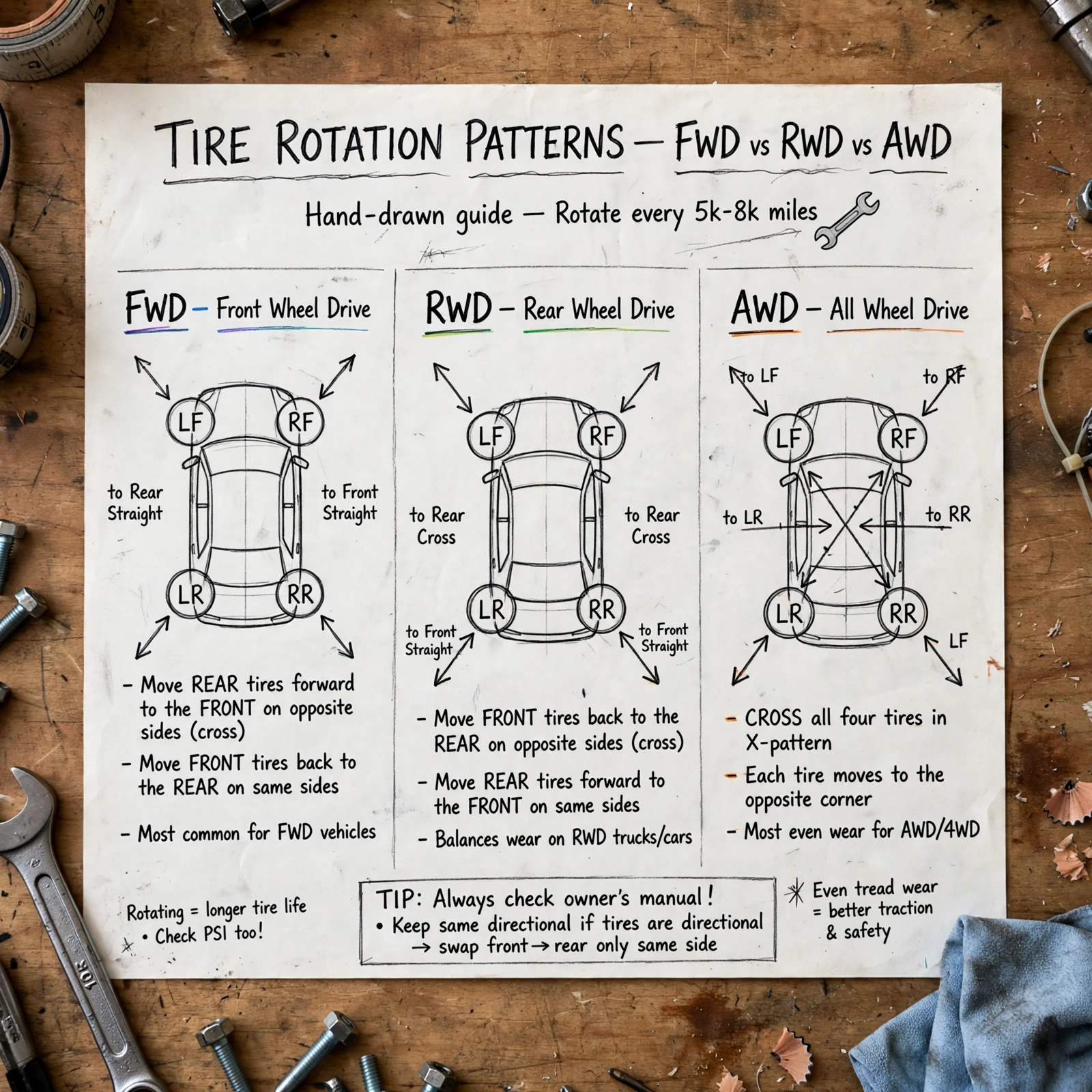
Don’t just swap front to back. You need to cross them so each tire sees both sides. Rubber has memory.
FWD: Forward Cross
This is the big one. Fronts go straight back. Rears cross to opposite front.
- Left Front -> Left Rear
- Right Front -> Right Rear
- Left Rear -> Right Front
- Right Rear -> Left Front
Why? Front tires have directional shoulder wear. Moving them straight back keeps noise down. Rears crossing up front evens the outside edge.
RWD / 4WD Truck: Rearward Cross
- Left Rear -> Left Front
- Right Rear -> Right Front
- Left Front -> Right Rear
- Right Front -> Left Rear
AWD: Use the Approved Pattern and Keep Tire Circumference Matched
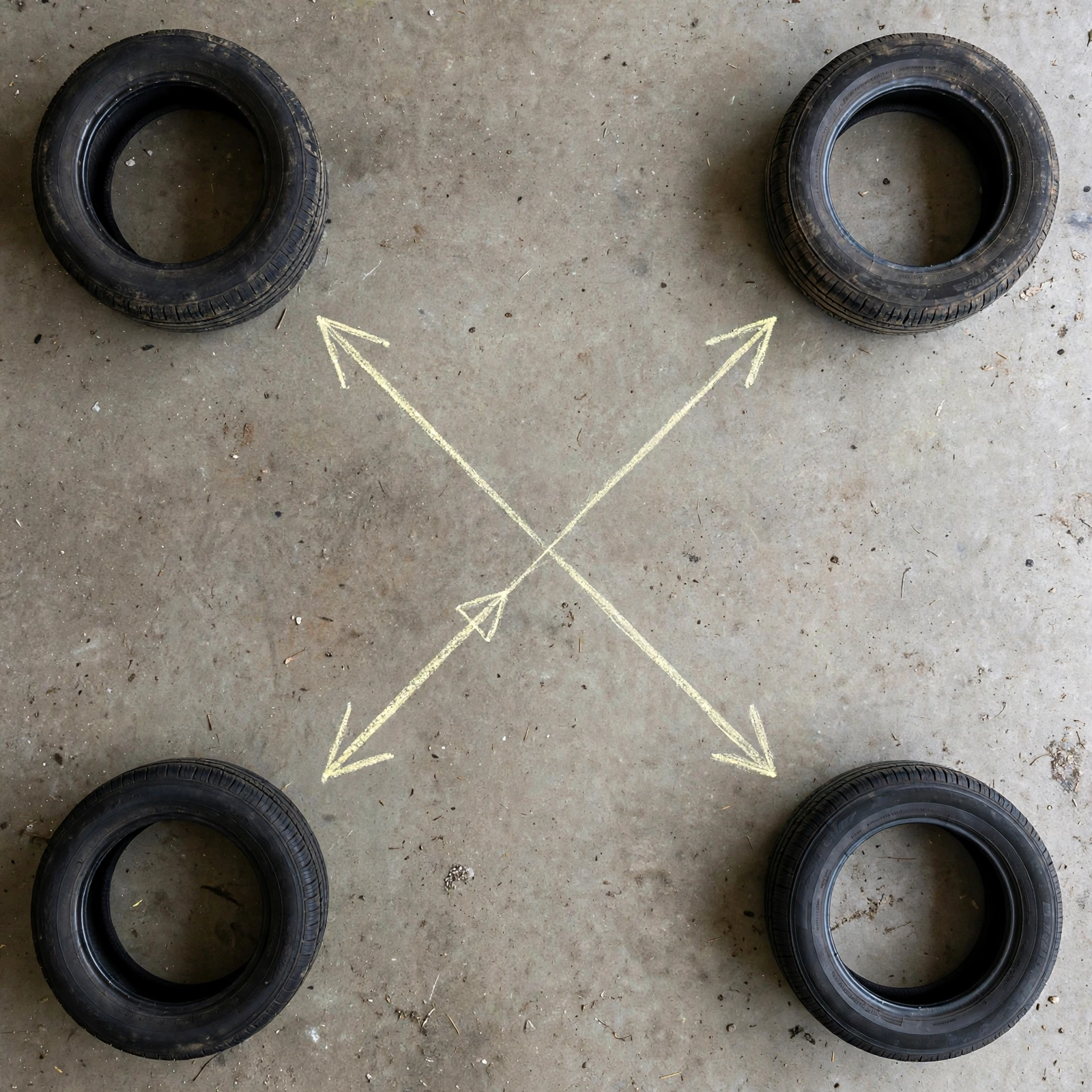
All four cross. Left Front to Right Rear, Right Front to Left Rear, and same rear to front. Keep it even or you stress the center diff. Subaru guys know — a 2/32″ mismatch can cook a viscous coupling.
Directional or Staggered Tires? Different Rules
- Directional tread (arrow on sidewall): front to rear only, same side. No crossing.
- Staggered setup (wider rear on BMW, Mustang): you can only side-to-side if non-directional, otherwise no rotation possible. Rotate via alignment and pressures.
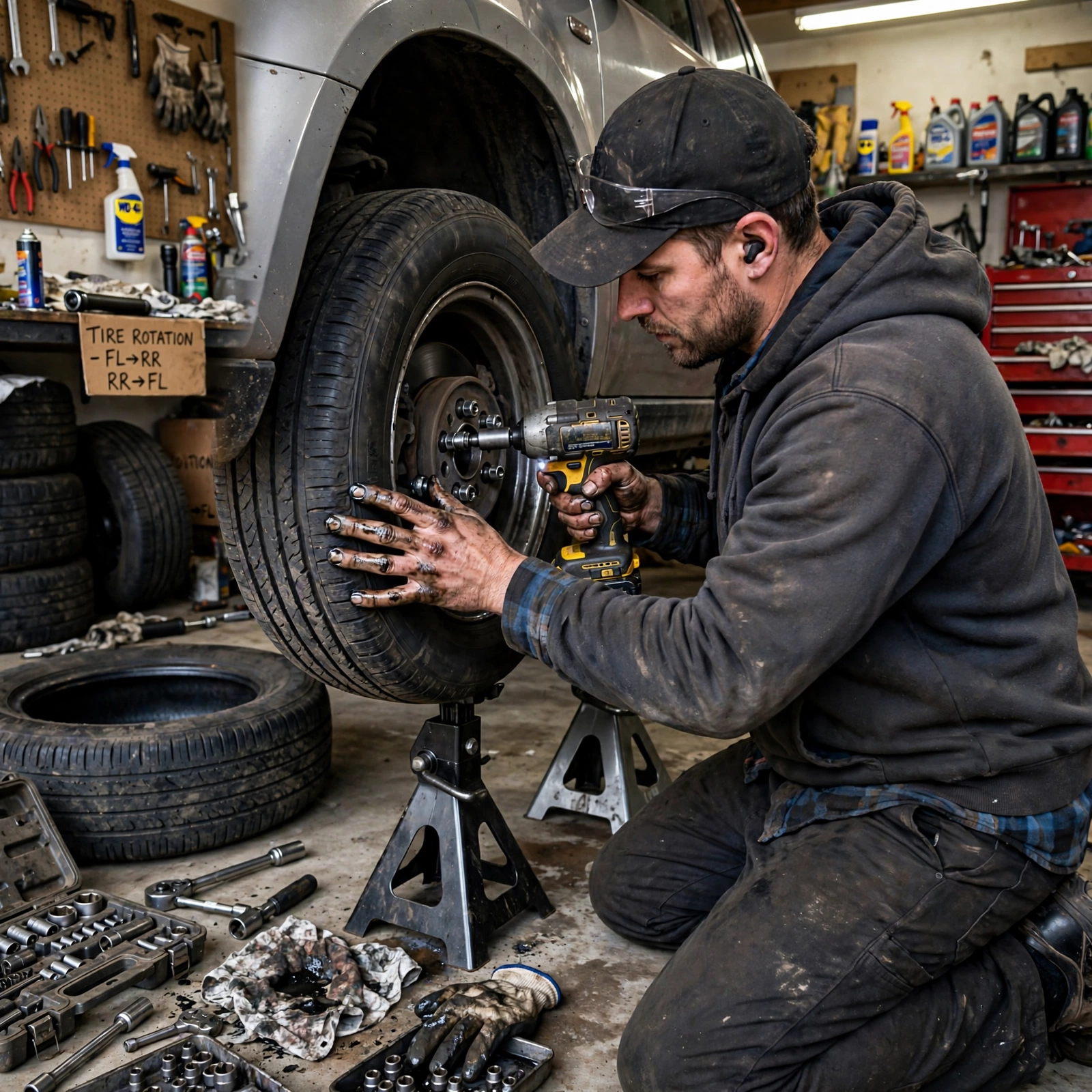
DIY Rotation: Tools, Torque, and Safety I Wish Someone Told Me
- Hydraulic floor jack — don’t use the scissor jack that comes with the car for this. It will bite you.
- 2 jack stands rated 3-ton+ — place on pinch weld or subframe, never on floor pan
- Breaker bar + 19mm, 21mm, or 22mm deep socket — check your car. Toyota usually 21mm, Honda 19mm, Ford trucks 21mm or 22mm
- Torque wrench that reads in ft-lbs — this is non-negotiable
- Wire brush to clean hub bore rust
- Anti-seize — dab on hub center, never on studs. Lube on studs throws torque off by 20-25%
Torque specs you should know:
- Small sedans (Civic, Corolla): 80 ft-lbs (108 Nm)
- Mid-size (Camry, Accord, Model 3): 76-85 ft-lbs (103-115 Nm)
- Small SUVs (CR-V, RAV4): 76-80 ft-lbs
- Trucks and SUVs: Use the exact lug-nut torque specification in the owner’s manual or service information. Do not apply a generic range or assume alloy and steel wheels share a value.
Safety that matters: Lug nuts too loose and the wheel wobbles off at 70. Too tight and you stretch studs — Over-tightening can stretch or damage wheel studs, so use the vehicle manufacturer’s specified torque and tightening sequence. Clean dirt off the wheel mating surface before you mount. That little ring of rust can make a wheel feel tight but it loosens 50 miles later. Tighten lug nuts in the specified sequence with a calibrated torque wrench. Recheck torque only if the vehicle or wheel manufacturer’s instructions call for it; do not assume every vehicle requires a 50–100-mile re-torque.
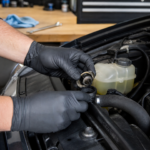
Another real one: brake fluid ruins paint to bare metal in minutes. If you’re topping off while wheels are off, clean dirt off the reservoir cap first to save the ABS valves. My hands were greasy once, knocked the cap, fluid dripped on fender — clear coat bubbled by lunch.
My Simple Process (If You DIY)
- Chock rear wheels, loosen lugs 1/4 turn while car on ground — 19mm or 21mm socket on breaker bar.
- Jack front, place stands. Same for rear. Don’t do one side only. You need both sides up to swap properly.
- Mark tires with chalk: LF, RF, LR, RR. You’ll forget.
- Wire brush hub, seat wheel, hand-thread all lugs first to avoid cross-threading.
- Lower until tire touches but still holds. Torque in star pattern. Two passes — 40 ft-lbs then final spec.
- Check all pressures. FWD often 35 front / 33 rear for comfort. Use door sticker, not tire sidewall max.
- Reset TPMS if light stays on. Toyota needs button hold under dash. Honda in infotainment settings.
So What Should You Do? Decision Time
If you drive FWD and you’ve been doing 8k rotations because the dealer sticker said so, you’re leaving tire life on the table. Switch to 5k. Pair it with every other oil change if you’re on 5k synthetic. You’ll see fronts and rears hit 4/32″ together at 45k-55k instead of fronts dying at 25k.
If you’re mostly highway in a RWD truck, 6.5k is totally fair. If you’re AWD, don’t argue — just do 5k. Your diff will thank you.
Pressure and Alignment: Rotation Won’t Fix Everything
Alignment matters more than rotation if you hit a curb or pothole. One degree of toe-out will feather a tire in 2,000 miles. No rotation pattern fixes that. If wheel is off-center after a hit, or car dog-tracks, get a $99 4-wheel alignment. Ask for printout. You want total toe under 0.20 degrees, camber within 0.5 of spec.
Winter and Summer: Adjust Your Interval
If you swap winter tires every year, your rotation math changes. I mark my winter set LF, RF, etc with chalk and next season I swap sides. That’s a built-in rotation.
- Winter tires are softer. Rotate every 4,000-5,000. They feather faster.
- Summer performance with big blocks (Pilot Sport 4S) also likes 5k. Heat cycles make edges hard.
- If you run all-seasons year-round, stick to 5k FWD / 6.5k RWD and you’re safe.
Common Mistakes That Actually Cost You
- Not checking pressures after rotation — TPMS shows 5 PSI low only after damage starts
- Using impact to tighten to ugga-dugga — you’ll warp rotors. I’ve measured 0.006″ runout after that
- Forgetting to look at direction arrows — directional tires backwards howl and hydroplane
- Skipping rotation because rears look new — that’s the whole point, they ARE new compared to fronts
Your tires are the only thing touching the road. They’re four hand-sized patches doing everything. Treat them like it.
Why AWD Is The Strictest Of All
AWD systems can be sensitive to differences in tire circumference, but the permitted tread-depth or circumference variation is model-specific. Check the owner’s manual; replace or match tires as specified rather than applying a universal 2/32-inch rule.
On AWD, the computer thinks the faster-spinning axle (the one with smaller diameter from wear) is slipping. It engages clutches constantly. Fluid cooks. You get a $900 repair that a free rotation would have avoided.
That’s why I tell every AWD owner: 5k max, no debate. If you’re measuring and you’ve got more than 1.5/32″ difference front to rear, you’re overdue already.
What About The Spare? Full-Size Rotation Tricks
If you run a full-size matching spare — common on Jeeps, 4Runners, some Subarus — do a 5-tire rotation. That spare rots in the trunk while the others wear. Better to use it.
- Pattern for 5-tire FWD: Spare → Right Rear, Right Rear → Right Front, Right Front → Left Rear, Left Rear → Left Front, Left Front → Spare
- Lug torque on spare winch carriers is often lower — check manual, usually 80 ft-lbs for alloy spare
- Don’t forget to check spare pressure. I’ve pulled spares at 18 PSI. Useless when you need it
Money Math: Does 5k Actually Save Cash?
- No rotation: fronts dead at 28k, rears at 60% left. You buy two new fronts at 28k = $404. Then you still need four at 40k because mismatched tread makes noise. Total in 50k: $1,212
- 5k rotation: all four dead evenly at 54k. One set for 50k. Total $808
- Savings: $404 over one cycle. Over 150k ownership that’s $1,200
Shop rotation costs $25-$40. Free if you bought tires at Discount Tire or Costco. DIY costs zero but 35 minutes and a 10mm socket to remove those stupid engine covers if you’re also checking fluids.
Signs You Waited Too Long
- Steering wheel shimmy at 65-75 mph but tires balance fine — that’s uneven wear
- Front tires roar in turns, quiet straight — feathered edges
- Tread depth gauge shows 2/32″ difference front to rear — do it today
- TPMS light after long highway drive — low spot heats and pressure drops




Leave a Reply