
Why I Stopped Guessing My Rotation Schedule
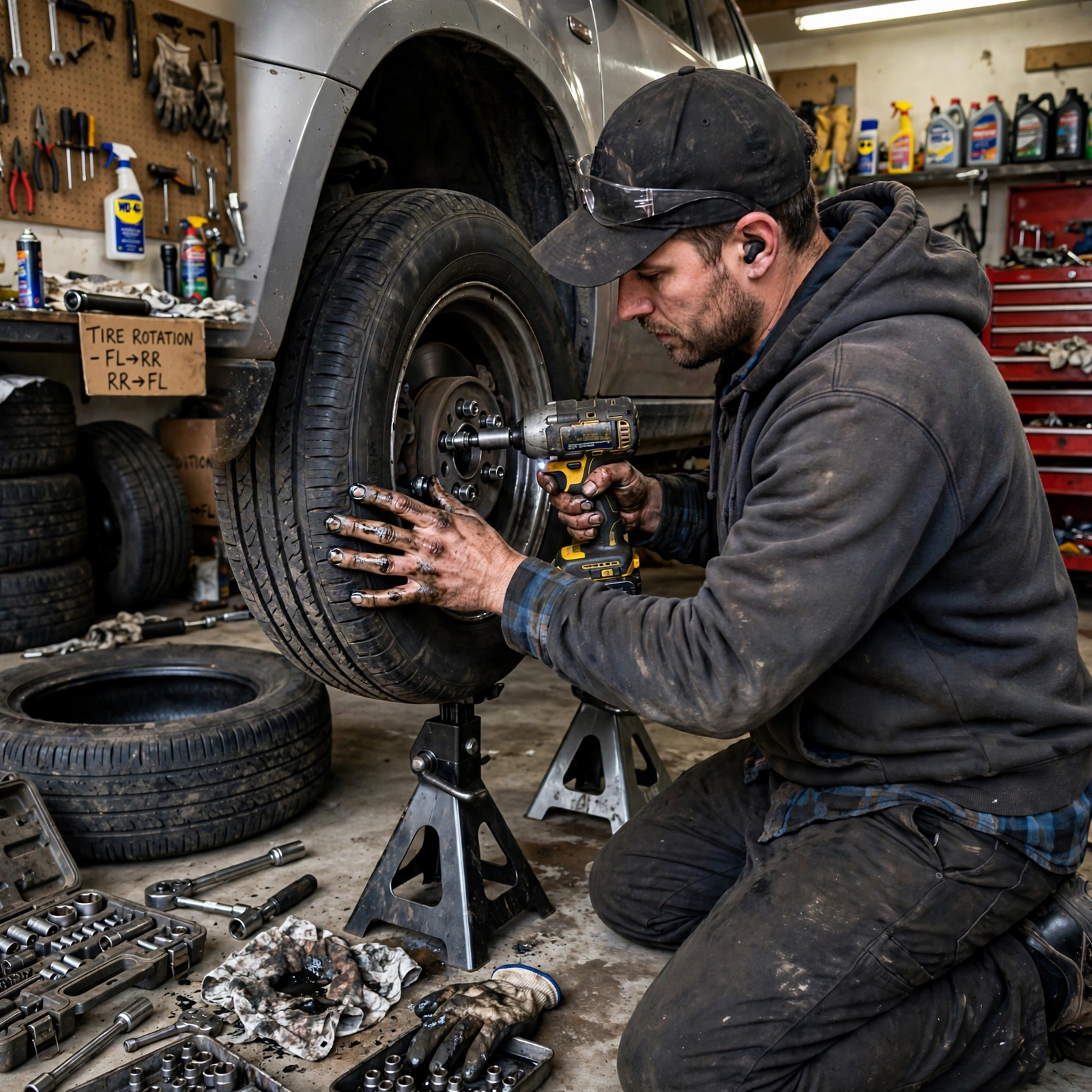
I was under my Mazda in the garage last spring, hands black, 19mm socket still on the impact. My front tires looked like they’d been chewed on the edges. Rears? Almost new. That’s when it clicked — I’d pushed it to 9,200 miles since the last rotation.
Your manual says 5,000 to 8,000 miles. That’s a big gap. And if you drive a front-wheel-drive car like 80% of us do, that generic advice costs you money. I learned the hard way, so you don’t have to.
Rotate too little and you get noisy cupping, squirrelly braking, and a set of tires that dies at 30k instead of 50k. Rotate too often and you’re just burning Saturday hours and lug nut threads.
5k vs 8k: What Actually Matters?
The real battle isn’t 5,000 vs 8,000 on paper. It’s your drive type, your tire compound, and how hard you turn.
- 5,000 miles — best for FWD, performance summer tires, aggressive city driving, and AWD vehicles. If you brake late and turn hard, this is your number.
- 6,000-7,500 miles — sweet spot for most RWD trucks and SUVs with all-season tires and lots of highway miles.
- 8,000 miles — only OK if you’re 90% highway, RWD or light FWD commuter, and you check pressures monthly. I still don’t love it for FWD.
I run my wife’s FWD Civic at 5k flat. My old RWD Tacoma? I let it go to 6,500. That small change added about 12,000 extra miles to her last set of Continentals. That’s $480 I didn’t spend.
How Tread Actually Wears
You’ve got 10/32″ to 11/32″ new. Legal minimum is 2/32″. The front tires on a FWD car do everything — steer, brake, and drive. The rears just tag along.
On my measurements with a $6 tread depth gauge (way better than the penny test), my Civic fronts lose 1/32″ every ~3,500 miles. Rears? 1/32″ every 7,000 miles. Without rotation, you’re 2/32″ apart in 7k. That’s enough to hum at 65 mph and mess with traction control on wet roads.
| Drivetrain | Front Wear Rate | Rear Wear Rate | My Recommended Interval |
|---|---|---|---|
| FWD | Fastest – edges + center | Slow, even | 5,000 miles |
| RWD | Moderate – shoulder wear from turning | Fast – center if over-inflated | 6,000-7,500 miles |
| AWD | Fast | Fast, but slightly less | 5,000 miles, never skip |
Front-Wheel-Drive Wear Pattern: Why It’s Brutal
If you own a Civic, Corolla, Accord, Camry, CR-V, RAV4 — you’re FWD. Here’s what you’ll see if you don’t rotate:
- Outer edge feathering on fronts from cornering loads
- Center wear faster if you run 36+ PSI in fronts
- Rear tires get cupped or flat-spotted because they never change direction
- Car pulls a bit under hard braking because grip is uneven
And here’s a safety bit no one tells you: put the best tread on the rear, always. Even on FWD. If your rears are bald you oversteer in rain. I’ve felt that rear swing on my Mazda3 in a storm — not fun. Shops that put new tires on front only are doing it wrong.

The Right Rotation Pattern For Your Car
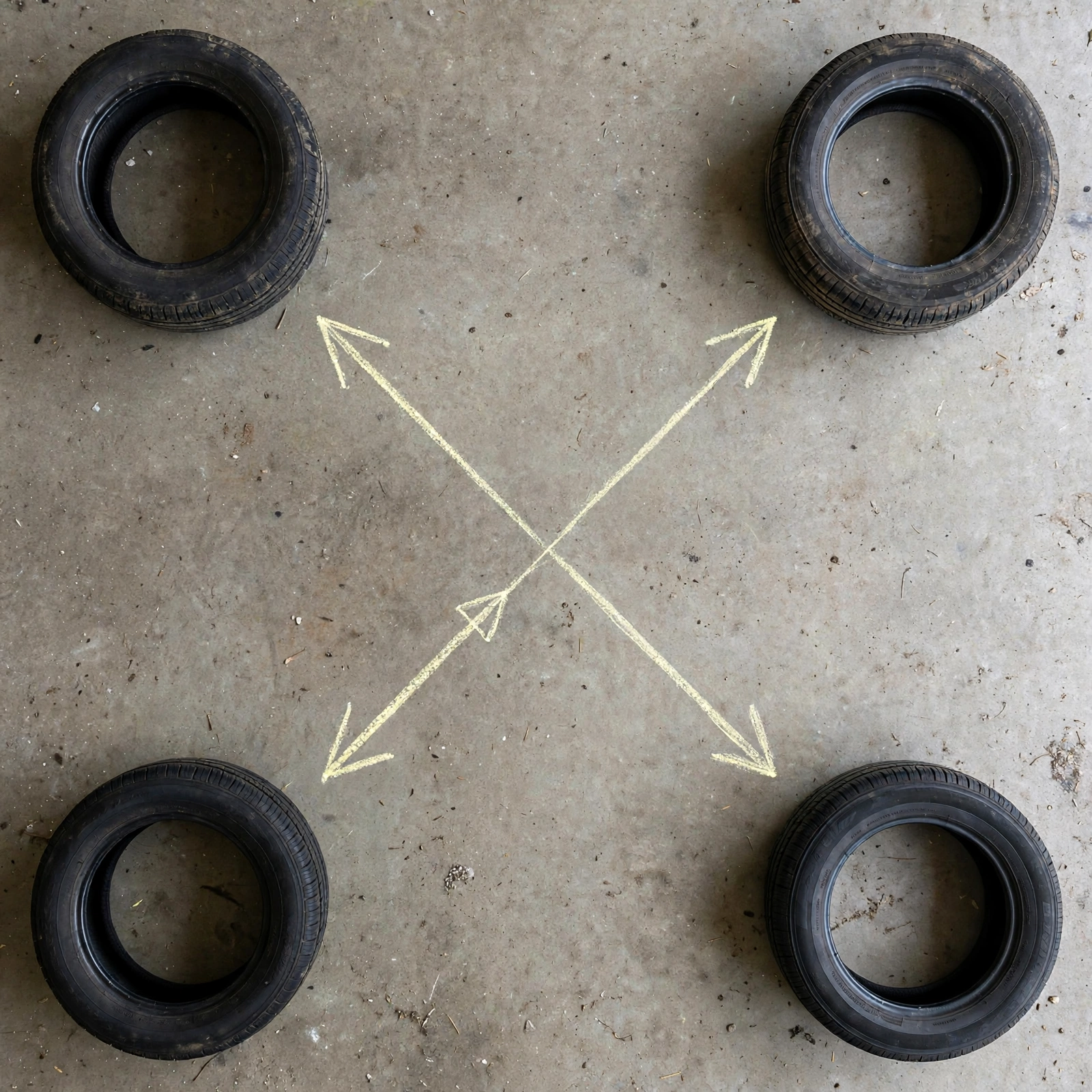
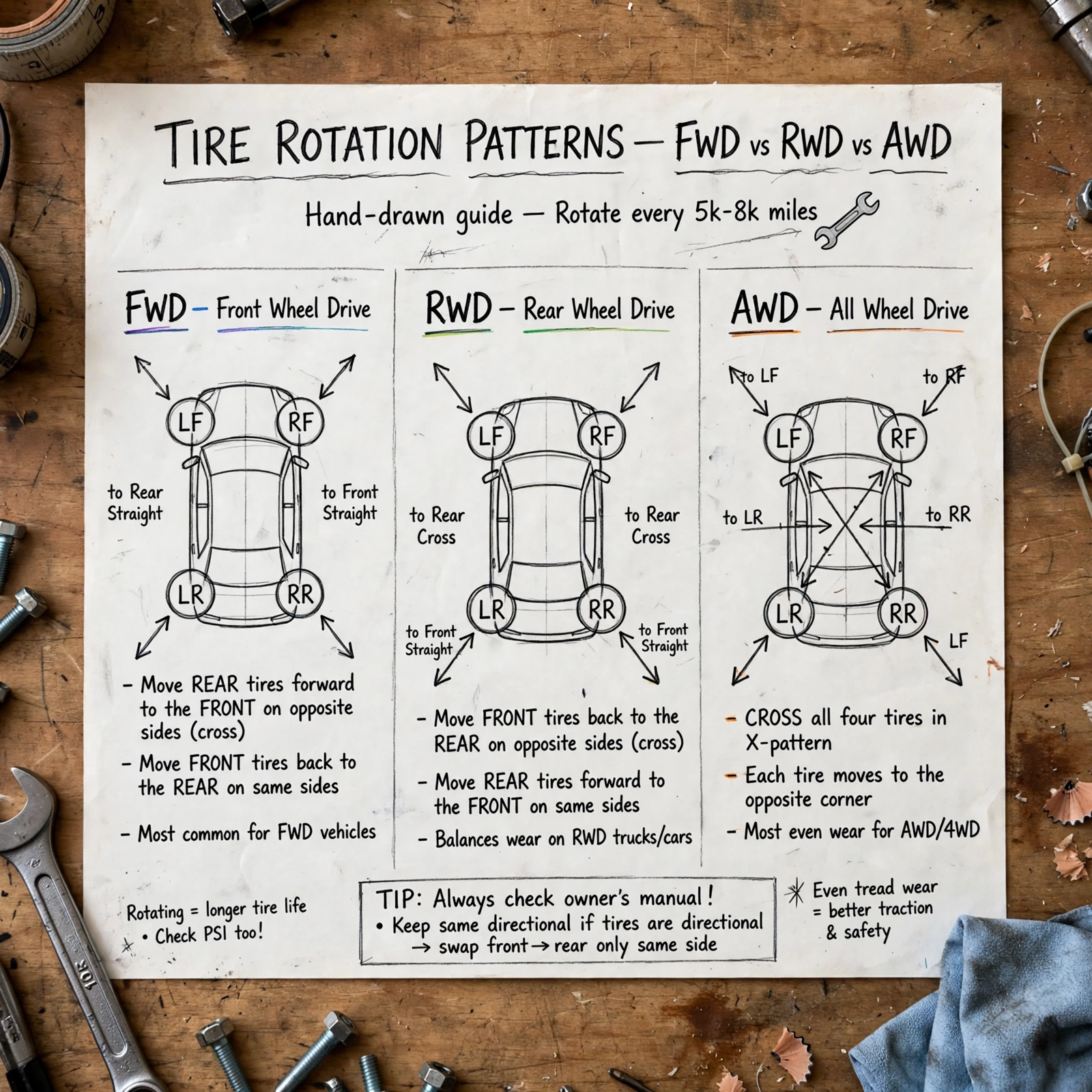
Don’t just swap front to back. You need to cross them so each tire sees both sides. Rubber has memory.
FWD: Forward Cross
This is the big one. Fronts go straight back. Rears cross to opposite front.
- Left Front -> Left Rear
- Right Front -> Right Rear
- Left Rear -> Right Front
- Right Rear -> Left Front
Why? Front tires have directional shoulder wear. Moving them straight back keeps noise down. Rears crossing up front evens the outside edge.
RWD / 4WD Truck: Rearward Cross
- Left Rear -> Left Front
- Right Rear -> Right Front
- Left Front -> Right Rear
- Right Front -> Left Rear
AWD: Full X-Pattern
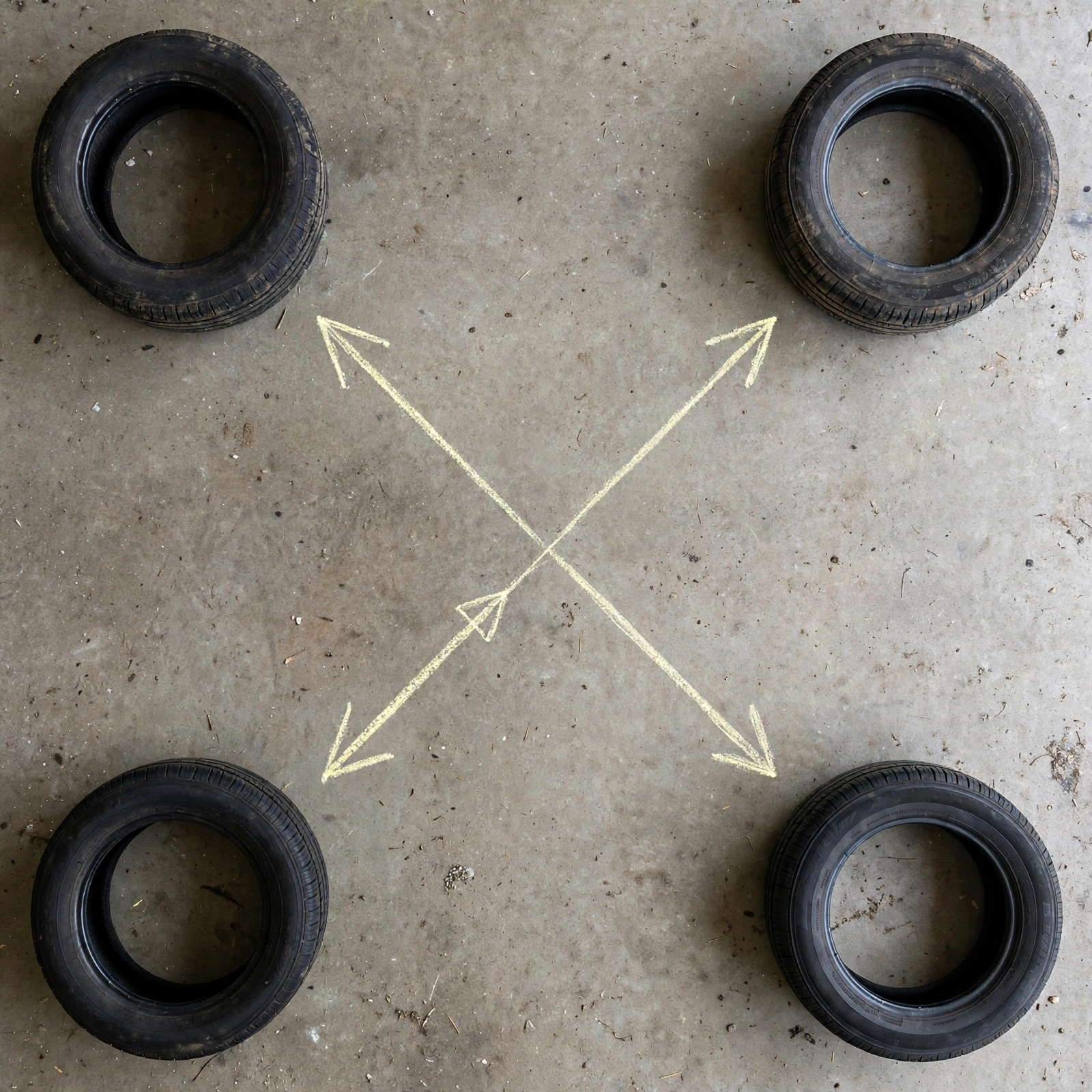
All four cross. Left Front to Right Rear, Right Front to Left Rear, and same rear to front. Keep it even or you stress the center diff. Subaru guys know — a 2/32″ mismatch can cook a viscous coupling.
Directional or Staggered Tires? Different Rules
- Directional tread (arrow on sidewall): front to rear only, same side. No crossing.
- Staggered setup (wider rear on BMW, Mustang): you can only side-to-side if non-directional, otherwise no rotation possible. Rotate via alignment and pressures.
DIY Rotation: Tools, Torque, and Safety I Wish Someone Told Me
I do mine in my driveway in 35 minutes. Here’s what you actually need:
- Hydraulic floor jack — don’t use the scissor jack that comes with the car for this. It will bite you.
- 2 jack stands rated 3-ton+ — place on pinch weld or subframe, never on floor pan
- Breaker bar + 19mm, 21mm, or 22mm deep socket — check your car. Toyota usually 21mm, Honda 19mm, Ford trucks 21mm or 22mm
- Torque wrench that reads in ft-lbs — this is non-negotiable
- Wire brush to clean hub bore rust
- Anti-seize — dab on hub center, never on studs. Lube on studs throws torque off by 20-25%
Torque specs you should know:
- Small sedans (Civic, Corolla): 80 ft-lbs (108 Nm)
- Mid-size (Camry, Accord, Model 3): 76-85 ft-lbs (103-115 Nm)
- Small SUVs (CR-V, RAV4): 76-80 ft-lbs
- Trucks / Large SUVs (F-150, Tacoma, Tahoe): 100-140 ft-lbs (135-190 Nm) — my Tacoma is 83 ft-lbs for alloy, but steel spare is 97. Check door jamb sticker sheet.
Safety that matters: Lug nuts too loose and the wheel wobbles off at 70. Too tight and you stretch studs — I’ve snapped two on my old Jetta learning that. Clean dirt off the wheel mating surface before you mount. That little ring of rust can make a wheel feel tight but it loosens 50 miles later. And after rotation, drive 50-100 miles and re-torque. Seriously.
Another real one: brake fluid ruins paint to bare metal in minutes. If you’re topping off while wheels are off, clean dirt off the reservoir cap first to save the ABS valves. My hands were greasy once, knocked the cap, fluid dripped on fender — clear coat bubbled by lunch.
My Simple Process (If You DIY)
- Chock rear wheels, loosen lugs 1/4 turn while car on ground — 19mm or 21mm socket on breaker bar.
- Jack front, place stands. Same for rear. Don’t do one side only. You need both sides up to swap properly.
- Mark tires with chalk: LF, RF, LR, RR. You’ll forget.
- Wire brush hub, seat wheel, hand-thread all lugs first to avoid cross-threading.
- Lower until tire touches but still holds. Torque in star pattern. Two passes — 40 ft-lbs then final spec.
- Check all pressures. FWD often 35 front / 33 rear for comfort. Use door sticker, not tire sidewall max.
- Reset TPMS if light stays on. Toyota needs button hold under dash. Honda in infotainment settings.
So What Should You Do? Decision Time
If you drive FWD and you’ve been doing 8k rotations because the dealer sticker said so, you’re leaving tire life on the table. Switch to 5k. Pair it with every other oil change if you’re on 5k synthetic. You’ll see fronts and rears hit 4/32″ together at 45k-55k instead of fronts dying at 25k.
If you’re mostly highway in a RWD truck, 6.5k is totally fair. If you’re AWD, don’t argue — just do 5k. Your diff will thank you.
And one last peer tip: take a photo of your tread after each rotation with your phone light at an angle. You’ll spot feathering before you feel it. I keep a folder — nerdy, but it saved me from needing an alignment after I hit a pothole on I-35.
Pressure and Alignment: Rotation Won’t Fix Everything
I see guys rotate religiously but never check pressure. Wrong order. Under-inflation by 6 PSI scrubs edges off 30% faster. Over-inflation centers wear. Your door jamb sticker says 32-35 PSI cold for most cars. Check it cold, not after driving. I keep a $25 digital gauge in glove box. That stick pencil gauge lies.
Alignment matters more than rotation if you hit a curb or pothole. One degree of toe-out will feather a tire in 2,000 miles. No rotation pattern fixes that. If wheel is off-center after a hit, or car dog-tracks, get a $99 4-wheel alignment. Ask for printout. You want total toe under 0.20 degrees, camber within 0.5 of spec.
Winter and Summer: Adjust Your Interval
If you swap winter tires every year, your rotation math changes. I mark my winter set LF, RF, etc with chalk and next season I swap sides. That’s a built-in rotation.
- Winter tires are softer. Rotate every 4,000-5,000. They feather faster.
- Summer performance with big blocks (Pilot Sport 4S) also likes 5k. Heat cycles make edges hard.
- If you run all-seasons year-round, stick to 5k FWD / 6.5k RWD and you’re safe.
Hot coolant burns and brake dust is nasty. When wheels are off, don’t pop coolant cap hot. Wait. And wash hands before touching brake rotor face. Greasy fingerprints cause pulsation that feels like warped rotors. I use brake cleaner $5 can and a rag.
Common Mistakes That Actually Cost You
- Not checking pressures after rotation — TPMS shows 5 PSI low only after damage starts
- Using impact to tighten to ugga-dugga — you’ll warp rotors. I’ve measured 0.006″ runout after that
- Forgetting to look at direction arrows — directional tires backwards howl and hydroplane
- Skipping rotation because rears look new — that’s the whole point, they ARE new compared to fronts
Your tires are the only thing touching the road. They’re four hand-sized patches doing everything. Treat them like it.
Why AWD Is The Strictest Of All
People think AWD means you can ignore rotation. Opposite. I blew a transfer case lesson on my buddy’s 2018 Forester. He ran 14k without rotation. Fronts at 4/32″, rears at 7/32″. Subaru’s manual says keep all four within 2/32″. His diff was binding in parking lots.
On AWD, the computer thinks the faster-spinning axle (the one with smaller diameter from wear) is slipping. It engages clutches constantly. Fluid cooks. You get a $900 repair that a free rotation would have avoided.
That’s why I tell every AWD owner: 5k max, no debate. If you’re measuring and you’ve got more than 1.5/32″ difference front to rear, you’re overdue already.
What About The Spare? Full-Size Rotation Tricks
If you run a full-size matching spare — common on Jeeps, 4Runners, some Subarus — do a 5-tire rotation. That spare rots in the trunk while the others wear. Better to use it.
- Pattern for 5-tire FWD: Spare → Right Rear, Right Rear → Right Front, Right Front → Left Rear, Left Rear → Left Front, Left Front → Spare
- Lug torque on spare winch carriers is often lower — check manual, usually 80 ft-lbs for alloy spare
- Don’t forget to check spare pressure. I’ve pulled spares at 18 PSI. Useless when you need it
Money Math: Does 5k Actually Save Cash?
I tracked this on my wife’s Civic. Four new Michelin Defender 2 at $172 each = $688. Mount and balance $120. Total $808 installed.
- No rotation: fronts dead at 28k, rears at 60% left. You buy two new fronts at 28k = $404. Then you still need four at 40k because mismatched tread makes noise. Total in 50k: $1,212
- 5k rotation: all four dead evenly at 54k. One set for 50k. Total $808
- Savings: $404 over one cycle. Over 150k ownership that’s $1,200
Shop rotation costs $25-$40. Free if you bought tires at Discount Tire or Costco. DIY costs zero but 35 minutes and a 10mm socket to remove those stupid engine covers if you’re also checking fluids.
Signs You Waited Too Long
- Steering wheel shimmy at 65-75 mph but tires balance fine — that’s uneven wear
- Front tires roar in turns, quiet straight — feathered edges
- Tread depth gauge shows 2/32″ difference front to rear — do it today
- TPMS light after long highway drive — low spot heats and pressure drops
If you see steel cords, bulges, or one side bald, don’t rotate. Replace. And get an alignment. No pattern fixes camber wear. My Mazda wore inside edge to canvas because lower control arm bushing was shot. Rotation just moved the problem.





Leave a Reply