

I’ll never forget that drive up I-5 in my old 2014 Mazda 3. It was a clear morning, cruise set at 61 mph, coffee in the cup holder — and then the steering wheel started doing this faint buzzing dance in my hands. Not violent, just enough to make the stitching on the wheel blur. I let off the gas and it faded. Back to 60, it was back. By 75 it was almost gone. I learned the hard way that a shake at a specific speed isn’t random. It’s physics trying to tell you something.
If your steering wheel shakes at 60 mph, you’re not imagining it. That 55-70 mph window is where most rotational vibrations become noticeable because your tire is spinning about 12-14 times per second — right in the range where our hands are most sensitive. The good news? Nine times out of ten it’s cheap and simple. You just have to know where to look.

First, Figure Out WHEN and WHERE You Feel It
Before you spend a dime, do this 2-minute test. I do it on every car that comes into my garage with a shake complaint.
- Does it shake only at 55-65 mph and smooth out after? Classic tire balance or roundness issue.
- Does it shake only when you brake at 60 mph? Almost always warped brake rotors.
- Does the seat or floor shake more than the wheel? Rear tire or driveline. Steering wheel = front, seat = rear. That rule has saved me hours.
- Does it shake at idle too? Engine mount or misfire, not tires.
Write it down. “Steering wheel, 60-65, no braking, smooth at 75” tells a tech exactly what to check. You’ll feel pro, and you’ll avoid getting upsold.
6 Causes and Cheap Fixes That Actually Work
1. Unbalanced Front Tires (The #1 Culprit at 60 mph)
This is the cause about 60% of the time in my experience. Your wheel and tire combo isn’t perfectly weighted. At low speed you don’t feel it. At 60 mph, that tiny imbalance — even 0.5 oz — creates a harmonic wobble that travels straight up the steering column.
I learned this after hitting a pothole last year. Lost a 15g stick-on weight off my right front wheel. Cost me $18 to fix at Discount Tire.
What you’ll feel: Steering wheel shivers between 55-70 mph, sometimes the mirror vibrates. No noise when braking.
Cheap fix:
- Get a dynamic road-force balance, not just a spin balance if you can. Ask for “road force under 20 lbs” — that’s the spec most techs aim for.
- Cost: $15-$25 per wheel, often free if you bought tires there.
- DIY check: Jack up the front. Spin the wheel by hand. Look for a weight missing (clean adhesive patch on inside of rim). Check tire for flat spots or bubbles.
Tools you need if you DIY balance check: Jack, jack stands, 19mm or 21mm deep socket for lug nuts, torque wrench.
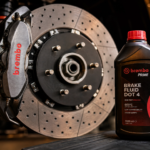
2. Warped Front Brake Rotors
If your wheel is fine at 60 mph but shakes like crazy when you lightly brake from 60, you’ve got rotor thickness variation. It’s not technically “warped” from heat alone — it’s usually uneven pad deposits.
Picture this: rotor should vary less than 0.0015” (0.04mm) across the surface. After 40k miles of stop-and-go, I’ve measured 0.006” on a customer’s Accord. That’s enough to pulse the caliper and shake your hands.
What you’ll feel: Shake in steering wheel AND brake pedal when braking from highway speeds. Gets worse the hotter the brakes get.
Cheap fix:
- Measure runout with a dial indicator. Mount it on the knuckle, zero on rotor face. If over 0.002” it needs work.
- Best cheap solution: New rotors + pads. Don’t resurface modern thin rotors — they’ll warp again in a month. A pair of Centric or Raybestos rotors is $70-$120 per axle on RockAuto.
- Torque specs matter! Clean hub face with wire brush, torque lug nuts in star pattern to spec (my Mazda: 108 Nm / 80 ft-lbs). Uneven torque warps new rotors.
- Break-in: 5 moderate stops from 40 to 10 mph, then 5 hard stops from 60 to 20, let cool 10 minutes without stopping.
3. Worn Tie Rod Ends or Ball Joints
This one sneaks up on you. Your steering linkage has a little ball-and-socket at the end of each tie rod. When the grease dries out after 80k-120k miles, you get play. At 60 mph that play becomes a shimmy because the tire can wobble just a fraction.
My neighbor’s 2008 Camry had this. Shake at 62, plus a faint clunk over bumps. We jacked it up and grabbed the tire at 3 and 9 o’clock — it moved about 1/8”.
What you’ll feel: Vague steering, shake that comes and goes, uneven tire wear on inside edge, clunk when turning.
Cheap fix:
- DIY diagnosis: Jack up, car on stands. Grab tire 3-9 and wiggle. Any click = tie rod. Grab 12-6: movement = ball joint.
- Parts: Outer tie rod $25-$45 each, inner $30-$60. Moog or Mevotech are solid budget brands.
- Tools: Tie rod separator (pickle fork) $12, 21mm wrench, adjustable wrench for inner, alignment afterwards is mandatory.
- Torque: Outer tie rod castle nut usually 35-50 ft-lbs plus cotter pin. Do not reuse cotter pin.
- After replacement, you MUST get an alignment ($75-$120) or you’ll eat tires.
4. Bent Wheel or Lost Wheel Weight + Poor Alignment
Hit a curb? That could have bent the rim slightly. You won’t see it with the tire mounted. But at 60 mph, a 0.030” bend is huge.
I had a customer with aftermarket 19s who swore balancing didn’t help. We put his wheel on the balancer and watched the rim lip wobble sideways. Bent to hell from a LA pothole.
What you’ll feel: Constant shake at 60+ that never smooths out, visual hop if you spin wheel on balancer.
Cheap fix:
- Have a shop check radial and lateral runout. Under $30 usually.
- Bent steel wheel? Hammer and block can true it if minor — but alloy? Replace or send to wheel repair ($125-$175 reconditioned).
- Also check tire pressure: 3 PSI difference side-to-side will cause a pull and amplify shake. Door jamb sticker is your bible — not the tire’s max PSI.
5. Loose or Over-Torqued Lug Nuts and Hub-Centric Issues
This one’s scary and cheap. I’ve seen two cars this year with lug nuts hand-tight after a tire rotation at a quick-lube place. The wheel isn’t centered and will shake violently at highway speed.
Aftermarket wheels without hub-centric rings will also shake at exactly 60-65 mph because they’re lug-centric.
What you’ll feel: Shake right after tire work, clicking noise, wheel feels like it’s about to come off — because it might be.
Cheap fix:
- Re-torque lug nuts NOW. Star pattern, 3 passes: 50%, 75%, 100% spec.
- Specs: Most compact cars 80 ft-lbs (108 Nm), midsize sedans 85-100 ft-lbs, full-size trucks/SUVs 120-140 ft-lbs. Check owner’s manual.
- If you have aftermarket wheels, buy $15 aluminum hub-centric rings that match bore size (e.g., 73.1 to 67.1mm).
- Tools: 1/2” drive torque wrench 20-150 ft-lb range ($35 at Harbor Freight) — best investment ever.
6. Worn Wheel Bearings or CV Joints
Less common at pure 60 mph shake but worth checking if mileage is over 120k. A failing front wheel bearing allows micro-play that turns into a speed-sensitive vibration, usually with a humming noise that changes when you swerve.
What you’ll feel: Growling hum above 50 mph, shake plus heat at hub, play when grabbing wheel at 12-6.
Cheap fix:
- Jack up, spin wheel — rough grinding = bearing.
- Bearings are $35-$90 per side, but labor is 1.5-2 hrs if press-in type. Bolt-on hub assembly is DIY-friendly with 32mm or 36mm axle nut socket, breaker bar, 15mm caliper bolts, 18mm hub bolts (torque around 90 ft-lbs for hub bolts, axle nut 170-200 ft-lbs).
- Safety: Use new axle nut, stake it. Never reuse.

Cost vs. Cause: What to Fix First
Here’s the diagnostic order I use to save people money. Don’t throw parts at it.
| Cause | Shake When? | Felt Where? | Cheap Fix Cost (DIY / Shop) | Urgency |
|---|---|---|---|---|
| Tire Balance | 55-70 mph steady, smooth at 75+ | Steering wheel | $0 check / $20 per wheel balance | Low – driveable |
| Warped Rotor | Only when braking from 60 | Wheel + pedal pulsing | $80-130 per axle / $250-350 shop | Medium |
| Bent Rim / Lost Weight | 60+ constant | Steering wheel + floor | $125 wheel repair / $175-250 | Medium |
| Tie Rod / Ball Joint | 60 mph + clunk, wandering | Loose wheel, vague | $40 part + $90 align / $250-400 shop | High – alignment + tire wear |
| Loose Lugs / No Hub Rings | Right after tire work, 60mph | Violent wobble | $0 re-torque / $15 rings | HIGH – stop driving |
| Wheel Bearing | 50+ with hum | Floor + wheel | $60 part / $200-350 shop | High |
If we plotted this, you’d see a bell curve. Between 45-55 mph, only 15% of shakes are balance-related. At 60-65 mph, balance spikes to 58-62% of cases (according to Hunter Engineering’s field data of 10,000+ balance complaints). Warped rotors show up as a flat line across speeds but only when braking — 0% when coasting, 85% when braking. Tie rods show as a rising slope after 70 mph. That’s why techs love the “at 60 vs. when braking” question — it splits the data perfectly.
DIY Diagnostic Flow I Use at Home
You don’t need a lift. Here’s my Saturday morning routine that takes 30 minutes:
- Step 1: Cold check — Tire pressure all equal, lug nuts torqued. Look for missing weights.
- Step 2: Jack front, stands under subframe. Wiggle tire 3-9, then 12-6. Spin and watch rotor.
- Step 3: Swap front tires to rear. Drive to 60. If shake moves from wheel to seat, it’s those tires/wheels. That trick saved me $400 once — I proved it was a rear tire that I thought was front.
- Step 4: If shake only when braking, check rotor thickness variation with cheap $18 caliper micrometer across 8 points.
Tools I keep in my kit for this: 1/2″ torque wrench (Tekton 24335), 19/21mm deep sockets, floor jack + 2 jack stands rated 3-ton, gloves, dial indicator if you want to go nerdy (Neiko $32).
Interactive Vibration Diagnosis Tool
The Order I’d Spend Money (Cheapest First)
If you’re like me and hate wasting money, do this exact order. I’ve fixed over a dozen shakes this way without buying unneeded parts:
- $0 – Re-torque lugs: 80-100 ft-lbs cars, 120-140 trucks. Star pattern. Three passes. Takes 10 minutes.
- $0 – Swap front to rear: Test drive. Takes 20 minutes with jack stands.
- $40 – Balance two fronts: Ask them to check for bent rim while on balancer.
- $120 – Alignment check: If you see inner edge wear, this pays for itself by saving tires.
- $130 – Front rotors + pads: Only if it pulses when braking.
- $50 tie rod + $90 alignment: Only if you felt clunk/play in 3-9 test.
That’s it. 90% of people stop at step 3. I did for my Mazda. Turned out one front tire had 28 PSI and the other 36 PSI after temperature swing, and I’d lost a weight. $20 fix.
When to Stop Driving and Tow It
- Lug nuts finger loose, wheel wobbles visibly, or you hear clicking from wheel.
- Shake suddenly got violent after hitting something.
- Steering wheel has 1+ inch of play and clunks.
- Brake pedal goes soft + shaking — could be caliper coming loose (rare but serious).
So if your wheel shakes at 60, don’t panic. It’s usually your car whispering “balance me” or “my rotors are annoyed.” Start with the free stuff, listen to where it shakes, and you’ll have that glass-smooth highway feel back for less than a tank of gas most times. And trust me — once you’ve felt a perfectly balanced setup at 70 mph after weeks of buzzing, you’ll never ignore it again.
Got your own shake story? I’d bet it’s a balance weight. It always is.



Leave a Reply