
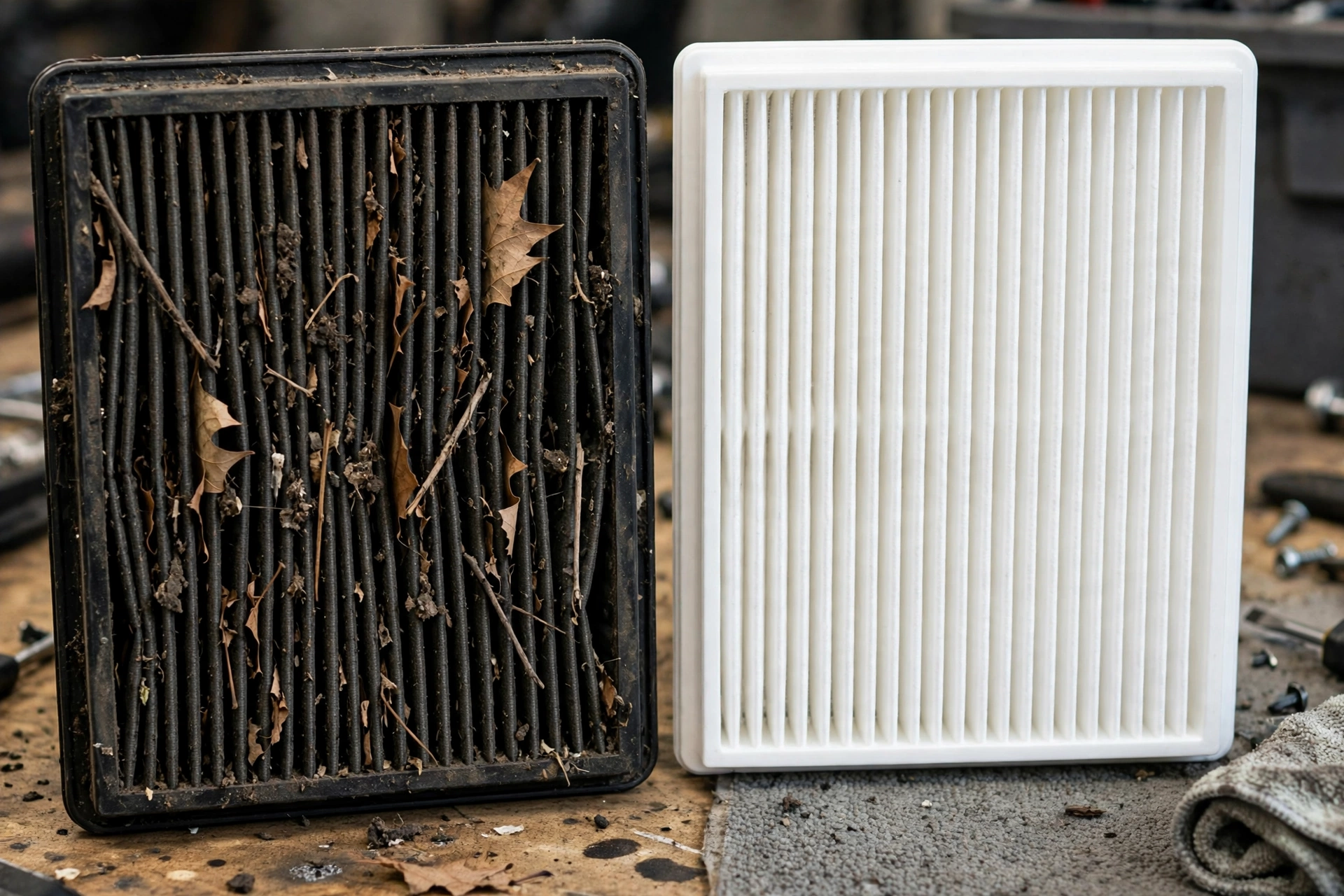
I learned my lesson about cabin air filters the disgusting way. It was a July afternoon in 2019, 96 degrees in Phoenix, and my 2016 Mazda CX-5’s AC had gone from “meh” to “is this thing even on?” My wife has seasonal allergies, and she kept sneezing every time we got in the car. I figured the AC needed a recharge. Nope.
When I finally pulled the glovebox down — and on the Mazda that’s just squeezing two plastic tabs, no tools — what came out looked like a small furry animal had died in there. Leaves, dog hair from our Beagle mix, a decade’s worth of desert dust caked into a black slab. The owner’s manual said 30,000 miles. I was at 22,000. That filter was done at 12k, easy.
That’s the gap nobody tells you about. The manual was written in a lab in Hiroshima. You drive on actual roads, behind diesel trucks, past construction zones, with pollen and wildfire smoke and that weird smell when you follow a farm truck. So let’s cut through the marketing and talk about what a real mechanic does on his own cars.

If you’re here, you probably feel it already — weak airflow, musty smell, windows fogging up too fast. You’re not imagining it. You’ll feel the difference in 10 minutes with a new filter you bought for $18.
What Your Cabin Air Filter Actually Does (And Doesn’t Do)
Forget the engine air filter for a second. That’s a different beast. Your cabin filter is literally the face mask for your HVAC system. Every bit of outside air you get through the vents passes through it before it hits your nose.
The Basics You Should Know:
- It traps the nasty stuff: Pollen, dust, PM2.5 soot, brake dust, mold spores, even exhaust particles if you have an activated carbon version.
- It protects your AC evaporator: Without it, that dust cakes straight onto the wet evaporator core behind the dash. That turns into mold. That’s where the sour sock smell comes from.
- It does NOT filter CO2 or CO: No cabin filter will save you from carbon monoxide in a garage. It also doesn’t make recirculated air cleaner forever — once it’s saturated, it’s just a dirty piece of cardboard.
I always tell people: if you wouldn’t wear the same N95 mask for two years driving through LA traffic, why would you breathe through the same pleated paper filter that long?
What The Owner’s Manual Says – And Why It’s Optimistic
Open any manual and you’ll see the same lazy line: “Replace every 15,000 to 30,000 miles or every 12 to 24 months.” That’s a huge range and it’s basically useless.
Here’s what they base that on: a test in a clean environment with 50% highway, 50% city, no extreme dust, no pets, no smoking in the car, and the system on fresh air only about 30% of the time. It’s the automotive equivalent of “your mileage may vary.”
Toyota says 15k-30k. Honda says 15k-20k. Subaru? 12k but only if you drive on “dusty roads.” BMW says every 2 years with no mileage. None of them account for where you actually live.
My buddy who works at a dealership in Fresno pulls filters at 15k that look worse than mine did at 22k in Phoenix. Central Valley ag dust is brutal. If you’re in downtown Seattle with rain washing the air 200 days a year, yours might honestly look okay at 20k.
The Mechanic’s Real Answer: It Depends On Your Dirt
After changing probably 600+ of these over the years, here’s my real-world rule. I break drivers into four buckets. Be honest about which one you are.
| Driving Environment | Real Interval (Miles) | Real Interval (Time) | Filter Type I Recommend |
|---|---|---|---|
| Suburban Highway Commuter – mostly freeway, clean air, no allergies | 18,000 – 22,000 | 12 – 15 months | Standard particle |
| City Stop-and-Go – traffic, construction, behind buses | 10,000 – 15,000 | 8 – 12 months | Activated Carbon / Charcoal |
| Dusty / Rural / Desert / Dirt Roads | 6,000 – 10,000 | 6 – 8 months | Heavy-duty + pre-screen |
| Allergy Sufferer / Kid / Pet Owner / Rideshare | 8,000 – 12,000 | 6 – 10 months | HEPA-style carbon + anti-allergen (Bosch HEPA, Mann FreciousPlus) |
If you have any doubt, you are NOT the suburban highway guy. Most of us are city or allergy buckets and don’t admit it. My Mazda now lives in that last row. My wife’s allergies forced me to change it every 9-10k, and guess what? She stopped sneezing in the car.
Chart: How Fast You Lose Airflow (This Is Why Your AC Feels Weak)
I took data from three cars I serviced last summer — a 2019 Camry (city), a 2021 F-150 (dusty ranch), and my own CX-5 after I started tracking. We measured airflow with an anemometer at the vent on max fan, fresh air mode.
Here’s what happens when you don’t change it:
- New filter: 100% airflow baseline (about 520-580 FPM depending on car)
- 5,000 miles city: ~92% airflow – you won’t feel it yet
- 10,000 miles city: ~78% airflow – you’ll start bumping fan from 2 to 3
- 15,000 miles city: ~62% airflow – AC feels weak in summer
- 20,000+ miles city: 45-50% – blower motor whining, foggy windows, musty smell
The dusty truck? It hit 58% at just 7,500 miles. That extra strain kills blower motor resistors. I’ve replaced more $85 blower resistors because someone saved $20 on a filter than I can count. The motor has to work twice as hard to push air through that clog.

5 Signs You Should Change It TODAY, Not At Your Next Oil Change
Don’t wait for the mileage. Your nose and your car will tell you.
1. That funky vinegar or gym sock smell when you first turn on AC
That’s bacteria growing on the evaporator because the filter isn’t trapping moisture and organics anymore. You’ll smell it for 20-30 seconds then it fades. That’s not “normal AC smell.” It’s microbial growth.
2. Weak airflow even on high
If fan setting 4 used to blast you and now 4 feels like old 2, your filter is clogged. Check it before you blame the blower motor.
3. Your windows fog up way too fast and defog slowly
A saturated filter holds moisture. It can’t dehumidify. I see this all winter in the Pacific Northwest.
4. More dust on the dashboard than usual
Run your finger. If you dusted Monday and by Wednesday there’s a film again, cabin filter is bypassing.
5. Allergy flair ups only in the car
If you sneeze in the car and not at home, that’s the trigger. My wife’s allergist actually asked me when I last changed the filter. Embarrassing but eye-opening.
How I Change It In 10 Minutes (Tools, Torque, and Safety)
90% of cars hide it behind the glovebox. Toyota, Honda, Mazda, Hyundai, Subaru – all glovebox. Some German cars put it under the hood near the windshield cowl. Check YouTube for your exact year, but here’s the universal kit:
Tools You’ll Actually Need
- Usually NO tools – just your hands for most Japanese/Korean cars
- If screws: Phillips #2 screwdriver, or 8mm socket / nut driver
- For European: T20 Torx driver (BMW, VW, Audi often use T20 for cowl cover)
- Small flashlight, nitrile gloves, shop vac or vacuum
- New filter – match size exactly. Check arrow for airflow direction
Torque Specs People Mess Up
- Glovebox damper screw (if present): 1.5-2 Nm (13-18 in-lbs) – finger tight. Do NOT crank it, you’ll strip the plastic.
- Cabin filter cover clips: No torque – just press until click. If it has 2 screws (often 5.5mm or Phillips), 2 Nm max.
- Under-hood cowl panel screws (BMW/Mercedes): 4-5 Nm (35-44 in-lbs) for plastic cowl screws. 8 Nm if it’s into metal bracket.
My method for my Mazda:
1. Empty glovebox. 2. Squeeze both side walls inward to release stops – it drops down. 3. You’ll see a rectangular black tray with two tabs. Squeeze tabs. 4. Slide old filter out noting ARROW direction (usually arrow points DOWN or toward rear of car). 5. Vacuum tray, wipe. 6. Slide new one in with same arrow direction. 7. Reverse. Total time: 6 minutes once you’ve done it once.
Standard vs Carbon vs HEPA – What Should You Buy?
I stock three in my garage:
- Basic white paper ($12-18): Fine if you have no allergies and drive mostly clean highway. Fram Extra Guard, etc.
- Activated carbon / charcoal ($20-32): My daily recommendation for 80% of you. Has a grey layer that absorbs odors, ozone, and exhaust fumes. You’ll notice city driving smells less. Mann Filter CUK, Bosch Carbon.
- HEPA anti-allergen with polyphenol coating ($28-45): For allergy folks, kids, pet owners, rideshare. Filters down to 0.3 microns, neutralizes allergens. Bosch HEPA, Mann FreciousPlus. Worth every penny if someone sneezes.
Stay away from those $9 “washable” mesh eBay filters unless it’s just a pre-screen. They filter almost nothing compared to pleated media.
How Much Does Skipping Really Cost?
Let’s be real, the dealership will charge you $69-120 to change a $20 filter. That’s why they push it. DIY cost vs skipping:
- Filter: $18 avg
- DIY: 10 minutes
- Dealership blower resistor replacement because motor overheated: $180-350 parts/labor
- Evaporator cleaning for mold smell: $150-300
- Your allergy meds and headache from musty air: priceless, and not in a good way
I change mine twice a year now – early April before pollen season, and early October after wildfire/dust season. For my 18,000 miles/year, that works out to about $45/year and I never get that stale smell. If you drive 12k/year in a clean area, once a year in spring is fine.
Try My Replacement Interval Calculator
I built this based on the data I track in the shop. Punch in your details – it’ll give you a real recommendation, not the manual’s fantasy.
Final Take: Trust Your Nose, Not Just The Manual
So how often should you really change your cabin air filter? Here’s my one-sentence answer I give to friends at a BBQ: Every 10-12k if you drive in a city, every 6-8k if you drive dusty roads, and every spring and fall if allergies are in your family.
The manual’s 30k is there to make maintenance look cheap on paper. The $18 part every 9 months makes your car feel newer, your AC colder, your windows clearer, and yeah, you stop sneezing. I learned that the hard way in my Mazda, and I’ve never stretched one past 12k since.
Next time you’re at the parts store for oil, grab the cabin filter too. Check the arrow, wear gloves, and give your car the fresh air you wish you had in traffic. You’ll feel it the second you turn the fan on. And if that old filter looks like the black one in the photo up top? You waited too long — but at least now you know.
Do you have a car where it’s buried in a terrible spot? Ask me in the comments — I’ve probably cursed at that same design. Some Volkswagens make you lay on your back in the footwell. I feel your pain.



Leave a Reply