The first exhaust I ever swapped was on a rusty ’94 Civic hatch. I was seventeen, I had a borrowed socket set, and I learned about seized flange bolts the hard way — with a cutoff wheel, at nine at night, in a neighbor’s driveway.
Twenty-some years later, I’ve bolted on, cut off, welded, and cursed at hundreds of exhaust systems. So here’s the good news: this is one of the few mods you can genuinely do in a driveway with basic tools. And here’s the honest part: most of the power-gain marketing is exaggerated.
This guide walks the whole ladder, from a simple muffler swap to a full header-back system, and tells you what each rung actually buys you.
Know what you’re working on first
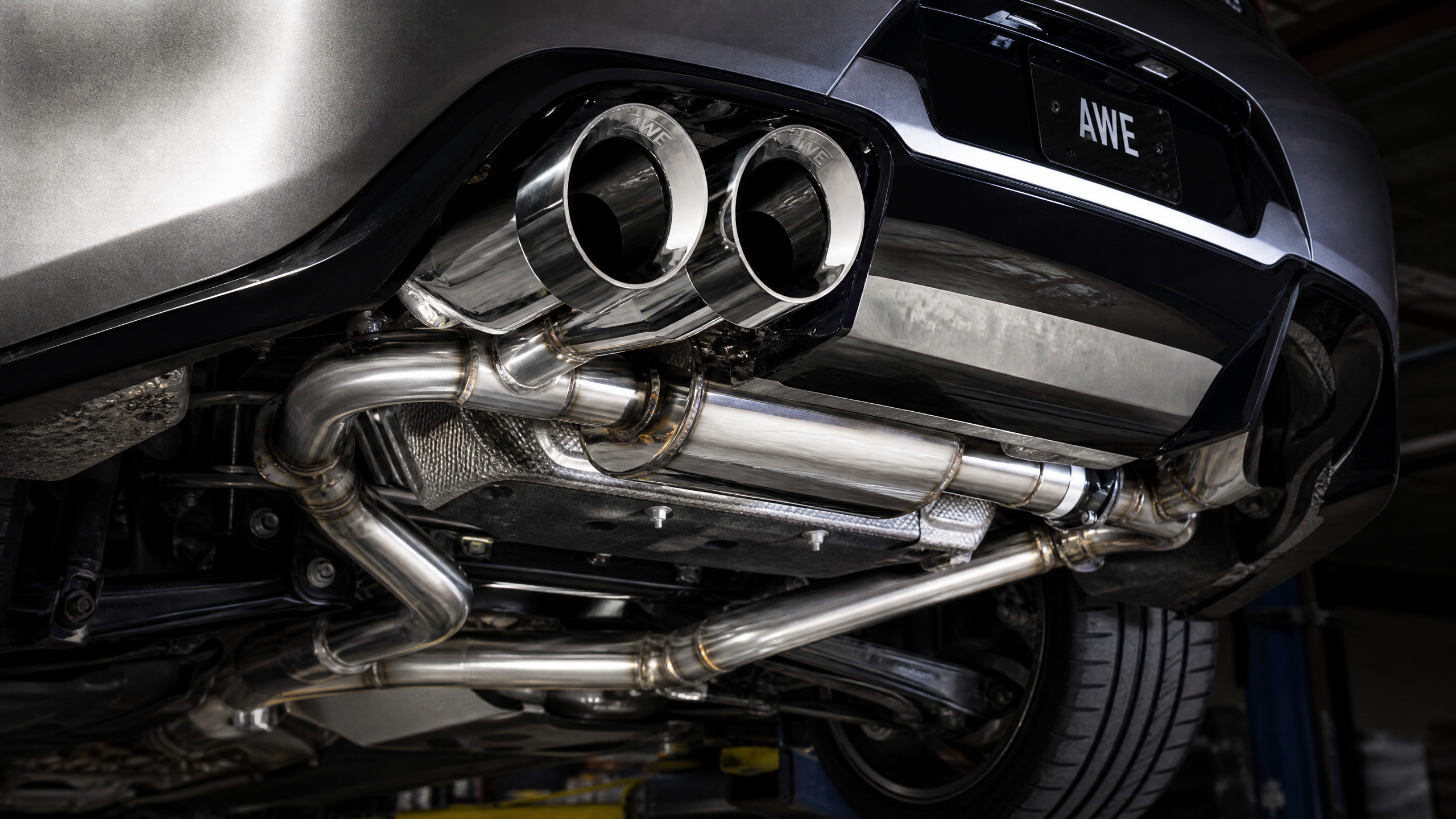
Walk under your car and point at the parts. From the engine back, you’ve got the manifold (or headers), the catalytic converter, the mid-pipe, the muffler, and the tip. Rubber hangers hold it all up, and donut gaskets seal the joints.
Every upgrade type is named after how much of that chain you replace. That’s the whole naming scheme. Nothing about it is mysterious.
Muffler swap: the $300 entry point
Swapping just the muffler changes the sound and nothing else. It’s the cheapest way to make your car stop sounding like a vacuum cleaner, and it’s a one-hour job on most cars once the bolts cooperate.
You’ll pick between two designs. The cutaway below shows both.
Chambered mufflers (think Flowmaster) bounce sound waves off internal plates to cancel noise. You get that classic lopey, aggressive growl. They can drone on the highway at certain RPMs, though.
Straight-through mufflers (Magnaflow, Borla style) run a perforated core wrapped in sound-absorbing packing. The tone is deeper and smoother, more of a rumble than a bark. The packing can burn out after many hard miles and the muffler gets louder — I’ve re-packed a few on my bench.
Axle-back systems
An axle-back replaces everything behind the rear axle: the muffler and the tips. On many cars it bolts to a factory flange, so no cutting is needed.
Power gains are basically zero, maybe 1–2 hp. You’re buying sound and looks. That’s fine. Just know what you’re buying.
Cat-back systems: the sweet spot
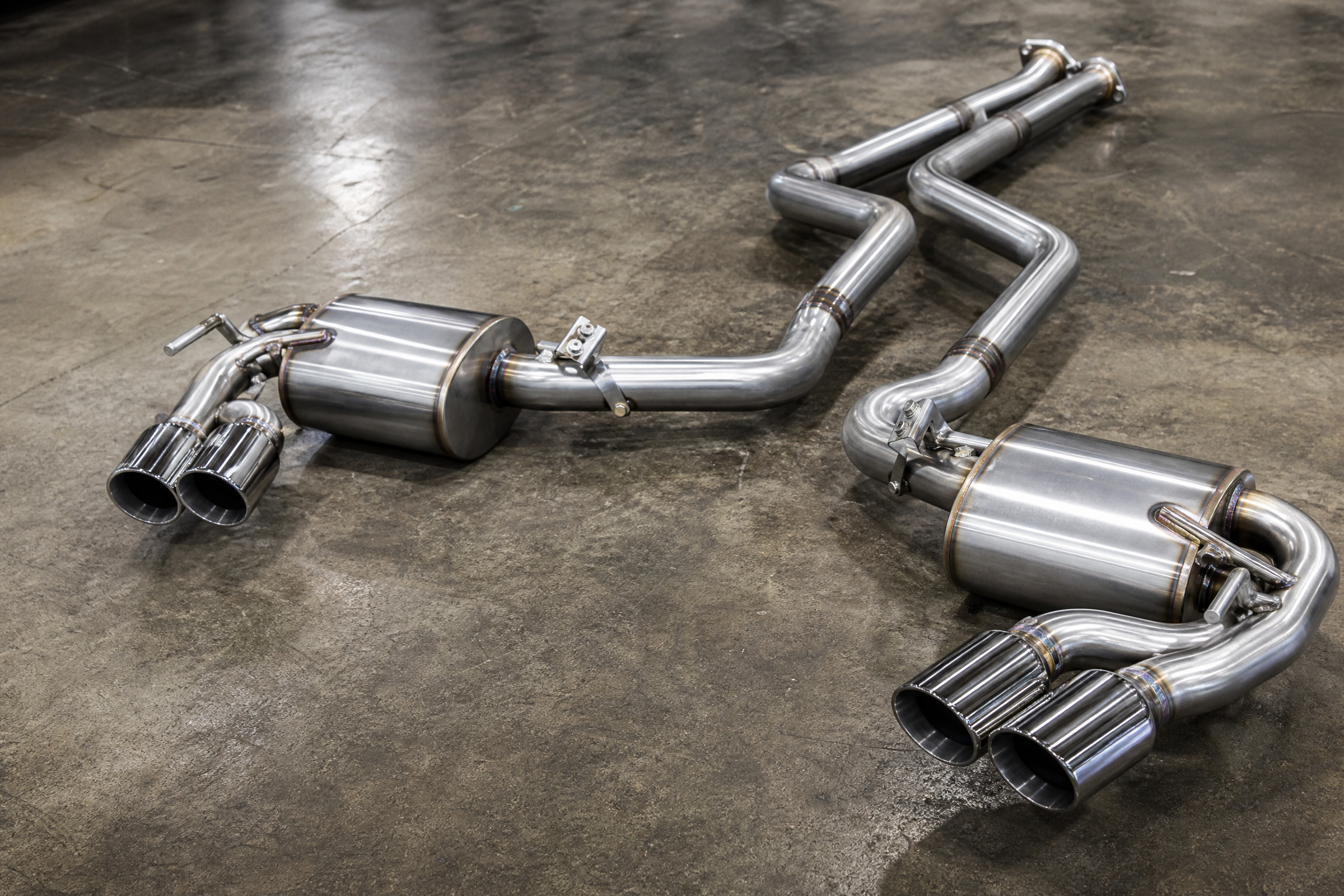
A cat-back replaces everything behind the catalytic converter: mid-pipe, muffler, tips. This is the upgrade I recommend most often, because it hits the three things people actually want.
- Sound: a real, full-bodied tone instead of just a loud muffler.
- Weight: my shop scale says most cat-backs shave 15–40 lb versus stock, all of it at the rear of the car.
- A little power: typically 5–15 hp on a naturally aspirated car, sometimes more on a turbo car, because the whole path flows better.
It also keeps your cats and all emissions equipment in place, so it’s street-legal in most places and won’t trip a check engine light. That matters if you ever face inspection.
Header-back and turbo-back: the whole enchilada
Replace everything, including the cats, and it’s a header-back. On a turbo car, replacing everything after the turbo (including the downpipe) is a turbo-back.
This is where real power lives on forced-induction cars. A catted downpipe is a bottleneck, and clearing it can be worth 20–40 hp on a turbo car once it’s tuned. More on tuning in the second guide of this series.
Pipe diameter and bends: the details that matter
For most street builds, 2.5-inch pipe is right up to about 350 hp. Step to 3-inch past that. Bigger is not automatically better — an oversized pipe on a mild engine loses exhaust velocity and can actually hurt low-end torque.
Look for the word mandrel bent. Mandrel bending keeps the pipe perfectly round through the curves. Cheap crush bends kink the pipe oval at each turn, which is exactly the restriction you’re paying to remove. I’ve held both up to a light, and the crush-bent pipe looks like a garden hose someone stepped on.
Materials: pay once or pay twice
- Aluminized steel: cheap, lasts 3–6 winters, then rusts at the seams.
- 409 stainless: the standard for quality systems. Lasts a decade or more, may show surface rust.
- 304 stainless: the good stuff. Stays shiny, outlives the car, costs more.
My rule: if you plan to keep the car, buy stainless. If it’s a flip or a beater, aluminized is fine. A magnet sticks to 409 and not to 304, which is a handy trick when checking a “stainless” system at a swap meet.
The truth about drone
Drone is that booming cabin resonance at steady highway speed, usually between 2,000 and 3,000 RPM. It’s the number one complaint I hear after someone buys the loudest system on the shelf.
Big muffler volume, resonated mid-pipes, and chambered designs all calm it down. If you commute an hour a day, test-listen to sound clips at highway cruise, not just at redline. Your ears at 70 mph are the ones that matter.
Install day: tools and tricks I actually use
- Soak every flange bolt in penetrating oil the night before. Twice a day for old cars.
- Have a cutoff wheel or reciprocating saw ready. On rust-belt cars, I cut more exhausts off than I unbolt.
- Use 6-point sockets (usually 12mm, 14mm, or 17mm on flanges and hanger bolts) so you don’t round fasteners.
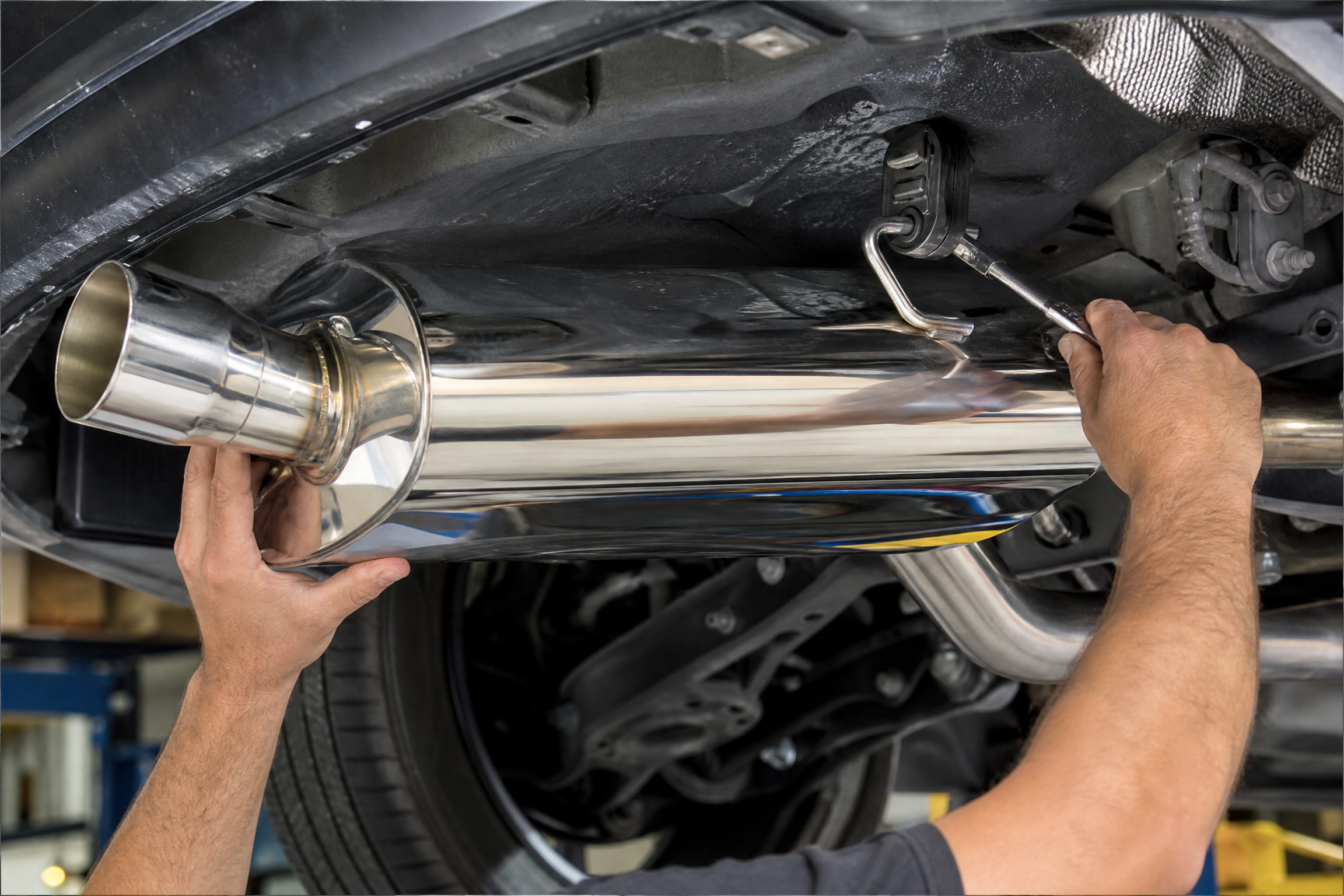
- Spray the rubber hangers with dish soap and water — they slide right off. WD-40 swells the rubber, so skip it there.
- Always fit new donut gaskets and a dab of anti-seize on the new bolts. Future-you says thanks.
- Support the pipe as you go. A jack with a piece of wood cradles the mid-pipe while you align flanges.
- Start every bolt by hand. Cross-tighten flanges evenly, snug plus a quarter turn. Overtightening warps flanges and cracks gaskets.
- Check clearances everywhere with the engine running and after a test drive. Exhaust moves a surprising amount under torque.
- Leak check: with the engine idling, brush soapy water on the joints. Bubbles mean a leak you’ll hear later as a tick.
What gains are actually real?
| Upgrade | Typical cost (parts) | Real-world gain | Sound change | DIY difficulty |
|---|---|---|---|---|
| Muffler swap | $150–$400 | 0–2 hp | Big | Easy–moderate |
| Axle-back | $300–$700 | 1–3 hp | Big | Easy |
| Cat-back | $600–$1,500 | 5–15 hp | Big + tone | Moderate |
| Header / downpipe | $300–$900 | 10–40 hp (tuned) | Moderate | Moderate–hard |
| Full header-back | $1,200–$3,000 | 15–50 hp (tuned) | Full | Hard |
Notice the word “tuned.” On modern cars, the biggest numbers only show up when the ECU is retuned to use the airflow. That’s the bridge to the next guide in this series.
Quiz: which exhaust upgrade fits your build?
1. What’s the main goal?
2. Your budget for parts?
3. How do you use the car?
4. Emissions and inspection?
5. Tool confidence?
Buy for the way you actually drive, not the way the internet drives. A mellow 304 stainless cat-back you enjoy every day beats a race pipe you hate by Tuesday.
Mike R. has run an independent repair and modification shop for over two decades. He still installs exhausts the old way: soak the bolts, keep the gaskets new, and listen to the car at cruise before signing it off.



Leave a Reply