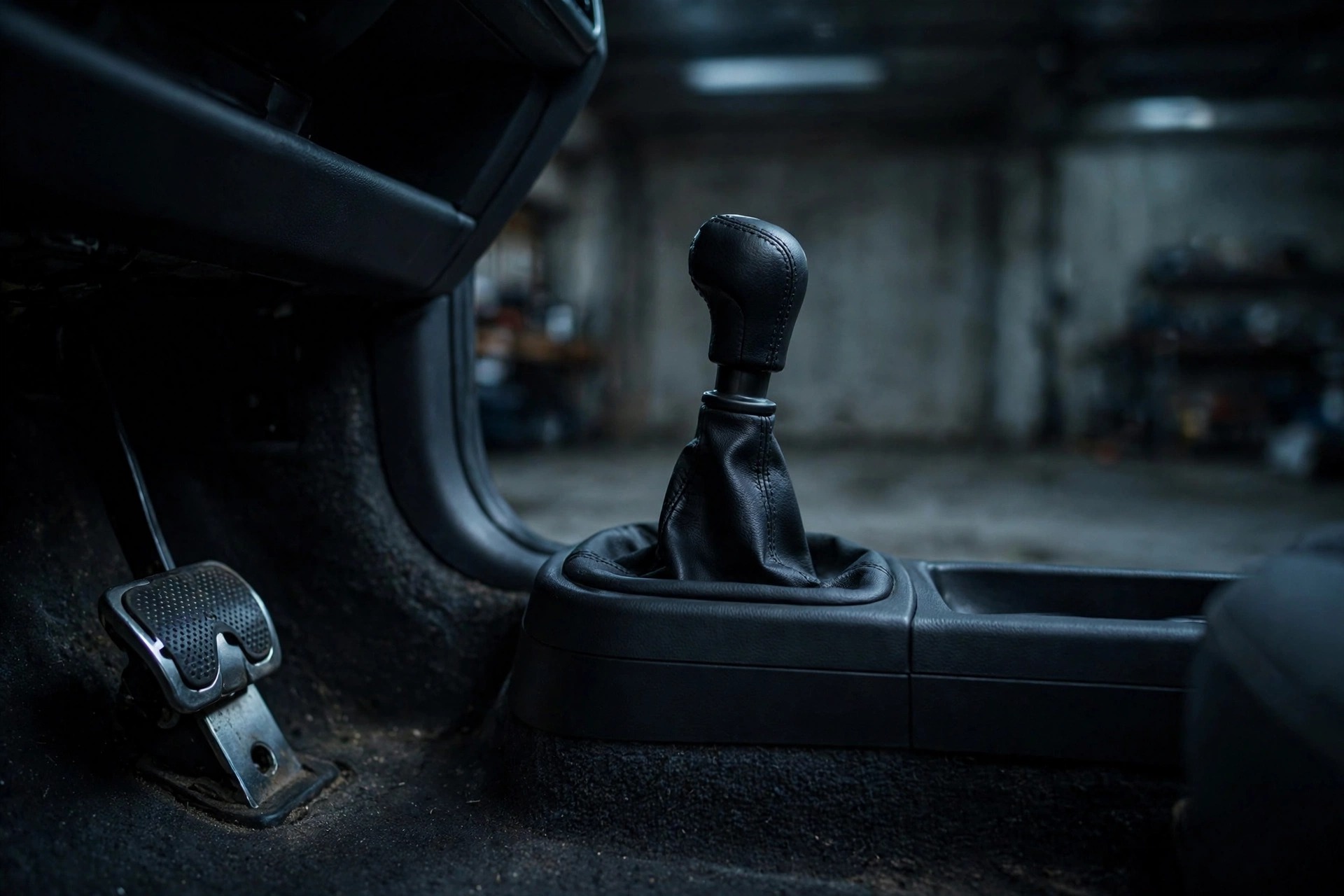
You move the shifter from Park to Drive and something under the car goes “clunk.” Sometimes it’s a dull thud. Sometimes it feels like someone hit the floor with a hammer. Either way, it’s the sort of noise that makes you wonder what just broke.
Most of the time, nothing just broke. Something has been loose for a while, and the shift is the moment it gets caught. Here’s how to work out what.
What Happens at the Moment of the Clunk
When you select Drive, the transmission connects the engine’s torque to the driveline. Think of pulling on a chain that has some slack in it. The chain goes tight in an instant, and you hear and feel the snap.
Every link between the engine and the tires can have slack: engine mounts, transmission mounts, driveshaft joints, axles, the differential. Slack in any of them gets taken up when torque arrives. Parts that are meant to stay put but don’t can also bang into something.
So the question is where the slack lives. Three quick sorting questions help.
- Does it clunk from Park only, or from Neutral to Drive too? Only from Park points toward the parking pawl or a mount. Neutral to Drive too points toward driveline slack or a mount.
- Does it clunk going from Neutral into Reverse, too? If yes, slack taking up torque is the cause, not the parking pawl.
- Where do you feel it? Front, rear, or through the floor.
The Causes, in the Order I’d Check Them
I’m listing these from easiest and cheapest to check to hardest. Work down the list.
1. Parking on a Slope
When you park on a hill and shift to Park while the car is still rolling or the brake pedal is released, the car’s weight settles onto a small metal pin in the transmission called the parking pawl. When you shift out, that load lets go with a clunk.

This is mostly normal, but you can stop it. When you park, stop completely, keep your foot on the brake, set the parking brake, then shift into Park and release the pedal. When you leave, keep your foot on the brake, shift into Drive, then release the parking brake. The brakes carry the weight instead of the pawl, and the pawl lasts longer too.
2. Worn Engine or Transmission Mounts
Mounts are rubber and metal sandwiches that hold the engine and transmission in the car. Over time the rubber cracks, tears, or separates. Some cars use fluid-filled mounts that leak and go soft.
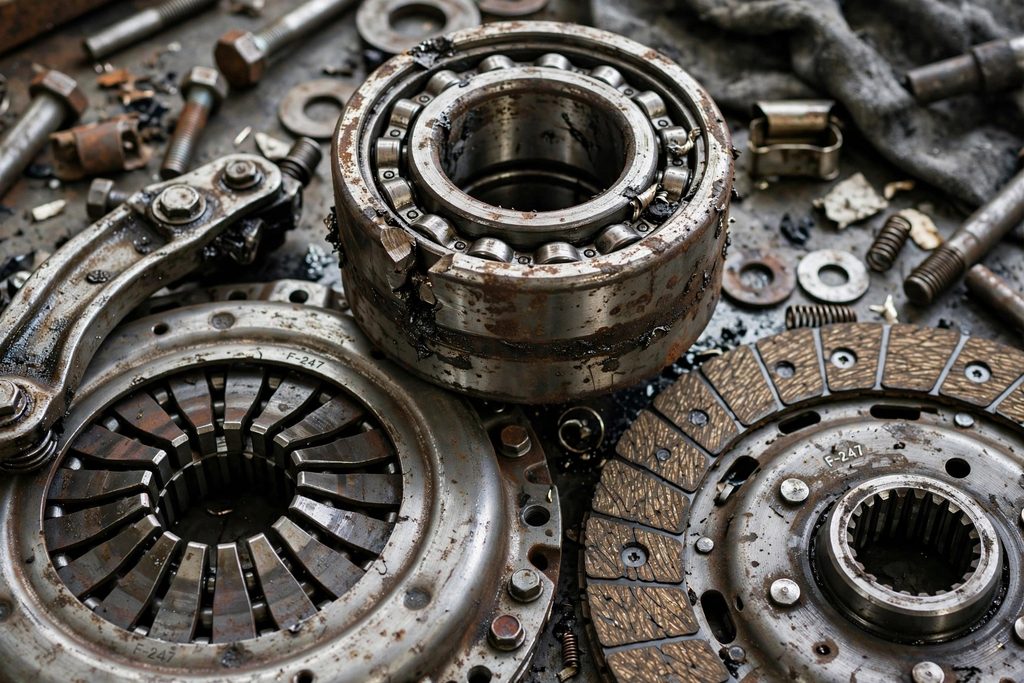
A bad mount lets the engine rock hard when torque hits, and that movement either bangs into something or just stretches the mount to its limit with a thud. Look for cracked or split rubber, a gap between the metal and the rubber, or oily residue on a fluid-filled mount.
3. Fluid and Idle Speed
If the clunk comes with a delay before the gear engages, check the transmission fluid first. Low fluid, burnt fluid, or old fluid makes the engagement harsh or late. Many modern cars have sealed transmissions with no dipstick. In that case, your manual or a shop tells you how to check the level.
Idle speed matters too. If the engine idles higher than it should after a cold start, the transmission slams into gear harder. A dirty throttle body or a vacuum leak is often behind a high idle.
4. Worn U-Joints and Driveshaft Parts (Rear-Wheel Drive and 4×4)
If your car drives the rear wheels, a driveshaft runs from the transmission to the rear axle. It has universal joints at its ends, and long driveshafts have a center support bearing in the middle. When a joint wears, there’s a little free play, and that play gets taken up with a clunk when torque arrives.
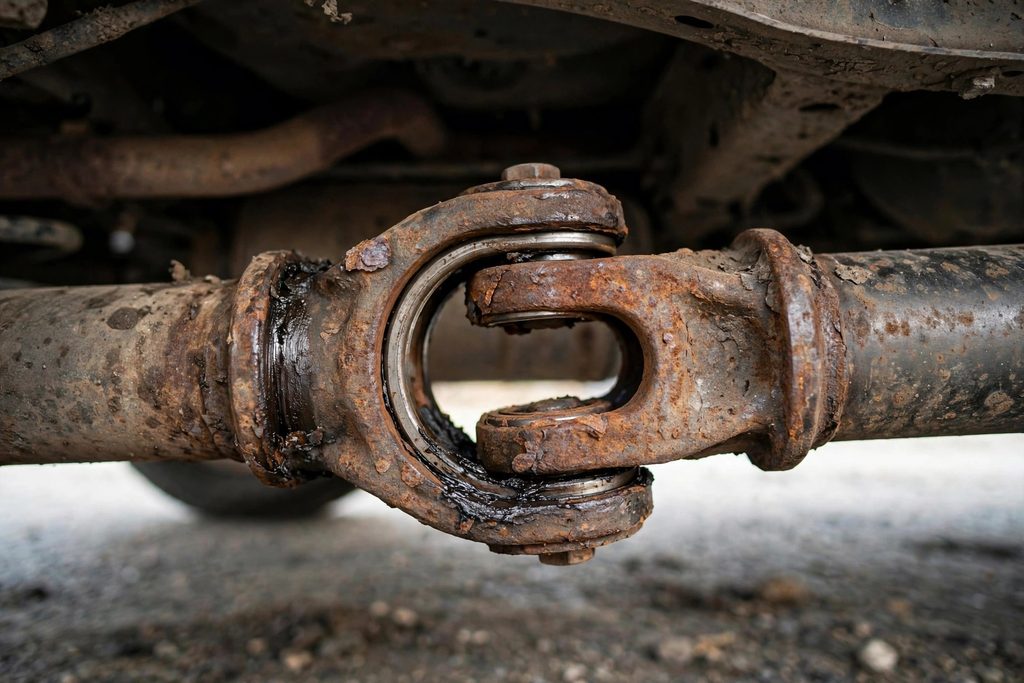
The usual signs are a clunk you feel through the seat or floor from the rear, plus a vibration at highway speed. You may also find rust-colored dust around the joint caps.
5. Worn CV Axles (Front-Wheel Drive)
Front-wheel-drive cars send power through axles with constant-velocity joints. Worn outer joints click in tight turns. Worn inner joints and splines can clunk when you take up the slack.
A torn rubber boot is a good clue. Grease flung around the inside of the wheel or the nearby suspension parts means the joint has been running dry.
6. Differential and Transfer Case Slack
Gears in the differential have a small amount of built-in clearance called backlash. When wear or low oil makes that clearance bigger, you get a clunk as the gears contact each other. All-wheel-drive and 4×4 vehicles add a transfer case and extra driveshafts, which means more places for slack.
This is one that I’d confirm with a shop, since a bad differential is a bigger repair.
7. Suspension Bushings and Brake Hardware
When the car rocks forward or back at the moment of engagement, loose suspension parts shift. Worn control arm bushings, sway bar links, and subframe bushings are common offenders. Brake parts can do it too. Loose caliper brackets and worn pad clips let the pads slide forward and back when you change direction, and that makes a clunk when you go from Reverse to Drive.
If you also hear clunks over bumps, suspension rises to the top of your list.
8. Loose Exhaust or Hardware
The exhaust hangs on rubber hangers. When one fails, the pipe swings and hits the underbody when the engine rocks. Loose crossmember bolts, driveshaft flange bolts, or a heat shield can sound alike. A metallic rattle that comes and goes is the clue.
Try the Clunk Locator
Tick every statement that matches your car. The tool scores the causes above and shows the best matches with a first check for each.
The Mount Test
This one tells you quickly whether the engine is moving too much. You need a helper.
- Park on level ground and set the parking brake. Open the hood.
- Have your helper sit in the driver's seat with a foot firmly on the brake pedal and the engine running.
- Stand to the side of the engine bay, never in front of the car. Keep your hands, hair, and loose clothes away from the belts and the fan.
- Have your helper shift from Drive to Reverse and back, holding the brake the whole time.
- Watch the engine. A small rock is normal. A big lurch, or an engine that jumps and knocks against something, means a bad mount.
The U-Joint Check
This one needs the car off the ground, so safety comes first.
- Chock the front wheels and lift the rear with a floor jack.
- Set jack stands under solid points from the owner's manual. Never rely on the jack alone.
- Put the transmission in Neutral and release the parking brake so the driveshaft can turn.
- Grab the driveshaft near each joint. Try to push, pull, and twist it. Free play at a joint means it's worn.
- Look for rust-colored dust at the joint caps and for torn boots on any CV joints.
Habits That Make It Worse
A few daily habits wear out the parts that clunk.
- Shifting while the car is still moving. Going from Reverse to Drive before the car has stopped slams the transmission and driveline. Come to a full stop first.
- Revving in Neutral, then dropping it into Drive. It's a quick way to break a mount or a U-joint.
- Skipping the parking brake. On any slope, the parking pawl takes the whole load.
- Putting off fluid service. Old fluid wears the clutch packs faster, and engagement gets harsher over time.
What a Shop Will Do
Expect a good shop to work through this list in roughly this order.
- Scan for transmission and engine codes
- Check the fluid level and condition
- Road test the car and feel each gear engage
- Lift the car and check the mounts, U-joints, axles, and bushings
- Measure the idle speed
Tell them what you've already checked, and they can skip ahead.
When a Clunk Is a Warning Sign
A single clunk now and then isn't a crisis. These combinations are:
- A delay of a second or more before the gear engages
- Slipping, or revs that rise without the car speeding up
- A transmission or check engine warning light
- Fluid that's dark brown or smells burnt
- A clunk that is getting harder or more frequent
Any of those means you should have the car looked at soon. A transmission shop can scan for stored codes and check the fluid condition.
Quick Answers
Is the clunk hurting my transmission? It can. Repeated hard engagement puts extra stress on internal parts and mounts. That's reason enough to track it down.
Can a worn mount cause a clunk by itself? Yes. It's one of the most common causes, and one of the cheapest to fix compared to driveline repairs.
Why only in the morning? Rubber is stiffer when cold, and idle runs higher on a cold start. Both make a harsh engagement more likely.
Does it matter if it happens from Neutral into Reverse too? Yes. It tells you the clunk comes from slack taking up torque, so the parking pawl is off the suspect list.
Should I shift into Neutral to avoid it? That only dodges the noise. The slack is still there, so track down the cause.
Start with how you park, then look at the mounts and the fluid. Those three cover most of the clunks I see, and none of them needs more than a flashlight and a helper. If you get to the driveline or the differential, a shop with a lift can check it in minutes, and they'll appreciate that you've already ruled out the cheap stuff.
Related posts:
 Brake Fluid Breakdown: Understanding DOT Ratings and When to Bleed Your Braking System
  Why Is Your Steering Wheel Shaking? (Diagnosing Tire Balance, Warped Rotors, and Loose Suspension)
  Check Engine Light On? 5 Common Causes & DIY Fixes
  Home Car Detailing Checklist: Carpets, Upholstery & Trim Cleaning
Leave a Reply