
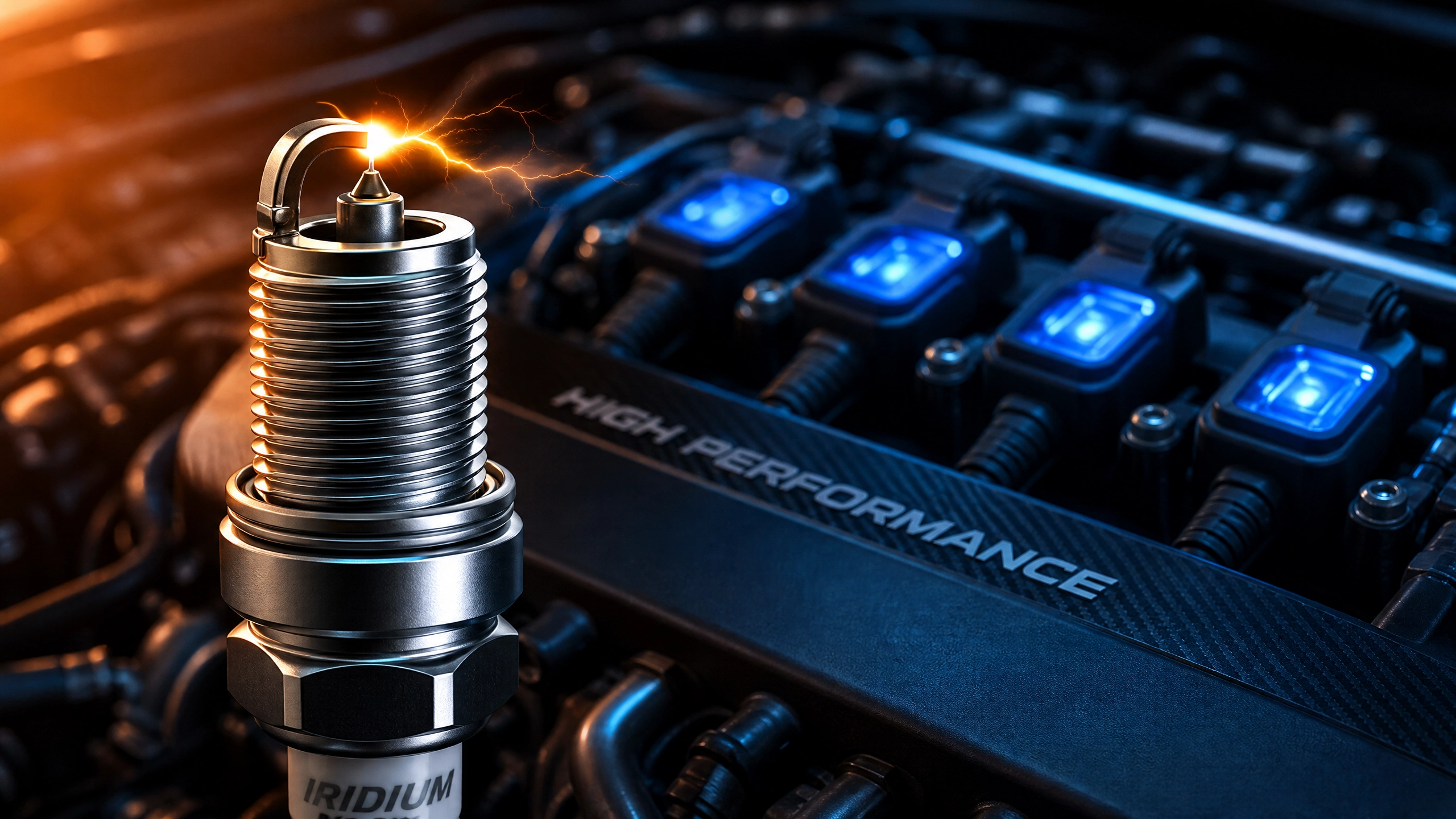
In terms of performance within the automotive industry, the first topics of discussion generally involve turbocharging, exhaust systems, and camshafts. But, if any of these are even worth considering, then there must be an accurate method by which combustion takes place. Ignition is the spark that gives your engine its life; without accurate, strong, and efficient sparks, your engine will waste fuel and lose efficiency.
During all the years I spent wrenching on project cars and dialing in engines for track days and daily drivers, I learned the ignition system is no place to cut corners. I can still recall pulling my hair out over a high-RPM misfire on a turbocharged build. I had the injectors and the turbo upgraded, but kept the stock ignition coils and plain old copper plugs. Only after I switched to a performance coil-on-plug system and went to colder iridium plugs with a smaller gap did the engine finally spring to life. That made me solidify my understanding of: you don’t just change the ignition system for maintenance reasons, it is a critical performance part.
This is your ultimate guide on spark plugs and I guarantee it covers everything you want to know about spark plugs, ignition systems, and more. If you want to know the best spark plugs for gas mileage or are considering performance ignition system upgrades for the highest horsepower, a little knowledge of the science behind the spark will never hurt.
Understanding Spark Plug Materials: Copper, Platinum, and Iridium
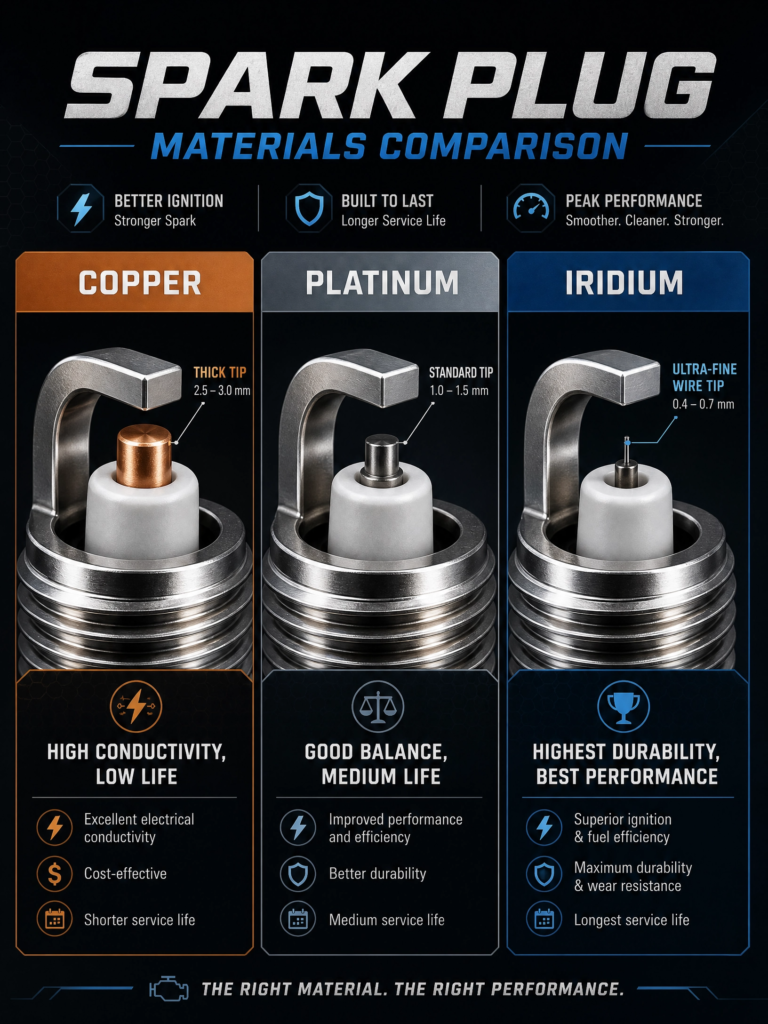
Material choice of the center electrode determines not only performance but also durability and applicability of spark plugs. If you wonder which one, iridium or platinum spark plugs, is better for performance, or just consider a standard copper spark plug, you should take into account some factors.
Copper spark plugs are the oldest type and, at first glance, the most conductive of all spark plugs. Since copper is a good conductor of electricity, spark plugs made of copper create a powerful spark. Therefore, they are highly appreciated by racing drivers and those who build engines with a high horsepower rate. But, since copper is a rather soft metal, it wears out pretty fast due to high temperatures.
Platinum spark plugs are meant to solve the problems of longevity associated with the copper alloy. Platinum is substantially harder and durable as well. The construction of a platinum spark plug involves platinum being used in the construction of a disc which is then welded to the center electrode. In double platinum spark plugs, platinum is used in both the center and ground electrodes. Such spark plugs have no problem operating over 60,000 miles before requiring maintenance. It is recommended in daily drivers because of that, although they are not as good at conducting electricity as copper.
Iridium spark plugs are one of the most modern spark plugs currently available on the market. Iridium is harder and stronger, as it is six times harder and eight times stronger than platinum. Its melting point is 1,200 degrees Fahrenheit higher. Because of such properties, manufacturers of spark plugs can make a very thin center electrode using this material. Thin center electrodes need less voltage to produce a spark, which leads to increased efficiency. As such, iridium spark plugs are considered one of the best options for modern cars.
| Material | Conductivity | Longevity | Best Application |
|---|---|---|---|
| Copper | Excellent | Low (~20k miles) | High-performance racing, older vehicles |
| Platinum | Good | Medium (~60k miles) | Daily drivers, extended maintenance intervals |
| Iridium | Very Good | High (~100k miles) | Modern engines, maximum efficiency, forced induction |
Spark Plug Recommendation Quiz
Here is a personalized tool to help you find your ideal spark plug based on your driving style and vehicle needs:
🔧 Find Your Perfect Spark Plug
Answer a few quick questions to get personalized recommendations
The Science of Heat Ranges: Cold vs Hot Spark Plugs Explained
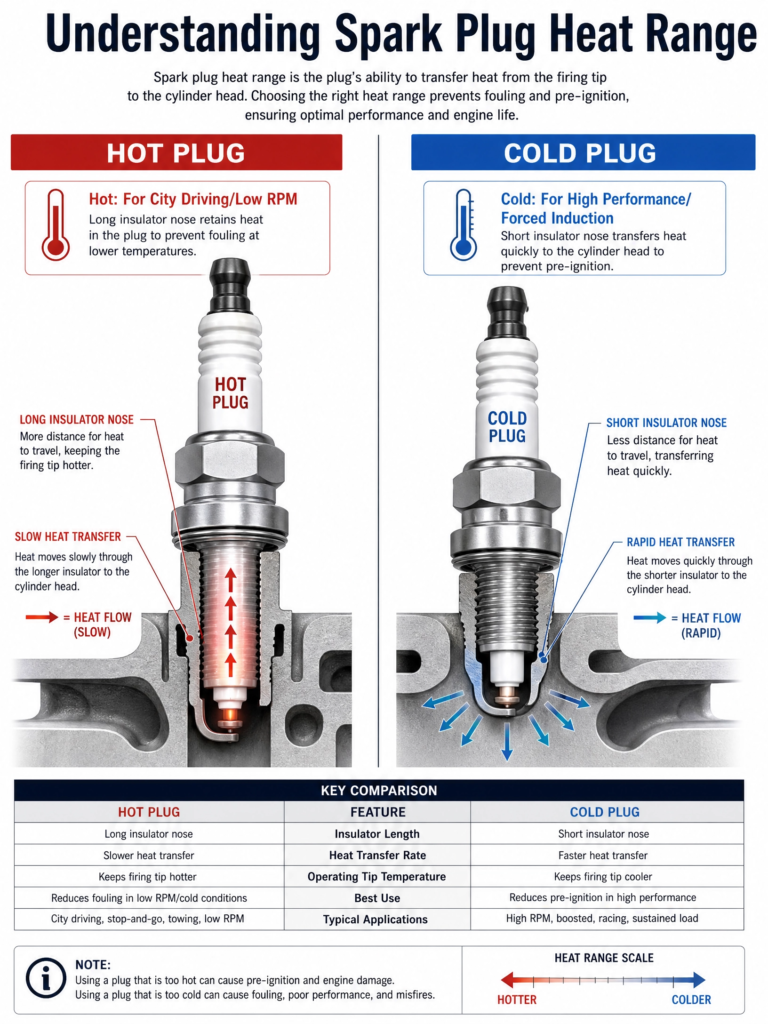
The heat range is one of the most misunderstood components of spark plug choice, and it’s essential for avoiding serious engine failure and optimizing engine performance. First, the term “heat range” does not apply to the spark’s temperature. It relates to the rate at which heat dissipation occurs from the combustion chamber to the cylinder head.
A hot spark plug has an elongated insulator nose. Heat dissipates less efficiently through an elongated nose, keeping the tip hotter and helping clean off carbon deposits. In engines that idle often or operate at low RPMs (such as city commuter vehicles), using a hot spark plug is preferable.
Alternatively, a cold spark plug will feature a short insulator nose to promote quick heat transfer to the cylinder head. As a result, the firing tip will stay cool. In high-performance engines, with high-compression ratios and turbo or supercharger, the temperatures inside the cylinders tend to be considerably higher. Using a hot spark plug in this kind of environment may result in the tip turning into a glow plug that will ignite the air-fuel mix before the spark plug even fires. This process is called pre-ignition and will cause severe engine damage.
Whenever you have to tune an engine to improve its performance, the best option would be to go for a colder heat range. Typically, there is a general rule of going down by one heat range per 75 to 100 horsepower gained from the factory.
Anatomy of a Modern Ignition System: The Evolution to Coil-on-Plug
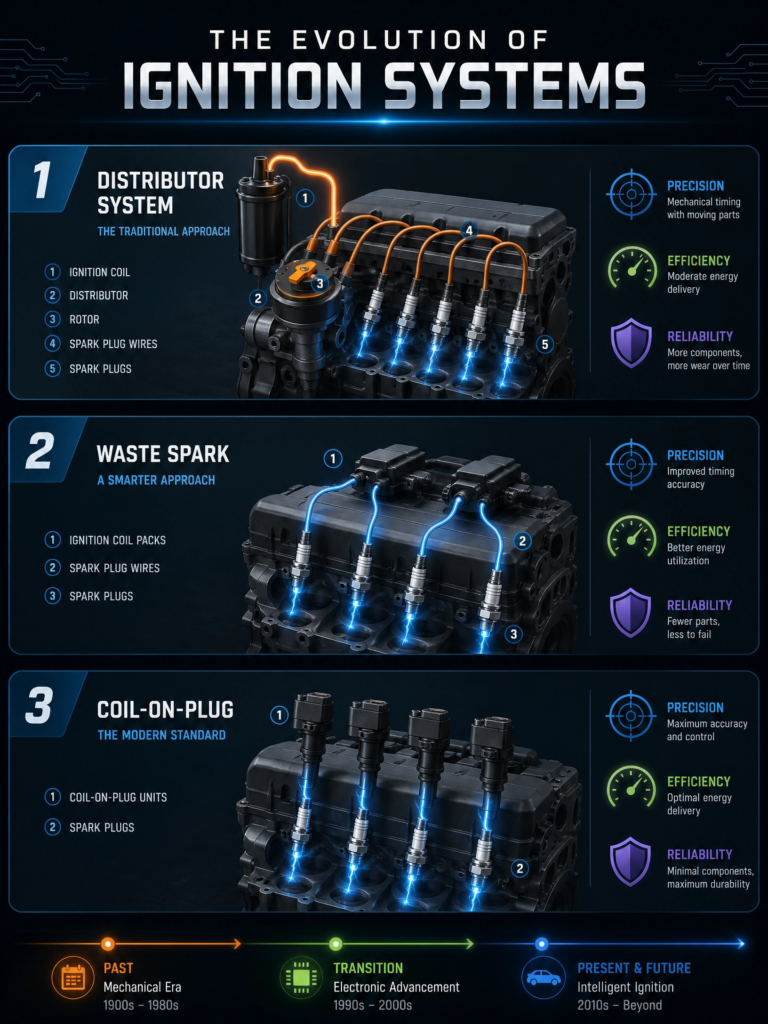
There have been many advancements in the ignition system through the years, and understanding its development aids in explaining the benefits associated with the coil-on-plug ignition system.
In older automobiles, a mechanical distributor was employed. There was only one ignition coil, from where the spark would travel through to the distributor cap, where a spinning rotor would direct the high voltage to the various spark plug wires, depending on the firing sequence. Although this was very simplistic, there were a number of disadvantages in this system – wear and tear of mechanical parts, high resistance caused by spark plug wires, among others.
This was followed by the distributorless ignition system (DIS), whereby one of the commonly used designs was called a “waste spark” system. Here, one coil pack ignites two cylinders at once; one of the cylinders in its compression cycle, while the other in its exhaust cycle.
The current state-of-the-art technology is known as Coil-on-Plug (COP). A COP system has a separate ignition coil located above each spark plug. In a COP system, there is no need to use high-tension spark plug wires, which decreases the electrical resistance significantly and helps avoid any electromagnetic interference. The ECU provides the capability to manage the timing of ignition for each cylinder individually. Such accuracy makes tuning more radical, saves fuel, and improves the idle of the engine.
High Performance Ignition System Upgrades
Upgrading the ignition system should be considered if you aim at getting additional power from the engine. Performance ignition systems are built specifically to ensure that the spark is powerful enough to ignite denser air/fuel mixtures, especially with forced induction.
Performance ignition coils can be easily modified. These special aftermarket products deliver a greater voltage than stock ignition coils do. This will lead to a complete burning of the air/fuel mixture, better throttle response and increased power of your engine. The improvement of the throttle response of my turbocharged project car became evident after I switched to upgraded coils, while high RPM misfires were no longer an issue.
Ignition amplifier or CDI (capacitive discharge ignition) box must also be taken into account if you are working on your ignition system. The latter will help you get a higher primary voltage delivered to the coil to provide a hotter spark.
Ignition Efficiency Calculator:
Here is a tool that estimates fuel savings and ROI from ignition upgrades.
⚡ Ignition Efficiency Calculator
Estimate fuel savings and maintenance costs from upgrading your ignition system
How to Gap Spark Plugs for Performance
Even the best spark plugs money can buy will be rendered ineffective when they do not have the proper gap settings. Gap setting refers to the physical space between the center electrode and the ground electrode. Knowing how to gap spark plugs for performance is a basic skill that must be acquired by an automobile enthusiast.
An increased gap will enable more of the air-fuel mixture to be subjected to the spark action, theoretically increasing the efficiency of the combustion process and improving fuel economy. Unfortunately, increased gaps mean higher voltages are needed to initiate the spark action. Should the ignition coil be unable to deliver such voltages, spark action fails and misfires result.
In high performance engine setups, where there is a turbocharger/supercharger that causes increased pressure in the cylinders, spark action becomes increasingly difficult. This problem is referred to as “spark blowout”. To counteract the problem, the spark plug gap is usually reduced. This reduces the exposure of the air-fuel mixture to the spark action, but increases the likelihood of spark action.
You must always use a wire style tool or a feeler gauge to make adjustments to the gap. Never pry the center electrode since the thin wire can easily snap.
Ignition System Maintenance for Efficiency
Ignition system servicing for efficiency is very important as it ensures proper functioning of your car as well as saving fuel economy.
Learning the symptoms of worn-out ignition coils and spark plugs is important to prevent getting stuck in the middle of nowhere. These symptoms include:
- Engine Misfire: This is usually characterized by engine stumbling during hard accelerations.
- Rough Idling: The engine appears unsteady during stops on traffic lights.
- Low Fuel Efficiency: Due to incomplete combustion, fuel economy goes low.
- Check Engine Light: Since modern cars have efficient ECUs, the light comes on when a fault such as misfiring occurs. Codes include P0300, which means a random misfire and P0301 meaning cylinder number one misfire.
- Hard Starting: This refers to a problem of starting the car, especially when the weather is cold.
While changing spark plugs, always remember to examine them. What the condition of the spark plug will tell you is that it reflects the state of your engine. Tan or gray spark plugs are good signs of good combustion in the engine. Blackened spark plugs mean the presence of excessive fuel mixture.
Conclusion: Investing in Your Engine’s Heart
Ignition system is actually what can be referred to as the lifeblood of the car’s engine. Right from the choice of spark plugs to using a coil-on-plug design, every piece of equipment in your ignition system plays an important role in determining how well and how fast your car can perform.
Regardless of whether you are competing to clock better times in your racing activities or just need to boost your fuel mileage on the road, spending some money on top-quality ignition parts will be worth it in the end. Learning about heat range considerations, correct gap settings and the use of superior material such as iridium can go a long way into guaranteeing that your engine gets the right spark each and every time.
Leave a Reply